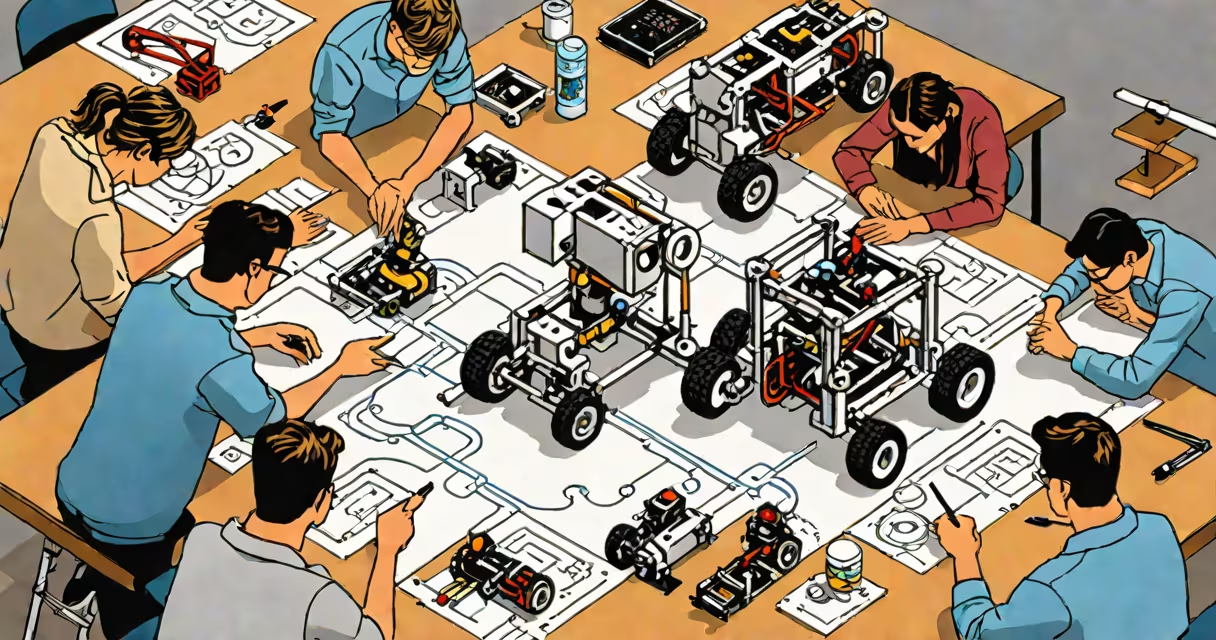
Project based learning STEM is an instructional approach where students explore real-world problems using science, technology, engineering, and mathematics concepts through extended, collaborative projects. It emphasizes inquiry, critical thinking, and application over memorization.
Students work in teams to investigate complex questions, design solutions, test prototypes, and present findings. Projects typically span multiple weeks and require research, planning, iteration, and reflection. This method aligns with national standards such as the Next Generation Science Standards (NGSS) and Common Core State Standards for math and literacy.
For example, a high school class might design a low-cost water filtration system for communities lacking clean drinking water. They apply chemistry principles to understand contaminants, use engineering to build models, employ math to calculate flow rates and material costs, and incorporate technology to monitor performance. The final product includes a working prototype, a cost analysis report, and a presentation to local stakeholders.
Each project begins with an open-ended challenge rooted in authentic context. Teachers frame the problem around a central question: "How can we reduce plastic waste in our school cafeteria?" or "Can solar power meet the energy needs of a small home?" The problem must be relevant, complex, and allow for multiple solution paths.
Students then engage in cycles of research, design, testing, and revision. They gather data, consult experts, build models, run simulations, and collect feedback. For instance, a group designing a wind turbine prototype measures blade angles, wind speed, and electrical output using sensors and spreadsheets. They adjust variables and retest until they meet efficiency targets.
Final deliverables include presentations, written reports, physical models, or digital portfolios. These are assessed using rubrics that measure content mastery, collaboration, communication, and creativity-not just correct answers. Teachers act as facilitators, guiding inquiry rather than delivering lectures.
Effective project based learning STEM integrates four essential elements: a challenging problem, sustained inquiry, authenticity, and student voice and choice. These components ensure depth, engagement, and transferable skills.
| Type | Description | Example |
|---|---|---|
| Interdisciplinary | Combines STEM subjects with social studies, art, or language arts. | Designing a sustainable city model incorporating urban planning, environmental science, and economics. |
| Community-Based | Projects address local issues with community input and impact. | Students survey neighborhood air quality and propose green space initiatives to city planners. |
| Technology-Integrated | Uses coding, robotics, CAD software, or data analytics tools. | Programming a robot to go through a maze using sensor inputs and conditional logic. |
A common misconception is that project based learning STEM requires expensive equipment. While access to labs and tools enhances learning, many successful projects use low-cost materials. One middle school class designed earthquake-resistant buildings using spaghetti, marshmallows, and tape. They tested structures under simulated seismic vibrations using a shake table made from a cardboard box and a vibrating motor.
Research shows that project based learning STEM improves long-term retention of STEM concepts. A 2021 study by the National Science Teaching Association found that students in PBL STEM classrooms scored 23% higher on standardized science assessments than peers in traditional lecture settings. The effect was strongest among underrepresented groups in STEM fields.
These projects develop skills beyond content knowledge. Students learn to manage time, resolve conflicts, communicate ideas, and adapt to failure. A 2019 Stanford University study showed that PBL STEM participants demonstrated greater persistence on difficult tasks and higher levels of intrinsic motivation compared to control groups.
Teachers report increased student engagement during project phases. One high school physics instructor noted that during a bridge-building project, even disengaged students volunteered to lead team roles. "They weren't just doing homework-they were building something that mattered," he said.
Project based learning STEM is often confused with science fairs or single-day experiments. Unlike those activities, PBL STEM involves ongoing investigation, multiple iterations, and sustained collaboration. A science fair project may test one variable in isolation; a PBL STEM project addresses systems-level problems requiring integrated knowledge.
Another confusion arises between project based learning STEM and play based learning. While both emphasize exploration, play based learning focuses on unstructured discovery in early childhood. Project based learning STEM is structured, goal-oriented, and academically rigorous. Play based learning develops social-emotional skills; PBL STEM builds technical and analytical competencies.
There's also a persistent myth that PBL STEM reduces academic rigor. On the contrary, it increases cognitive demand. Students must analyze data, justify decisions, evaluate trade-offs, and defend their designs. A project to improve a school's energy use requires understanding thermodynamics, reading utility bills, calculating carbon footprints, and proposing policy changes-all within a single assignment.
In 2022, a group of 10th graders in Austin, Texas, tackled the issue of food insecurity in their district. Their project began with a survey of 150 students and staff, revealing that 38% reported skipping meals due to lack of funds.
They researched local food banks, analyzed transportation routes, and studied nutritional guidelines. Using spreadsheet modeling, they identified gaps in distribution. They then designed a mobile kitchen truck that could serve hot meals during lunch breaks.
The team built a scale model using recycled materials and programmed a microcontroller to simulate meal preparation timing. They presented their proposal to the school board, which approved a pilot program funded by a local nonprofit. Over six months, the truck served over 1,200 meals, reducing student hunger reports by 60%.
This project combined biology (nutrient balance), engineering (vehicle design), math (cost-per-meal calculation), and civic engagement. It met state standards in science, math, and career readiness while addressing a real community need.