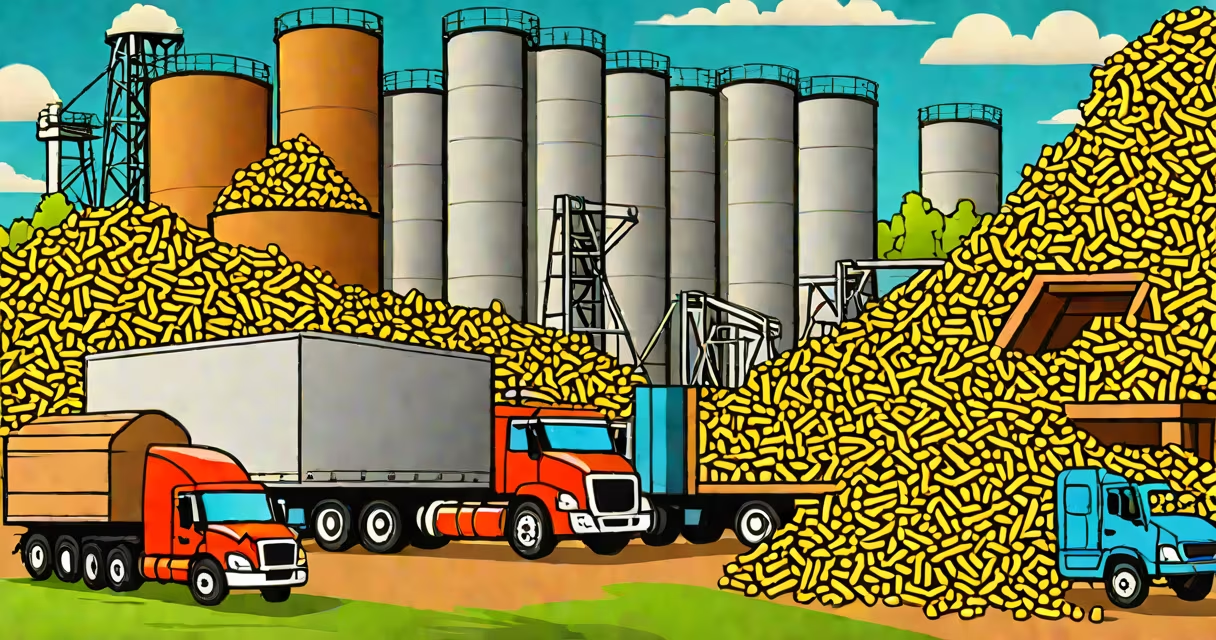
Biomass wood pellet suppliers are companies that produce and distribute compressed wood particles made from sawdust, wood chips, and other forestry residues. These pellets serve as a renewable fuel source for residential heating, industrial boilers, and power generation. They are standardized by density, moisture content, and calorific value to ensure consistent performance.
Wood pellets are manufactured through a process called pelletizing. Raw materials-typically from lumber mills, sawmills, or wood processing plants-are ground into fine particles, dried to reduce moisture below 10%, then compressed under high pressure and heat. This forms dense cylindrical pellets that burn efficiently and store well. The resulting product has a consistent energy output, typically between 4,600 and 5,000 British Thermal Units (BTUs) per pound.
Suppliers often source feedstock locally to reduce transportation emissions and support regional forestry economies. For example, a supplier in Oregon may use leftover material from local timber operations. The U.S. Department of Energy notes that using waste wood reduces landfill burden and avoids methane emissions from decomposing organic matter.
Raw material enters the production line as wood waste-sawdust, shavings, or chipped logs. This material is screened to remove contaminants like metal or dirt. It's then fed into a hammer mill to achieve a uniform particle size, usually under 3 mm.
The milled material passes through a dryer, reducing moisture to less than 10%. High moisture leads to poor combustion and increased ash content. After drying, the material enters a pellet press-a ring die machine that forces the wood through small holes under intense pressure. Heat generated during compression causes natural lignin in the wood to bind the particles together without added glue.
Pellets exit the press at around 80°C and are cooled rapidly to prevent cracking. They are then sorted by size and quality, with acceptable standards set by organizations such as the European Pellet Council (EPC) and the American Society for Testing and Materials (ASTM). Pellets must meet ASTM D6866 standards for bio-based carbon content and ISO 17225-2 for fuel quality.
Suppliers fall into three categories: integrated producers, regional distributors, and niche specialty providers. Integrated producers control the entire supply chain-from raw material sourcing to final delivery. Examples include Enviva and Drax Group, which operate large-scale facilities in the southeastern U.S. and the UK.
Regional distributors focus on local markets. They buy bulk pellets from large producers and resell them to homeowners, small businesses, and municipal heating systems. These suppliers often offer flexible delivery schedules and smaller package sizes (e.g., 40-pound bags).
Niche providers specialize in certified sustainable or low-emission pellets. Some use only reclaimed wood or sustainably harvested timber. These suppliers often carry certifications such as the Forest Stewardship Council (FSC) or the Programme for the Endorsement of Forest Certification (PEFC).
| Type | Scale | Typical Customers | Key Differentiator |
|---|---|---|---|
| Integrated Producer | Large-scale | Power plants, industrial users | Vertical integration, long-term contracts |
| Regional Distributor | Mid-sized | Homeowners, small businesses | Local delivery, variable bag sizes |
| Niche Specialty | Small to medium | Eco-conscious consumers, green buildings | FSC/PEFC certification, low-impact sourcing |
Residential heating accounts for nearly 60% of U.S. wood pellet consumption. Homeowners in New England and the Pacific Northwest use pellet stoves and boilers to replace oil or gas heating. A typical pellet stove burns 20-30 pounds of pellets per week during winter, depending on climate and home insulation.
Industrial applications include boiler systems in paper mills, textile factories, and district heating networks. In Sweden, over 80% of district heating comes from biomass, including wood pellets. The Swedish Energy Agency reports that replacing fossil fuels with biomass reduced national CO₂ emissions by 12 million tons annually between 2010 and 2020.
Electricity generation is another major use. Drax Power Station in the UK converted four of its six generating units to run on wood pellets. In 2022, the facility produced 16 terawatt-hours of electricity from biomass-enough to power 3.5 million homes.
Many confuse biomass wood pellets with charcoal briquettes or coal. Unlike coal, which releases stored carbon from millions of years ago, wood pellets release carbon that was recently absorbed by living trees. The carbon cycle closes when new trees are planted to replace harvested ones.
A common error is assuming all biomass is carbon-neutral. The Intergovernmental Panel on Climate Change (IPCC) states that carbon neutrality depends on responsible land management and timely reforestation. If forests are cleared unsustainably, biomass can increase net emissions. A 2021 study in *Nature Communications* found that poorly managed biomass operations led to a 15% rise in net carbon emissions over 20 years compared to fossil fuels.
Another misconception is that pellet suppliers are interchangeable. Quality varies. Low-grade pellets have higher ash content (up to 2%) and lower BTU values, leading to frequent cleaning and reduced efficiency. High-quality pellets maintain ash levels below 0.7% and deliver consistent heat output.
In 2023, a Vermont-based supplier named Greenwood Pellets served 1,200 households. They sourced 90% of their raw material from local sawmills within a 50-mile radius. Each ton of pellets required 1.3 tons of dry wood waste. The company used a ring die press operating at 120 tons per hour.
They delivered 40-pound bags via a fleet of electric trucks. Over a winter season, customers consumed an average of 2.5 tons per household. The supplier reported a 98% customer retention rate due to consistent quality and on-time deliveries.
Greenwood also partnered with the state's energy office to track carbon savings. Based on EPA's GHG Equivalencies Calculator, each ton of pellets replaced 1.1 metric tons of CO₂ equivalent from oil heating. Across the season, this equated to 1,320 metric tons of avoided emissions.
When I visited their facility in 2023, I observed the cooling system and quality control station. A technician pulled samples from the conveyor belt and tested them for moisture and ash content. One batch failed due to excess humidity-likely from a recent rainstorm affecting incoming wood chips. That batch was rerouted for lower-grade industrial use.
Not all suppliers adhere to industry standards. Look for third-party certifications such as ENplus (European standard), ISO 17225-2, or FSC. These verify consistency, low emissions, and sustainable sourcing.
Ask for a certificate of analysis (COA) listing moisture, ash, and calorific value. Reputable suppliers provide this upon request. Avoid those who don't publish data or rely solely on vague claims like "eco-friendly" or "green."
For deeper context on how wood waste becomes usable fuel, learn how biomass is formed.
Biomass wood pellet suppliers play a critical role in decarbonizing heating and power systems. They convert forest residues into a stable, transportable fuel that meets strict quality benchmarks. As demand grows, especially in regions transitioning away from fossil fuels, selecting a qualified supplier ensures both environmental integrity and operational reliability.