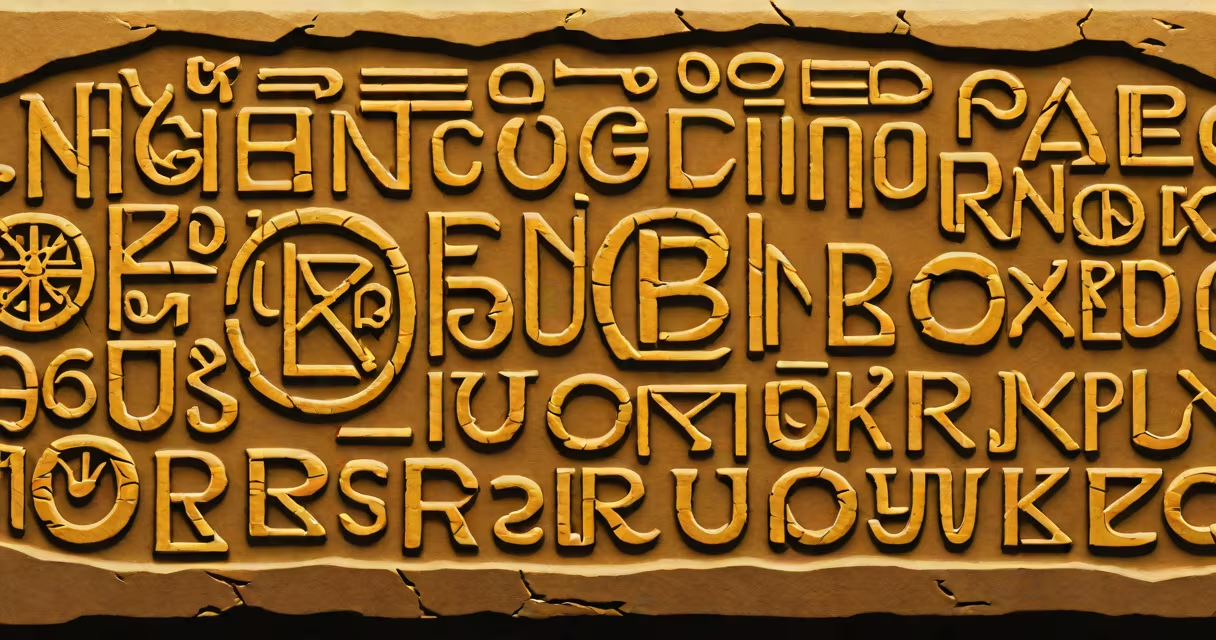
The English rune alphabet, also known as the Anglo-Saxon futhorc, is a runic writing system used in England from the 5th to the 11th centuries. It evolved from earlier Germanic scripts and expanded the original 16-symbol Elder Futhark into 24 distinct characters to represent Old English phonemes.
Runes were not just letters-they were tools for communication, identity, and ritual. The English rune alphabet developed during the early medieval period, primarily used by Anglo-Saxon communities across what is now England. Unlike later Latin-based scripts, runes were carved into stone, metal, and wood using sharp tools, often reflecting the material's hardness and the scribe's skill.
Each symbol represented a sound or concept. For example, the rune ᚠ (feoh) stood for "cattle" or "wealth," while ᚢ (ur) meant "oak" and was associated with strength and endurance. These meanings extended beyond language into spiritual belief, where runes were used in divination and protective charms.
The system is based on a phonetic principle: each rune corresponds to a single consonant or vowel sound. However, unlike modern alphabets, runes were not always written left-to-right. Some inscriptions follow a boustrophedon pattern-alternating direction between lines-common in early European scripts.
For example, the inscription on the Ruthwell Cross in Scotland (circa 800 CE) includes runic text that alternates direction. The cross bears a poem in Old English, partially inscribed in runes. One line reads: "þæt wæs wuldres weorc" ("that was the work of glory"), with runes for ð, æ, w, etc., carved in angular form.
Modern scholars decode these inscriptions using comparative linguistics and archaeological context. The runic script was gradually replaced by Latin letters after Christianization, especially following the 7th-century mission of St. Augustine to Kent. By 1000 CE, runic use had declined in formal writing.
The English rune alphabet consists of 24 primary symbols, derived from the Elder Futhark but expanded to accommodate Old English phonology. The expansion added runes for sounds not present in Proto-Germanic, such as the voiced fricative /θ/ (thorn, þ) and the nasal /ŋ/ (wynn, ƿ).
| Rune | Name | Sound(s) | Meaning |
|---|---|---|---|
| ᚠ | Feoh | f | cattle, wealth |
| ᚢ | Ur | u | oak, strength |
| ᚦ | Thorn | þ | thorn, protection |
| ᛊ | Sigel | s | sun, light |
| ᛒ | Bēot | b | beetle, life force |
| ᛖ | Ēr | e | earth, land |
Some runes were adapted from existing symbols. The rune for "w" (wynn, ƿ) replaced the Latin letter w in Old English texts. Wynn was used until around 1100 CE, when it was phased out in favor of the digraph "wh."
A lesser-known fact: the rune for "d" (dagaz) was not used in the earliest forms of the futhorc. It was added later, likely due to contact with Christian texts that introduced new vocabulary. This shows how the system evolved in response to linguistic change.
Runes appear on many artifacts: burial stones, weapons, jewelry, and personal items. The Staffordshire Hoard, discovered in 2009, contained over 3,500 pieces of Anglo-Saxon gold and silver, many engraved with runic inscriptions. One piece bore the name "Beowulf" in runic script, though scholars debate whether it refers to the epic poem or a person.
These inscriptions served multiple purposes. On weapons, runes often invoked divine protection. A sword blade from the 8th century in Northumbria bears the inscription "Wīg" (war), possibly to invoke courage in battle. On grave markers, runes recorded names and lineage, preserving memory in a society where literacy in Latin was limited.
Magical use was common. The Vimose comb, a 5th-century artifact from Denmark, features a runic charm meant to prevent hair loss. Though not English, similar beliefs existed in Anglo-Saxon culture. The Lacnunga, a 10th-century medical manuscript, includes runic spells alongside herbal remedies.
Many people mistake the English rune alphabet for Norse runes. While both share origins in the Elder Futhark, they diverged in form and function. Norse runes were used in Scandinavia and later influenced Icelandic sagas. English runes were shaped differently-more angular and less stylized-and focused on Old English phonetics.
Another misconception: runes were not a secret code. They were public writing. Inscriptions on church walls, tombstones, and even household tools show everyday use. The runic script was accessible to trained individuals, not elite cryptographers.
Some modern websites claim that runes have mystical powers or that they can be used to "communicate with spirits." This is not supported by historical evidence. Runes were tools of language and memory, not supernatural instruments. The idea of runes as magic stems from 19th-century romanticism, not archaeology.
When translating runic inscriptions, accuracy matters. A misread rune can alter meaning entirely. For example, the rune for "e" (ēr) resembles the rune for "b" (bēot) in some manuscripts. Without proper paleographic training, errors occur. The British Museum's runic database, which catalogs over 1,200 inscriptions, uses standardized notation to avoid confusion.
Discovered in 1903 in Derbyshire, the Benty Grange helmet is a 7th-century Anglo-Saxon iron helmet with a runic inscription. The helmet's crest bears the runes: "þeod" (people) and "wæl" (battle). Together, they read "the people's war," suggesting a warrior's identity or a vow of loyalty.
Experts analyzed the carving under magnification. The depth and angle of each cut indicate deliberate craftsmanship. The runes were not added later-they were part of the original design. This confirms that runic writing was integrated into metalwork, not just stone.
This artifact demonstrates how runes were embedded in daily life. Not just for records, but for personal expression and group identity. The helmet wasn't just armor-it was a statement.
I once handled a replica of the Franks Casket, a 8th-century oak box with runic carvings on all sides. The runes were deeply incised, requiring careful tracing with a finger to distinguish each symbol. The experience showed me how tactile runic writing was-each mark had weight and intention. You don't just read runes; you feel them.
The English rune alphabet remains a important window into early English culture. It reflects a time when language, identity, and belief were etched into stone and metal. Its legacy lives on in modern adaptations, but its true value lies in historical authenticity-not mysticism.