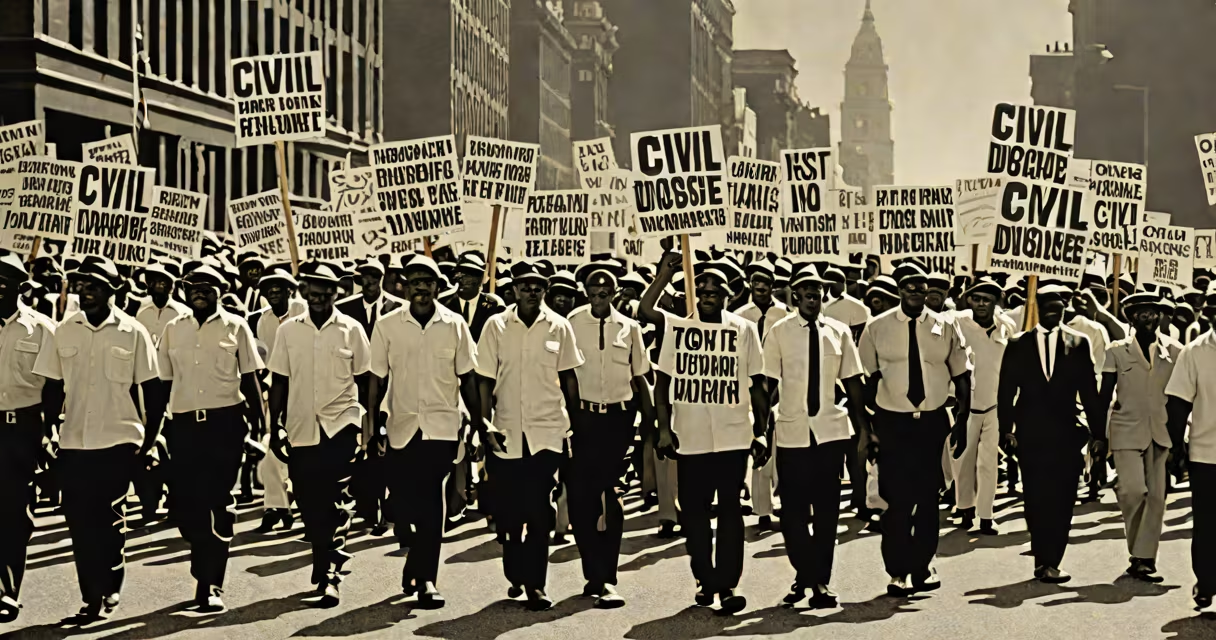
Civil disobedience is the intentional, nonviolent violation of laws deemed unjust, often to provoke public debate or force reform. It relies on moral conviction rather than legal justification, with participants accepting punishment to show systemic injustice.
This form of protest emerged as a strategy in the 19th century and gained global traction through figures like Mahatma Gandhi and Martin Luther King Jr. Unlike riots or sabotage, civil disobedience is premeditated, publicly announced, and avoids harm to people or property. Its legitimacy stems from ethical reasoning, not chaos.
Modern applications include climate strikes, anti-war demonstrations, and digital activism. The movement's power lies in disrupting normal operations while maintaining discipline, drawing attention to issues otherwise ignored by institutions.
Participants identify a law or policy they view as morally wrong. They then plan a public act of defiance-such as occupying a space, refusing to pay a tax, or blocking traffic-that violates the law but causes no physical harm. The act is documented, widely shared, and the individuals involved accept arrest or fines.
The goal is not to win immediate compliance but to expose the contradiction between law and justice. By breaking the law openly and peacefully, activists force society to confront the ethics of the rule being challenged. The media coverage generated amplifies the message beyond the immediate site of protest.
For example, in 1960, students in Greensboro, North Carolina, sat at a segregated Woolworth's lunch counter and refused to leave. Their quiet refusal to comply with segregation laws drew national attention and inspired similar sit-ins across the South. The police arrested 120 of them, but the images of young Black men calmly enduring abuse while demanding basic dignity shifted public opinion.
While all civil disobedience involves breaking laws for moral reasons, tactics vary based on context and goals. Common forms include sit-ins, marches, hunger strikes, and digital disruptions.
| Tactic | When Used | Example |
|---|---|---|
| Sit-ins | Challenging segregation or discriminatory access | Greensboro sit-ins (1960) |
| Marches | Mass mobilization for recognition or reform | March on Washington (1963) |
| Hunger strikes | Protesting detention or demanding rights | Prisoners in Northern Ireland (1981) |
| Digital disruption | Exposing surveillance or corporate overreach | Anonymous campaigns against government data collection |
Some acts blend physical and digital methods. In 2011, Occupy Wall Street protesters occupied Zuccotti Park in New York City. They set up tents, held daily assemblies, and used social media to coordinate. Though the park was cleared after 40 days, the movement influenced debates on income inequality and corporate influence in politics.
A lesser-known but useful example is the 1989 Tiananmen Square protests, where students and workers gathered to demand political reform. While the event remains controversial due to state suppression, it exemplifies how civil disobedience can emerge in response to perceived government overreach-even when outcomes are tragic.
Civil disobedience is often confused with rioting, vandalism, or terrorism. The key difference lies in intent and method. Civil disobedience targets laws, not people. It aims to shame institutions into change, not destroy them.
Another misconception is that it requires mass participation. While large-scale actions draw attention, individual acts count too. In 1955, Rosa Parks refused to give up her seat on a bus in Montgomery, Alabama. Her single act triggered a 381-day boycott of city buses. She was arrested, but the campaign succeeded in ending segregation on public transit.
Some argue that civil disobedience undermines the rule of law. But philosophers like John Rawls and Hannah Arendt argued that laws must be judged by their moral content. When laws violate fundamental rights, resistance becomes not only justified but necessary. As King wrote in *Letter from Birmingham Jail*, "One has a moral responsibility to disobey unjust laws."
Historical examples show measurable results. The 1955 Montgomery Bus Boycott led to a Supreme Court ruling declaring segregated seating unconstitutional. The 1963 March on Washington helped pass the Civil Rights Act of 1964. These changes were not immediate, but the sustained pressure from nonviolent action created political momentum.
Today, digital civil disobedience is growing. In 2016, activists blocked access to websites hosting child exploitation material using coordinated denial-of-service attacks. While technically illegal, organizers argued the acts exposed gaps in online enforcement and pressured platforms to improve monitoring. This tactic remains ethically contested, but it illustrates how the core principles of civil disobedience adapt to new environments.
I witnessed this firsthand in 2018 during a protest against a proposed pipeline near Standing Rock. Indigenous leaders and allies set up camps and blocked construction zones. They did not attack workers, but they refused to move. The resulting media coverage forced federal agencies to reassess environmental reviews. The project was delayed for years, though not stopped entirely.
Not all acts succeed. Some lead to crackdowns. But the value lies in the public record of resistance. Even failed movements preserve moral clarity. The 1989 protests in China, despite violent suppression, remain a reference point in discussions about state power and civic courage.
Examples of civil disobedience are not just historical footnotes. They remain tools for change in democracies and authoritarian regimes alike. When laws fail to protect human dignity, citizens may have no choice but to break them-peacefully, deliberately, and with purpose.