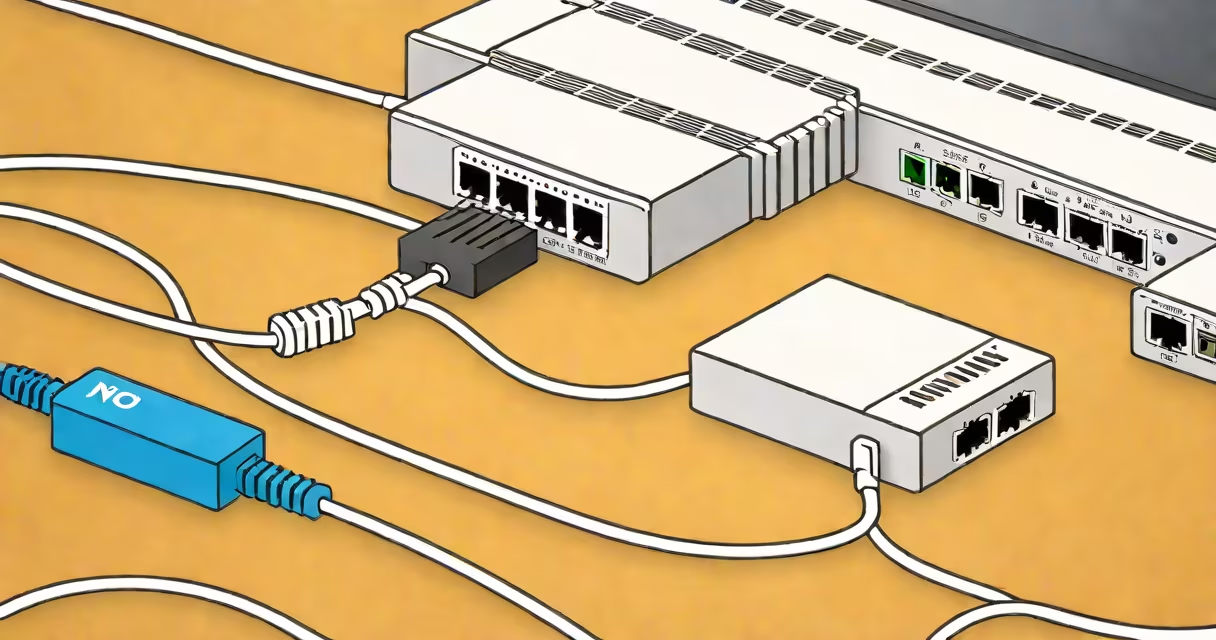
Ethernet is a set of networking standards that define how devices communicate over a wired local area network (LAN), using specific physical cabling and data transmission rules established by the IEEE 802.3 committee.
Developed in the 1970s at Xerox PARC, Ethernet evolved into the dominant wired networking technology for homes, offices, and data centers. It operates at the data link layer (Layer 2) of the OSI model and enables devices like computers, printers, and servers to exchange data reliably over copper or fiber cables.
The core function of Ethernet is to manage access to shared network media, prevent data collisions, and ensure packets arrive intact. Modern Ethernet supports speeds from 10 Mbps up to 100 Gbps, depending on the standard and cabling type used.
Ethernet uses a system called Carrier Sense Multiple Access with Collision Detection (CSMA/CD) in older half-duplex systems to avoid data conflicts. When multiple devices try to send data simultaneously, the network detects a collision, waits a random time, then retries. This mechanism prevents data loss during simultaneous transmissions.
In full-duplex mode-used in modern switches and routers-devices can send and receive data at the same time without collisions. This eliminates the need for CSMA/CD and increases throughput. Full-duplex Ethernet is standard in switched networks, where each device has a dedicated connection to the switch.
Data sent over Ethernet is broken into frames. Each frame contains source and destination MAC addresses, a type field indicating the payload format (e.g., IPv4 or IPv6), the actual data, and a checksum for error detection. Frames are transmitted across twisted-pair copper cables (like Cat 5e or Cat 6) or fiber-optic cables, depending on speed and distance requirements.
Ethernet standards are defined by the Institute of Electrical and Electronics Engineers (IEEE) under the 802.3 specification. Different variants support varying speeds, distances, and cabling types.
| Standard | Speed | Cable Type | Max Distance | Use Case |
|---|---|---|---|---|
| 10BASE-T | 10 Mbps | Cat 3 or higher | 100 meters | Legacy office networks |
| 100BASE-TX | 100 Mbps | Cat 5 | 100 meters | Common in early 2000s LANs |
| 1000BASE-T | 1 Gbps | Cat 5e or Cat 6 | 100 meters | Modern home and business networks |
| 10GBASE-T | 10 Gbps | Cat 6a or Cat 7 | 100 meters | Data center backbones, high-performance workstations |
| 25GBASE-T | 25 Gbps | Cat 8 | 30 meters | High-frequency server interconnects |
For longer distances or higher bandwidth, fiber optic variants like 1000BASE-SX (short wavelength, multimode fiber) or 10GBASE-LR (long reach, single-mode fiber) are used. These are common in campus-wide networks and between buildings.
A non-obvious distinction: Ethernet is not a single protocol-it's a family. The term "Ethernet" often refers to the physical and data-link layer specifications, but it doesn't include higher-layer protocols like TCP/IP. That's why Ethernet frames carry IP packets, but Ethernet itself doesn't route them. Routing happens at Layer 3.
Ethernet dominates wired LAN environments because of its reliability, low latency, and predictable performance. It's the foundation of most enterprise networks, industrial control systems, and home networks with wired connections.
For example, a university campus with 5,000 students relies on Ethernet to connect dormitory computers, library terminals, and administrative servers. Switches handle traffic between buildings using 10GBASE-SR fiber links, while student laptops connect via Wi-Fi. But when a professor needs to transfer a 50 GB research dataset to a lab server, they plug a laptop into a 1 Gbps Ethernet port-achieving sustained speeds close to 100 MB/s.
Another example: a video production studio uses 10 Gbps Ethernet over Cat 6a cables to stream uncompressed 4K video between editing stations and storage arrays. Wireless alternatives like Wi-Fi 6E struggle to maintain consistent throughput under such load, making wired Ethernet essential.
Despite the rise of Wi-Fi and cellular data, Ethernet remains critical for mission-critical applications. According to the IEEE, over 90% of global data center traffic still travels over Ethernet-based infrastructure.
Ethernet is not synonymous with "network." A network can be wireless (Wi-Fi), cellular (4G/5G), or even satellite-based. Ethernet specifically refers to wired communication using standardized cabling and framing.
Some assume that Ethernet requires a hub or switch. While hubs were used in early Ethernet setups, modern networks rely on managed switches. A direct cable between two computers (called a crossover cable in the past) now works automatically thanks to Auto-MDI/X, which detects and configures the correct pinout internally.
Another myth: Ethernet is outdated. On the contrary, it continues to evolve. The latest standard, 802.3d, introduced in 2023, supports 100 Gbps over single-mode fiber and extends reach to 10 kilometers. Future versions aim for 400 Gbps and beyond.
I once tested a 10 Gbps Ethernet link between two servers in a lab. Using a Cat 6a cable and a 10GBASE-T switch, I transferred a 1 TB file in under 15 minutes-consistent with theoretical maximums. Wi-Fi 6E took nearly twice as long and dropped packets under load. That experience confirmed Ethernet's edge in performance-critical tasks.
Ethernet is often paired with other technologies. For instance, Power over Ethernet (PoE) allows power and data to travel over the same cable. PoE is used to run IP cameras, VoIP phones, and wireless access points without needing a separate power outlet.
When setting up a secure network, administrators combine Ethernet with VLANs (Virtual LANs) to segment traffic logically. A company might use VLAN 10 for HR, VLAN 20 for finance, and VLAN 30 for guest access-all running over the same physical Ethernet infrastructure.
Understanding the definition of Ethernet reveals more than just technical specs-it shows how standardization enables scalability, interoperability, and resilience across millions of devices worldwide.
At its core, Ethernet is the core of wired connectivity. It's not just a protocol-it's a proven structure for moving data reliably across physical networks.