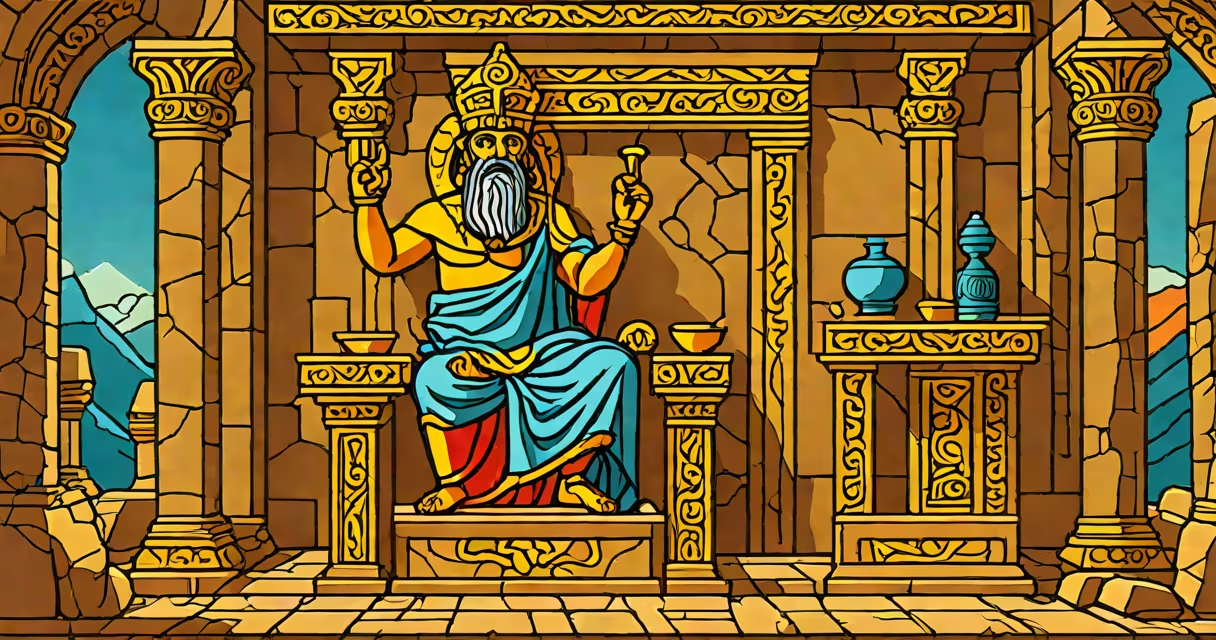
Idolatry in the Bible refers to the act of worshipping anything-images, objects, or concepts-instead of the one true God, violating the first two of the Ten Commandments. It is not limited to statues but includes any devotion that displaces divine authority.
The term originates from the Hebrew word *'ēlîl*, meaning "worthless" or "nothing," and *māṣṣāh*, which describes a carved image. In Exodus 20:4-5, God commands, "You shall not make for yourself a carved image... You shall not bow down to them or serve them." This prohibition extends beyond physical idols to any object or idea that becomes central to one's loyalty or identity.
Idolatry was a recurring issue in ancient Israel. During the divided monarchy, both the northern kingdom of Israel and southern kingdom of Judah repeatedly fell into idolatrous practices, adopting Canaanite deities like Baal and Asherah. The prophets Amos, Hosea, and Isaiah condemned this as spiritual adultery-God's people turning from their covenant relationship to worship foreign gods.
Idolatry is not merely ritual error-it disrupts the covenant between God and Israel. When the people built altars to Baal during the reign of King Ahab, they weren't just choosing different gods; they were rejecting God's exclusive claim on their allegiance. This breach led to social breakdown, injustice, and national exile.
A clear example occurs in 1 Kings 18, where Elijah challenges 450 prophets of Baal on Mount Carmel. After days of futile prayers, Elijah calls on God, who sends fire from heaven. The people respond, "The Lord-he is God!" The event exposes idolatry not as superstition but as a political and moral failure. Worship of false gods leads to moral compromise and societal decay.
Jesus later reframed idolatry in the New Proof. In Matthew 6:24, He says, "No one can serve two masters... You cannot serve both God and Mammon." Here, "Mammon" represents wealth, power, or status-anything that demands ultimate loyalty. Jesus identifies materialism and greed as forms of idolatry, showing the concept transcends ancient temples and statues.
Biblical idolatry appears in several distinct forms, each rooted in human desire for control, security, or identity:
| Type | Description | Scriptural Example |
|---|---|---|
| Physical Idols | Carved images of gods, often made of wood, metal, or stone. | Exodus 32:4-8 - The golden calf at Sinai. |
| Idolatry of Power | Placing trust in rulers, armies, or political systems above God. | Isaiah 36:6 - Assyrian king Sennacherib mocks Israel's reliance on God. |
| Idolatry of Wealth | Worshiping money, possessions, or success as sources of life and meaning. | Matthew 6:24 - Jesus warns against serving Mammon. |
| Idolatry of Self | Exalting personal ambition, reputation, or pleasure above divine purpose. | Proverbs 16:18 - "Pride goes before destruction." |
Modern readers often overlook the psychological dimension of idolatry. The Bible doesn't condemn all images-God commanded the creation of cherubim in the tabernacle (Exodus 25:18-20). What matters is intent: whether the image serves as a reminder of God's presence or becomes an object of worship itself.
Idolatry is frequently misunderstood as only involving pagan statues or ancient rituals. But the Bible treats internal attitudes-such as pride, greed, or obsession with status-as equally idolatrous. Paul writes in Colossians 3:5, "Put to death therefore what is earthly in you: sexual immorality, impurity, passion, evil desire, and covetousness, which is idolatry."
Another misconception is that idolatry is solely about religion. In reality, it affects every area of life: relationships, work, media consumption. When someone prioritizes career advancement over family time, or seeks validation through social media likes, they may be engaging in modern forms of idolatry-even without using a statue.
A lesser-known fact: the Hebrew word *'ēlîl* appears in Deuteronomy 32:37, where God says, "I will hide my face from them... because they have made themselves a god." The word is used to describe idols as "nothing"-not just powerless, but fundamentally unreal. This linguistic insight reveals that idolatry isn't just disobedience-it's a denial of reality.
Recognizing idolatry requires introspection. The early church practiced fasting and confession to identify hidden attachments. Today, Christians use spiritual disciplines like journaling, prayer, and accountability groups to examine what holds their heart's loyalty.
I once observed a small group in rural Ohio where members confessed their secret anxieties about financial stability. One man admitted he prayed daily not for wisdom, but for a promotion. His routine wasn't sinful in action-but his focus had become an idol. After a month of intentional reflection, he began redirecting his prayers toward gratitude and service. The change wasn't dramatic, but it shifted his entire sense of purpose.
Paul's instruction in Ephesians 5:5-6 is direct: "For you may be sure of this, that everyone who is sexually immoral or impure or covetous (that is, an idolater) has no inheritance in the kingdom of Christ and God." This passage shows that idolatry isn't peripheral-it determines eternal destiny.
Understanding the biblical meaning of idolatry begins with recognizing that God demands total devotion. Anything that takes priority over Him-whether a person, dream, or possession-is an idol. The solution isn't just avoiding statues, but cultivating a heart that sees God as sufficient.