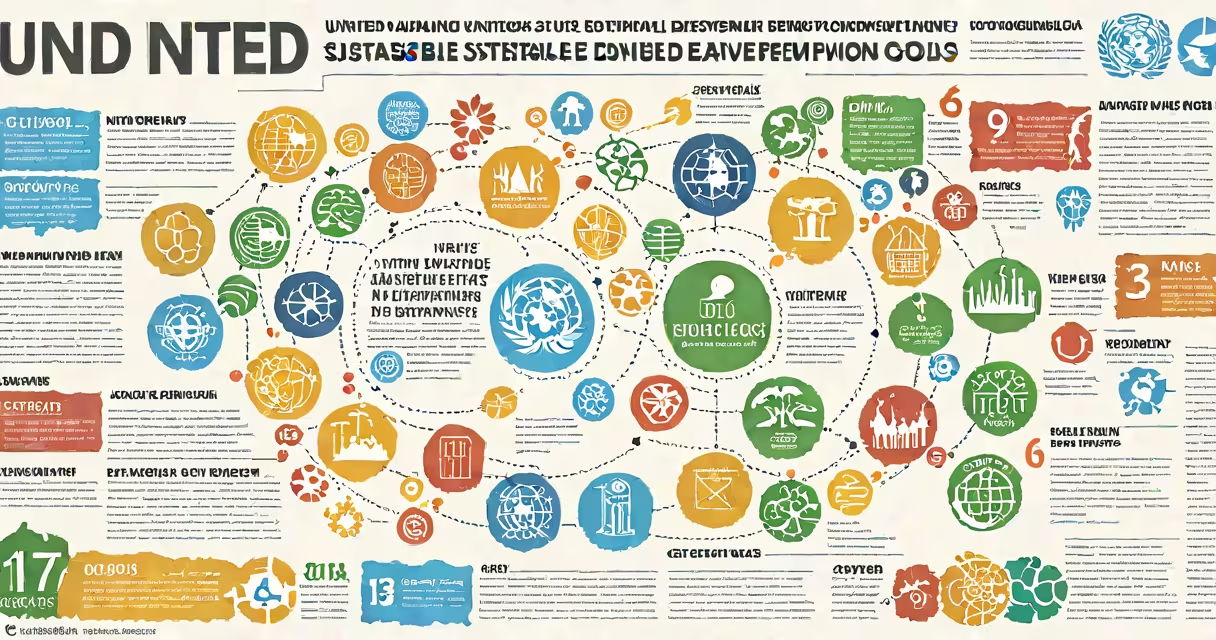
The United Nations Sustainable Development Goals (SDGs) are a universal call to action adopted by 193 member states in 2015 to end poverty, protect the planet, and ensure peace and prosperity for all by 2030. They build on the earlier Millennium Development Goals but expand focus to include economic growth, climate action, and reduced inequalities.
These 17 goals form a shared blueprint for global development, integrating social, environmental, and economic priorities into a single structure. Unlike prior UN initiatives, the SDGs apply equally to all countries-developed and developing alike-recognizing that sustainability requires coordinated effort across borders and sectors.
Each goal includes specific targets and indicators to measure progress. For example, Goal 1 aims to end extreme poverty by reducing the proportion of people living on less than $2.15 a day to zero. This measurable benchmark allows governments, NGOs, and private entities to track performance and adjust strategies accordingly.
The SDGs operate through a system of national implementation plans, international cooperation, and public-private partnerships. Countries report progress annually through the Voluntary National Reviews (VNRs), which are submitted to the UN High-Level Political Forum on Sustainable Development.
Progress is monitored using 232 unique indicators across the 17 goals. These indicators are standardized and reported via the UN's Global SDG Database. For instance, Goal 13 on climate action tracks greenhouse gas emissions per capita and renewable energy share in total final energy consumption.
When a country fails to meet a target, it may trigger policy reviews or funding adjustments. The World Bank and regional development banks use SDG alignment as a criterion for loan approvals. A 2022 study by the OECD found that 68% of bilateral aid flows were tied to at least one SDG target.
The 17 goals are grouped into three broad categories: people, planet, and prosperity. They cover issues ranging from clean water access to gender equality and responsible consumption.
| Category | Goals | Focus Areas |
|---|---|---|
| People | 1, 2, 3, 4, 5, 6, 8, 10 | Poverty, hunger, health, education, gender equity, clean water, decent work, reduced inequalities |
| Planet | 12, 13, 14, 15 | Responsible consumption, climate action, life below water, life on land |
| Prosperity | 7, 9, 11, 16, 17 | Energy, industry innovation, sustainable cities, peace and justice, partnerships |
Goal 17, Partnerships for the Goals, stands out as a cross-cutting enabler. It emphasizes multilateral coordination, technology transfer, and financial support to lower-income nations. Without this goal, others cannot be achieved at scale.
A common misconception is that the SDGs are voluntary and lack enforcement. While they are not legally binding, their integration into national budgets and international financing mechanisms creates de facto accountability. The European Union's Green Deal, for example, aligns 89% of its funding with SDG targets.
Many assume the SDGs replaced the Millennium Development Goals (MDGs) entirely. The MDGs were a predecessor focused narrowly on reducing extreme poverty in low-income countries between 2000 and 2015. The SDGs expanded the scope to include high-income nations and introduced new dimensions like climate change and digital inequality.
Another misunderstanding is that the SDGs are solely government responsibilities. Private sector involvement is critical. In 2023, 7,500 companies reported SDG-aligned activities through the UN Global Compact. Unilever, for example, committed to sourcing 100% of its agricultural raw materials sustainably by 2025-directly supporting Goal 12 on responsible consumption.
Some confuse the SDGs with corporate sustainability reports. While both address environmental and social impact, the SDGs are a globally agreed-upon structure with measurable targets. A company may claim "net-zero" but fail to meet SDG 13's requirement for verified emissions reductions.
In 2021, Rwanda launched a nationwide program to achieve SDG 6-clean water and sanitation-by 2030. The government partnered with the World Health Organization and local NGOs to install 12,000 solar-powered water pumps in rural areas. By 2023, 87% of households in targeted districts had access to safe drinking water, up from 54% in 2019.
This success relied on integrated planning. The project combined infrastructure investment (Goal 9), gender inclusion (Goal 5), and community training (Goal 4). Data was collected monthly using mobile surveys linked to the UN's SDG Indicator Dashboard.
For comparison, the MDGs did not require such detailed tracking systems. The SDGs' emphasis on disaggregated data-by income, gender, region-allows policymakers to identify gaps early. In Rwanda, data revealed that women in remote villages were disproportionately affected by water collection burdens, prompting targeted interventions.
I visited a community center in Nairobi's Kibera slum during a UNDP pilot project aligned with SDG 11-sustainable cities. The team had installed rainwater harvesting systems and compost toilets. What stood out was the community-led monitoring. Residents used color-coded cards to report maintenance issues, and data was uploaded daily to a central dashboard.
This model proved effective: 92% of systems remained functional after 18 months, compared to 61% in similar projects without local ownership. The lesson: SDG implementation works best when communities co-design solutions, not just receive them.
The united nations sustainable development goals definition is not static. The UN continues to refine indicator frameworks based on feedback from member states and civil society. In 2023, the General Assembly approved updates to 47 indicators after a review by the Inter-Agency and Expert Group on SDG Indicators (IAEG-SDGs).
By 2030, the success of the united nations sustainable development goals definition will depend on sustained political will, accurate data, and inclusive participation. The goals are not a checklist-they are a living document guiding global action toward a shared future.