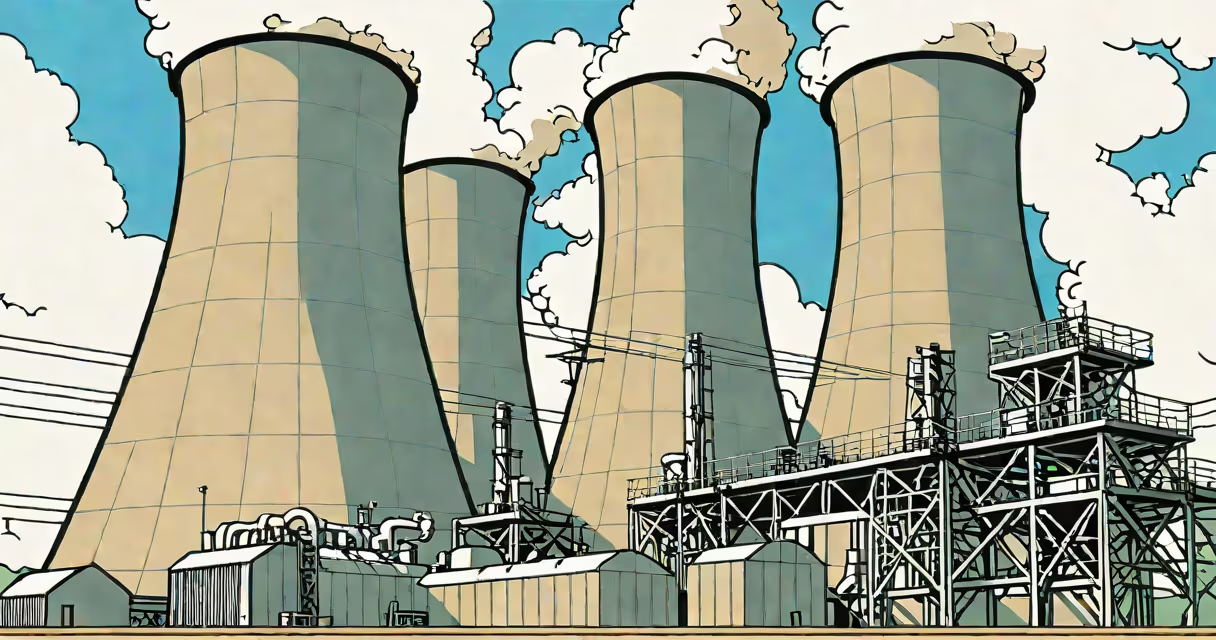
A cooling tower rejects excess heat from industrial processes, HVAC systems, and power generation by evaporating water. It maintains safe operating temperatures in facilities that generate large amounts of thermal energy.
Cooling towers are essential in environments where equipment must run continuously under high thermal load. They prevent overheating that could damage machinery, reduce efficiency, or trigger safety failures. These systems operate by circulating warm water through a structure where air contact induces evaporation, carrying heat away from the fluid.
According to the U.S. Department of Energy, cooling towers account for up to 30% of the total water usage in industrial facilities. Their role in managing thermal output is critical across sectors including manufacturing, energy production, and large-scale building climate control.
Water heated during industrial processes or HVAC operations flows into the cooling tower's distribution system. It spreads across fill material-typically plastic or wood-where it contacts ambient air moving upward or sideways through the tower. As water evaporates, it absorbs latent heat from the remaining liquid, lowering its temperature.
The cooled water then returns to the system, such as a chiller or heat exchanger, to absorb more waste heat. This cycle continues until the system reaches operational stability. The air exiting the tower carries moisture and heat, forming a visible vapor plume.
Evaporative cooling relies on the principle that water requires 540 calories per gram to change from liquid to vapor. This phase change removes significant thermal energy-about 2,500 kJ/kg-making it far more efficient than air-only cooling methods.
There are two primary designs: open-circuit and closed-circuit. Open-circuit towers expose water directly to the atmosphere. Closed-circuit towers (also called "dry coolers" or "hybrid towers") keep the process fluid isolated from external air via a heat exchange surface.
| Type | How It Works | Best For | Example Use Case |
|---|---|---|---|
| Open-Circuit | Water sprayed directly into air stream; evaporation cools it | High heat loads, low water quality tolerance | Power plants, steel mills |
| Closed-Circuit | Process fluid circulates in sealed tubes; air cools outer surface | Corrosive fluids, clean water requirements | Pharmaceutical labs, semiconductor fabrication |
Within open-circuit towers, two subtypes exist: natural draft and mechanical draft. Natural draft towers rely on buoyancy from hot air rising through a tall, hyperbolic structure. Mechanical draft towers use fans to force or draw air through the system. The latter are common in urban settings due to space constraints.
For example, the cooling towers at the Palo Verde Nuclear Generating Station in Arizona use mechanical draft design. Each tower handles over 1 million gallons of water per minute, maintaining reactor cooling under continuous load.
Cooling towers do not cool water to ambient temperature. They typically lower water temperature by 10-15°F (5.5-8.3°C) above the wet-bulb temperature of the surrounding air. This limit exists because evaporation efficiency drops as humidity increases.
Another misunderstanding is that cooling towers emit pollutants. While they release vapor plumes, these are primarily water vapor. The Environmental Protection Agency (EPA) classifies cooling tower discharge as non-toxic, though scaling and microbial growth require chemical treatment to prevent fouling and biofilm formation.
Cooling towers are not the same as evaporative condensers. Evaporative condensers are smaller units used in refrigeration systems, often integrated into chillers. Cooling towers handle larger volumes and are part of centralized cooling infrastructure.
Industrial facilities use cooling towers to manage heat from steam turbines, compressors, and chemical reactors. A typical petrochemical plant may have multiple towers processing tens of thousands of gallons per hour.
In commercial buildings, cooling towers support chilled water systems. A 100,000-square-foot office complex in Chicago uses two 300-ton cooling towers to maintain indoor temperatures. Without them, HVAC systems would overheat during summer peaks.
Power plants depend on cooling towers to reject waste heat from steam cycles. The North Anna Power Plant in Virginia uses six cooling towers to maintain turbine efficiency. Each tower is 300 feet tall and handles 1.2 million gallons of water per minute.
During a site visit to a data center in Phoenix, I observed that the facility used dry cooling towers to avoid water loss in arid conditions. While less efficient than evaporative models, they saved 1.5 million gallons of water annually compared to standard cooling towers.
Efficiency is measured by approach and range. Approach is the difference between outlet water temperature and ambient wet-bulb temperature. Range is the difference between inlet and outlet water temperatures. A typical cooling tower operates with a 10°F range and a 5°F approach.
For example, if incoming water is 100°F and ambient wet-bulb is 70°F, a 5°F approach means the cooled water exits at 75°F. This performance is influenced by fan speed, fill design, and airflow uniformity.
Modern towers incorporate variable frequency drives (VFDs) on fans to adjust airflow based on load. This reduces energy consumption by up to 35% compared to fixed-speed systems, according to ASHRAE Standard 90.1.
Cooling towers are used to reject waste heat from industrial and HVAC systems through evaporation. They enable continuous operation in high-thermal-load environments by maintaining stable water temperatures. Their design varies by application, with open and closed circuits serving different needs.
Understanding their function prevents confusion with similar systems like evaporative condensers. Real-world applications span power generation, manufacturing, and large-scale climate control. Proper maintenance ensures reliability and minimizes environmental impact.