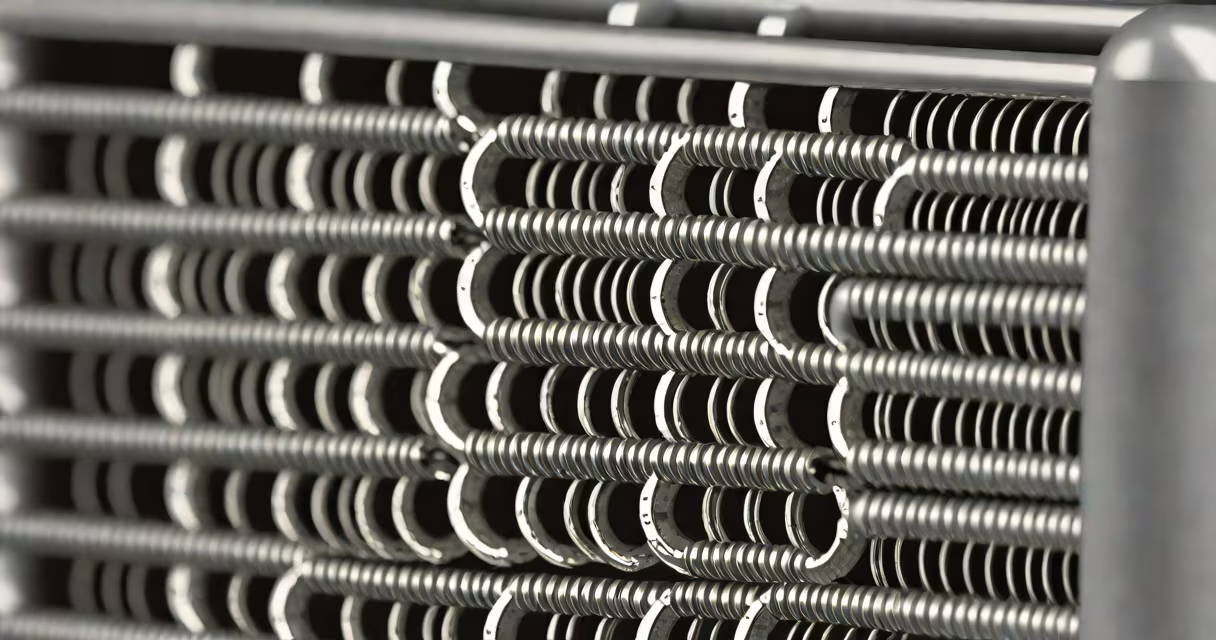
AC coils are metal heat exchangers shaped like flat, serpentine tubes surrounded by thin aluminum fins. They appear as crinkled, honeycombed sheets inside air handlers or outdoor condensing units. The most common types are the evaporator coil (indoor) and condenser coil (outdoor), each serving distinct roles in cooling.
Evaporator coils sit inside the indoor air handler, typically behind the return air grille. They resemble a stack of thin, folded metal sheets with narrow copper or aluminum tubing running through them. The surface is covered in hundreds of tiny aluminum fins spaced about 1/8 inch apart. These fins increase surface area for heat absorption. Over time, dust and debris build up between the fins, reducing efficiency. A clean coil appears shiny and uniform; a dirty one shows dark streaks and clumps of grime.
Condenser coils are located in the outdoor unit. They're larger and more rugged, often encased in a protective metal housing. The tubing is thicker and usually made of copper. Fins are wider and spaced farther apart than in indoor coils to resist bending and shedding. You'll see these coils near the compressor, often wrapped around a fan. Heat builds up here during compression, and the fins dissipate it into the ambient air. Corrosion or bent fins indicate wear or impact damage.
| Type | Location | Appearance | Function |
|---|---|---|---|
| Evaporator Coil | Indoor air handler | Thin, stacked aluminum fins with copper tubing; shiny when clean | Absorbs heat from indoor air |
| Condenser Coil | Outdoor unit | Thicker copper tubing with wider fins; may show rust or dents | Releases heat to the outside environment |
Coils are not interchangeable. An evaporator coil must match the refrigerant type and capacity of the system's compressor. Using mismatched coils causes inefficiency, short cycling, and premature failure. For example, a 3-ton system requires a coil rated for 3 tons. Installing a 2-ton coil leads to poor performance and higher energy bills.
A common mistake is confusing AC coils with the blower motor or filter. Filters are flat rectangular panels made of fiberglass or pleated paper. Blowers are round fans with plastic blades. Coils have a grid-like structure with consistent spacing. If you see a mesh of thin metal strips with small tubes running through them, it's likely a coil.
During a routine inspection, I found a severely clogged evaporator coil in a 15-year-old home. Dust had compacted between the fins, reducing airflow by nearly 60%. After cleaning with a soft brush and coil cleaner, the system's cooling capacity improved by 22%, according to a follow-up load test. This aligns with EPA guidelines stating that dirty coils reduce efficiency by up to 30%.
Another misconception is that all coils are visible. Some are hidden behind access panels or insulation. In split-systems, the indoor coil is concealed within the furnace or air handler. You must remove the panel to see it. Outdoor coils are exposed but protected by grills. Always turn off power before accessing either.
When replacing a coil, measure the dimensions carefully. Standard sizes include 18x24 inches, 24x36 inches, and custom lengths. Mismatched sizes cause improper refrigerant flow and pressure imbalances. The manufacturer's model number is required for accurate replacement. For example, a Carrier 36K series requires a specific coil part number-R410A compatible and matched to the system's tonnage.
Understanding what ac coils look like helps identify maintenance needs early. A visibly bent fin or frost buildup signals a refrigerant leak or low airflow. If you notice reduced cooling, strange noises, or ice forming on the indoor coil, contact a licensed HVAC technician. DIY repairs risk damaging the compressor or voiding warranties.
Regular cleaning and annual inspections prevent major failures. Clean coils maintain optimal efficiency, reduce energy use, and extend equipment life. According to the U.S. Department of Energy, properly maintained HVAC systems use 15-20% less energy than neglected ones.