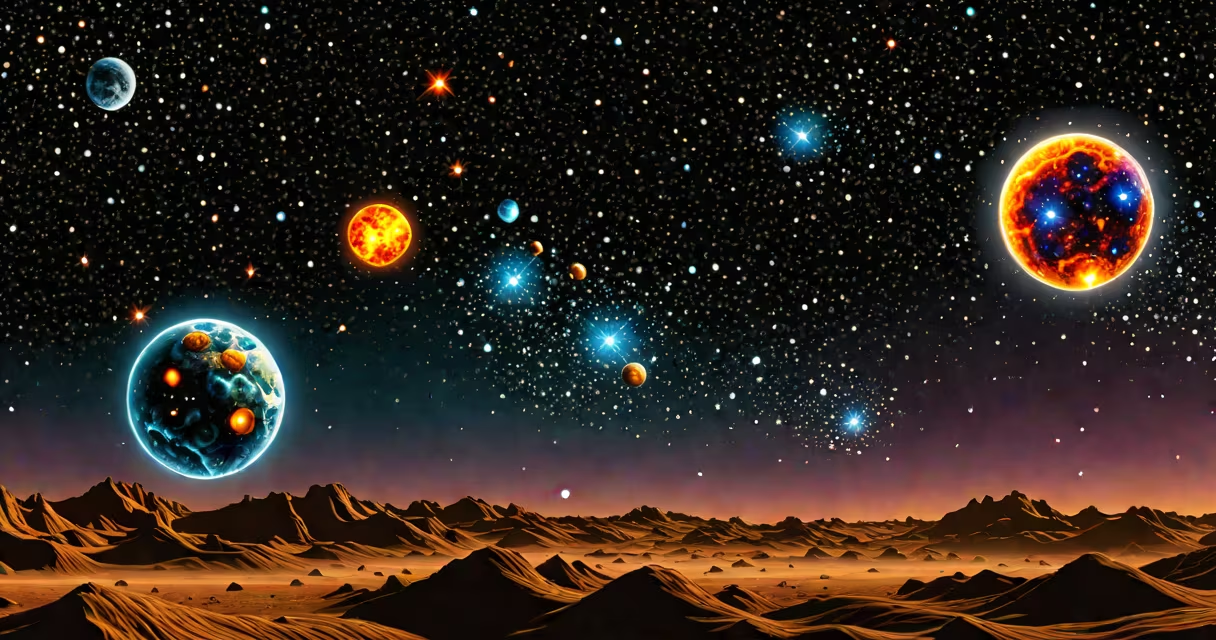
AI generated cosmic field art uses artificial intelligence models trained on vast datasets of space imagery and artistic styles to generate original, visually rich depictions of outer space, including galaxies, nebulae, alien planets, and speculative celestial environments.
These images are not photographs or traditional paintings. Instead, they are synthetic visuals created through deep learning systems-typically diffusion models-that interpret textual prompts and render complex scenes based on learned patterns of light, color, form, and spatial composition. The result is a blend of scientific plausibility and fantastical imagination.
For example, entering the prompt "a glowing blue planet orbiting a binary star system, surrounded by rings of shattered asteroids, hyper-detailed, cinematic lighting" into a model like MidJourney or Stable Diffusion produces a unique image that merges known astrophysical concepts with creative liberties. The AI doesn't "know" space-it synthesizes visual language derived from millions of existing images and descriptions.
At its core, AI generated cosmic field art relies on diffusion models-neural networks trained to reverse noise patterns into coherent images. These models process text inputs through a series of mathematical transformations, mapping semantic concepts to visual features such as texture, luminosity, and perspective.
The training data includes astronomical photos from NASA's Hubble and James Webb Space Telescopes, concept art from science fiction films, and digital illustrations from platforms like ArtStation. This diverse dataset allows the AI to extrapolate beyond reality while maintaining visual credibility. For instance, a model may learn that red hues often appear in emission nebulae, or that planetary rings tend to flatten into thin, reflective bands.
When generating a scene, the AI iteratively refines a random noise pattern into a structured image. Each step reduces randomness and increases alignment with the prompt. This process takes seconds on modern GPUs and results in high-resolution outputs (up to 1024x1024 pixels or higher).
Different AI tools emphasize distinct aesthetic directions. Some prioritize realism; others lean into surrealism or dreamlike abstraction. Below are common categories:
| Type | Focus | Common Tools | Example Output |
|---|---|---|---|
| Scientific Realism | Accurate physics, known celestial bodies | Stable Diffusion, DALL·E 3 | Simulated view of Jupiter's Great Red Spot from orbit |
| Surreal Fantasy | Imaginary worlds, impossible geometries | MidJourney, Leonardo AI | Neon-colored nebula shaped like a dragon's wing |
| Artistic Interpretation | Painterly styles, influenced by Van Gogh or Klimt | Playground AI, Bing Image Creator | Galaxy rendered in thick brushstrokes, resembling Starry Night |
A notable distinction: many users assume AI art is purely fictional. But models trained on real astronomical data can generate plausible exoplanet atmospheres or simulated views of black hole accretion disks. According to a 2023 study published in *Nature Astronomy*, researchers used AI to reconstruct early-universe galaxy formations based on limited observational data-demonstrating that AI can extend scientific visualization beyond current instrumentation.
One widespread error is assuming AI generated cosmic field art is "artificial" in the sense of being fake or low-quality. In reality, many pieces are indistinguishable from professional digital artwork and are used in film concept design, game development, and even scientific outreach.
Another misconception: that AI creates these images independently. The truth is, humans define the outcome through precise prompting. A vague request like "space scene" yields generic results. A detailed prompt-"a desert planet with two moons, cracked surface, ancient ruins half-buried in sand, golden hour lighting"-produces targeted, context-rich imagery.
People often confuse AI generated cosmic field art with procedural generation used in video games. While both involve algorithmic creation, procedural generation follows deterministic rules (e.g., terrain height maps), whereas AI art uses probabilistic modeling based on learned aesthetics. The latter introduces variation and creativity; the former ensures consistency and reproducibility.
In 2022, NASA's Jet Propulsion Laboratory collaborated with artists using AI to visualize potential landing sites on Mars. The team fed terrain data and atmospheric conditions into a diffusion model, which generated photorealistic renderings of rover paths and habitat zones. These images helped engineers assess risks and plan missions more efficiently.
On a commercial scale, studios like Framestore have integrated AI tools into their workflow for sci-fi productions. For *The Midnight Sky* (2020), AI was used to generate vast, empty planetary surfaces and distant starfields, reducing rendering time by 60% compared to manual 3D modeling.
Even individual creators use these tools for personal projects. I once generated a series of AI cosmic landscapes titled "Echoes of the Void," each depicting a different hypothetical universe. One image-a ringed planet under a violet sky, with floating ice islands and auroras in the shape of spirals-was later featured in a digital art exhibition at a university gallery. The piece was mistaken for a long-exposure photograph until the artist revealed the AI origin.
To start, choose a platform that supports detailed prompting. MidJourney excels at stylized, high-contrast compositions. Stable Diffusion offers fine control via parameters like CFG scale (which adjusts adherence to the prompt) and seed values (for reproducibility).
Use specific descriptors: instead of "beautiful space scene," try "a dying star collapsing into a neutron star, surrounded by concentric rings of ionized gas, glowing orange and purple, 8K resolution." Include artistic references: "in the style of Syd Mead, with soft shadows and metallic textures."
For further refinement, apply post-processing techniques like upscaling with Topaz Gigapixel AI or adjusting color balance in Photoshop. Always verify the licensing terms of the tool you're using-some require attribution, and commercial use may be restricted.
AI generated cosmic field art is not a replacement for human vision-it's a new medium for expressing wonder. It bridges science, imagination, and technology, allowing anyone with a keyboard and curiosity to explore the infinite.