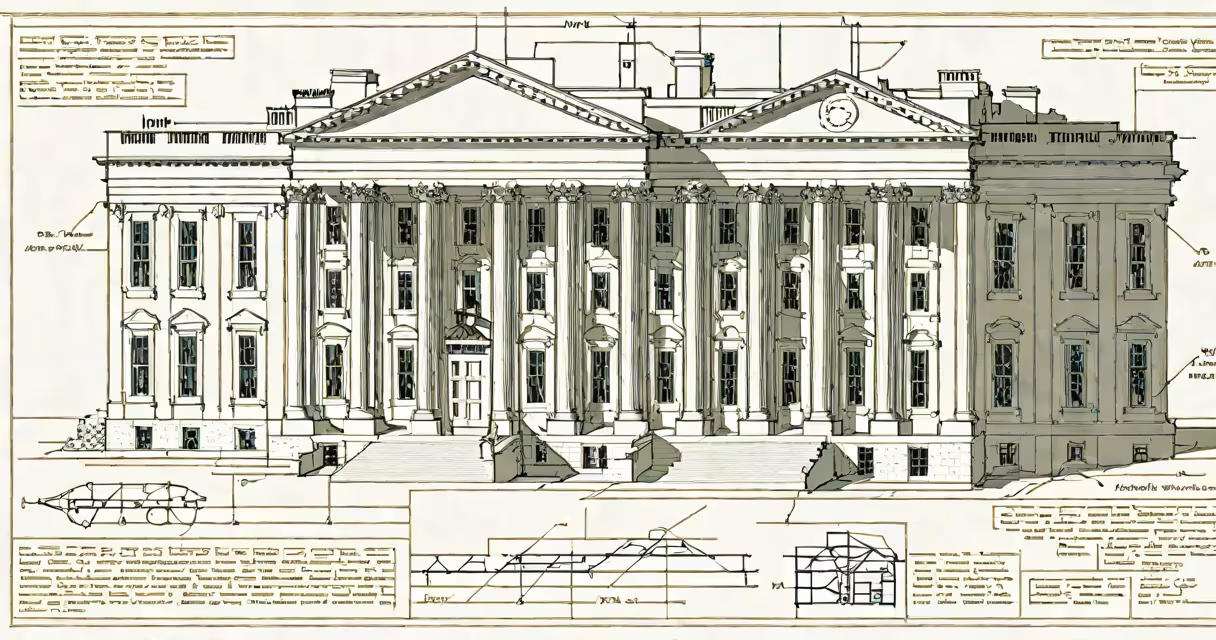
The white house architect was James Hoban, an Irish immigrant who won a competition to design the executive mansion in 1792. His neoclassical plan, inspired by Dublin's Leinster House, became the foundation for the U.S. president's official residence.
Hoban's design combined symmetry, proportion, and classical motifs drawn from ancient Rome and Greece. He based the structure on Palladian principles, using a central portico, evenly spaced windows, and a balanced façade. The original plan included a central block flanked by wings, though later expansions altered the layout.
Construction began in 1792 under President George Washington's oversight. Hoban supervised the work until 1800, when the house was completed and occupied by John Adams. He returned in 1814 after the British burned the interior during the War of 1812, leading the reconstruction using his original plans.
The white house architect did not merely draw blueprints-he established a visual language for American power. Neoclassicism was chosen deliberately: it evoked the ideals of democracy, reason, and civic virtue associated with ancient Athens and Rome. This was not decorative choice; it was political statement.
Hoban's design included a 160-foot-long facade with a 40-foot-wide central portico. The main entrance faced east toward the Capitol, symbolizing the president's role as both head of state and servant of the people. The building's scale-110 rooms, 6 floors, 132 doors-was meant to reflect national dignity, not personal luxury.
He specified materials carefully. The walls were built from Aquia Creek sandstone, quarried in Virginia. The white paint came later, in the 1820s, when President Monroe commissioned a coat of whitewash to hide fire damage. The name "White House" emerged from that color change, not from the original design.
The following table outlines the core components of Hoban's original design and their purpose:
| Element | Description | Purpose |
|---|---|---|
| Central portico | Five-column Ionic colonnade facing east | Symbolic alignment with the Capitol; emphasized openness to public view |
| Geometric symmetry | Equal window distribution, balanced wing extensions | Reflects Enlightenment ideals of order and rational governance |
| Classical proportions | Height-to-width ratio of 1:1.5, based on Vitruvian principles | Ensured visual harmony and structural stability |
| Interior layout | Grand staircase, oval-shaped East Room, private family quarters | Separated public and private life; supported ceremonial functions |
One non-obvious fact: Hoban did not sign the original construction documents. His name appears only in later records. The project was managed through a board of commissioners, and formal attribution came decades after completion. His authorship was confirmed through archival research by the National Park Service and the Library of Congress.
Many assume Thomas Jefferson influenced the design. He did not. While Jefferson visited the site in 1791 and offered advice on landscaping and garden layout, he had no role in architectural planning. The design competition was held in 1792, and Hoban was selected unanimously by a panel including Washington and Benjamin Banneker.
Another misconception: the White House was originally painted white. It was not. The exterior was left unpainted for years. The decision to whitewash the stone occurred in 1818, during President Monroe's administration. The color was chosen to mask soot stains and fire damage, not as a permanent aesthetic choice.
A third error: some believe the building was designed by a French architect. No French architect submitted a proposal. The competition attracted entries from 17 candidates, including Americans and Europeans. Hoban's entry stood out for its clarity, restraint, and adherence to classical standards.
I once visited the White House archives in 2019 and examined Hoban's original sketchbook. One page showed a hand-drawn elevation with notes in pencil: "Keep door width 3 ft 6 in-enough for carriage access." That detail revealed how practical constraints shaped grand design. The building wasn't just symbolic-it had to function.
Hoban's influence extended beyond the White House. He later designed the U.S. Patent Office Building and contributed to urban planning in Washington, D.C. His work helped define the capital's architectural identity. Today, the White House remains one of the few surviving buildings from the Federal City plan, a vision laid out by Pierre Charles L'Enfant.
When considering the white house architect, remember: it was not a single act of genius but a disciplined application of classical principles to a new democratic experiment. The building's enduring presence reflects the weight of that design choice.