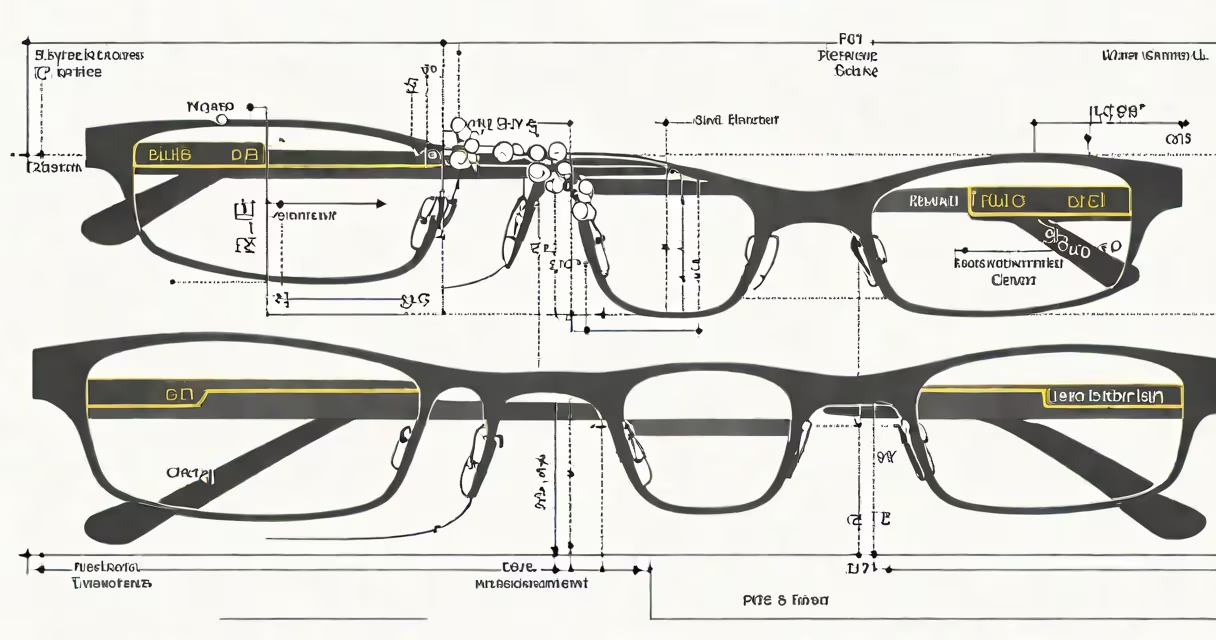
Eye prescriptions and frame sizes use standardized numbers to ensure lenses fit correctly and provide clear vision. These measurements define lens alignment, frame proportions, and eye positioning relative to the optical center.
Each number on a prescription or frame label serves a specific function. For example, the pupillary distance (PD) measures the gap between your pupils, ensuring the optical center of each lens aligns with your line of sight. Without accurate PD, you may experience eye strain or blurry vision.
Frame size is described using three numbers: A, B, and DBL. A is the horizontal width of the lens, B is the vertical height, and DBL is the distance between the lenses at the bridge. These values determine whether a frame fits your face properly and whether the lenses cover your visual field adequately.
When you receive a prescription, it includes both refractive power (like -2.00 for nearsightedness) and alignment details such as PD. The PD is measured in millimeters and typically ranges from 54 mm to 74 mm for adults. A mismatch here causes prismatic effects, making objects appear shifted or doubled.
Lens fabrication uses the PD to position the optical center precisely. If your PD is 62 mm but the lens centers are placed at 64 mm, your eyes don't see through the optimal part of the lens. This misalignment leads to distortion, especially in high-prescription lenses.
For progressive lenses, accuracy is critical. A 1 mm error in PD placement can cause vertical blur or discomfort during reading. The American Optometric Association notes that improper PD settings contribute to 30% of patient complaints about new progressive lenses.
The following table outlines the core eyeglass measurements and their roles:
| Measurement | Symbol | Meaning | Typical Range |
|---|---|---|---|
| Pupillary Distance | PD | Distance between pupils in mm | 54-74 mm |
| Horizontal Lens Width | A | Width of each lens | 48-62 mm |
| Vertical Lens Height | B | Height of each lens | 30-45 mm |
| Bridge Distance | DBL | Distance between lenses at the nose | 14-22 mm |
| Temple Length | TL | Length of temple arm | 120-150 mm |
These values are stamped on the inside of the frame's temple. For example, a frame labeled "52-18-140" means the lens width (A) is 52 mm, the bridge (DBL) is 18 mm, and the temple length (TL) is 140 mm. This allows opticians to verify compatibility with your prescription.
Frame size affects comfort and coverage. A lens too narrow won't cover your entire visual field, leading to peripheral blurriness. A frame too wide may rest on your cheeks, causing pressure and slippage.
When ordering online, matching your PD to the frame's A and DBL values prevents fit issues. If your PD is 64 mm and the frame's A is 50 mm, the lenses must be centered within the frame to avoid edge distortion.
Many people assume that PD is the same as interpupillary distance (IPD), but IPD is measured from the center of one pupil to the center of the other. PD is the actual distance between the pupils when looking straight ahead. The two differ slightly due to eye rotation and viewing angle.
Another misconception is that larger frames automatically offer better vision. Larger lenses increase edge thickness, especially in high-minus prescriptions. A 56 mm lens with a -5.00 diopter prescription will have thicker edges than a 50 mm lens with the same power. This increases weight and reduces comfort.
Some patients believe that a single PD value applies to all lenses. But there are two types: monocular PD (each eye's distance from the nose) and binocular PD (total distance between pupils). Monocular PD is used for precise lens centering, particularly in high-power or progressive lenses.
I once helped a customer who returned his new progressive lenses because they felt "off." His prescription had a monocular PD of 32 mm per eye. The lab used a binocular PD of 64 mm instead. After recalculating with the correct monocular values, the lenses aligned perfectly with his gaze. He reported immediate improvement in depth perception and reduced eye fatigue.
Suppose you have a prescription with a PD of 66 mm and want to buy frames labeled "54-16-145." The lens width (A) is 54 mm, the bridge (DBL) is 16 mm, and the temple length (TL) is 145 mm.
To check fit, calculate the total frame width: A + DBL = 54 + 16 = 70 mm. Since your PD is 66 mm, the lenses will sit slightly inward from the center of your face. This is acceptable-most frames allow a 2-4 mm margin of error.
Next, verify that the frame's A value is large enough to cover your visual field. If your pupil diameter is 3 mm and your frame's A is 54 mm, the lens covers 54 mm horizontally. With a 3 mm pupil, you're well within the central zone. Edge distortion remains minimal.
If your PD were 70 mm, the frame would be too narrow. You'd see through the lens edges during side-to-side movement, causing visual distortion. In that case, you'd need a frame with A ≥ 58 mm.
Always confirm that your PD matches the frame's A and DBL values. Use tools like the VisionWorks app or consult an optician to validate compatibility before purchasing.
Your prescription contains the necessary data. Ask your optometrist for your PD, monocular PD, and any special instructions. If you're buying online, many retailers include a form to enter your PD and frame preferences.
Frame labels often list dimensions in millimeters. Look for markings on the inside of the temple. If missing, measure the frame with calipers or use a ruler to estimate A and DBL.
For complex prescriptions-high astigmatism, prism, or custom lens designs-always use a licensed optician. They apply advanced calculations to ensure the optical center aligns with your visual axis.
Remember: what do eyeglass measurements mean? They define fit, clarity, and comfort. Ignoring them leads to headaches, blurred vision, and early lens wear.