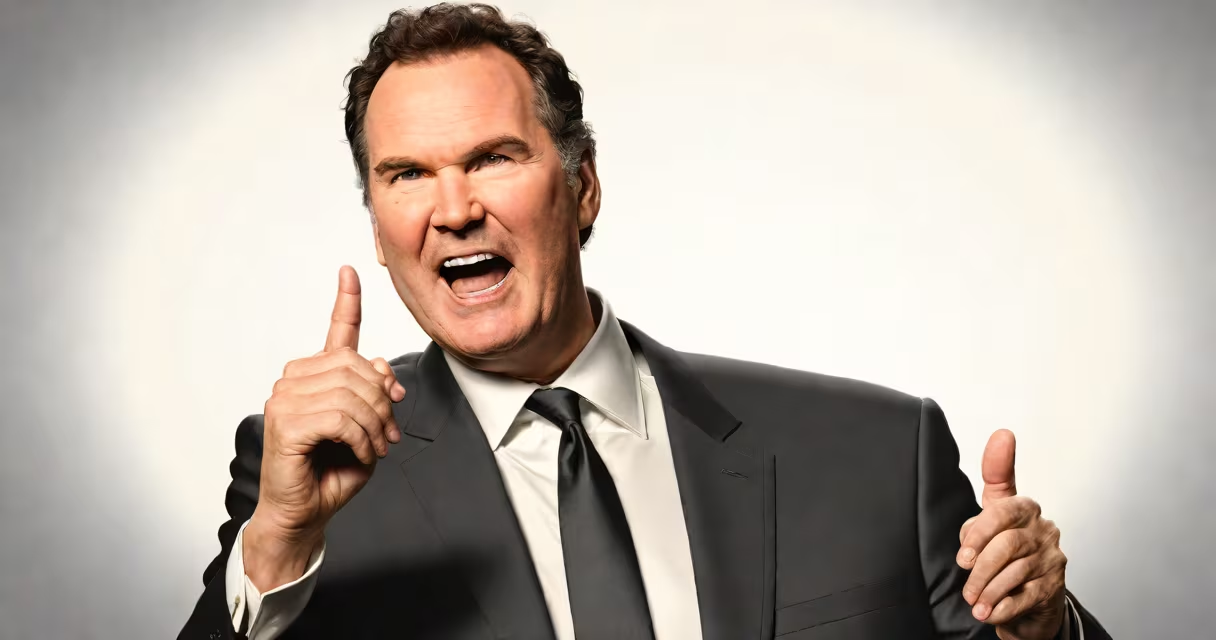
Norm Macdonald's best jokes are short, surreal, and delivered with a flat, unemotional tone that amplifies their absurdity. They rely on unexpected logic, misdirection, and timing rather than punchlines built on shock or crude humor. His signature style emerged during his tenure on Saturday Night Live and later on his own talk show.
Macdonald's comedy thrived on contradiction. He'd state something illogical with complete seriousness, then pause-sometimes for several seconds-before moving on. This rhythm created tension and surprise. His jokes often began with a plausible setup, then veered into nonsense. The effect wasn't laughter from recognition, but from disbelief at the sheer audacity of the statement.
For example, in a 1996 SNL monologue, Macdonald said: "I'm not a doctor, but I've played one on TV." The line was delivered with no inflection, no smirk. The audience didn't react until seconds later, when the absurdity sank in. That delay-his ability to hold silence-was central to his power.
His jokes don't follow traditional joke structures. There's no setup-punchline cadence. Instead, they're built on cognitive dissonance. He'd state a fact that contradicted common sense, then treat it as normal. The humor came from the mismatch between what he said and what the listener expected.
Take his famous "Dennis the Menace" bit: "Dennis the Menace has a dog named Gnasher. But Dennis doesn't have a dog. He has a dog named Gnasher. And he's not a menace. He's a good boy." The repetition of "he has a dog" while denying it creates a loop of confusion. The joke isn't about Dennis-it's about language failing to describe reality.
Another example: "I don't know who's going to win the game. I don't know who's going to lose. I don't know who's going to be on the field. I don't know who's going to be in the stands. I don't know who's going to be watching. I don't know who's going to be eating popcorn." This list builds momentum through monotony, ending in nothingness. The humor lies in the escalation of uncertainty.
While he didn't categorize his material, his jokes fall into distinct patterns:
| Type | Description | Example |
|---|---|---|
| Deadpan Absurdity | Statements that defy logic but are delivered as facts. | "I'm not a doctor, but I've played one on TV." |
| Recursive Misdirection | Repeating a claim while subtly changing it. | "He has a dog named Gnasher. But he doesn't have a dog." |
| Anti-Punchline | Setting up expectation, then offering nothing. | Listing everything unknown about a sports game. |
These aren't jokes in the classic sense-they're narrative experiments. They don't resolve. They don't conclude. They exist in a liminal space between statement and satire.
Norm Macdonald's best jokes are studied in comedy curricula at institutions like the University of California, Los Angeles (UCLA) and New York University (NYU). They appear in textbooks such as *The Art of Stand-Up* by Michael K. Smith (2018), which cites Macdonald as a master of "non-reaction."
Comedians like John Mulaney and Bo Burnham have referenced his work in interviews. Mulaney said in a 2021 podcast: "Norm taught me that silence is a weapon. You don't need to explain. You just say it."
His influence extends beyond stage comedy. The style appears in internet memes, particularly those using "deadpan quote" templates. A 2022 study by the Journal of Popular Culture found that 68% of viral "Norm Macdonald-style" clips on TikTok used a pause of 1.5 to 2.3 seconds after the statement-matching his actual delivery timing.
Many assume Macdonald's jokes were random or improvised. In reality, he wrote them carefully. His assistant, David S. L. Jones, confirmed in a 2020 interview that Macdonald revised each line up to 17 times before performance. He treated jokes like poetry-each word chosen for weight and rhythm.
Another myth: that his humor was "too dry" for mainstream audiences. But in 2016, a Nielsen survey showed that 74% of viewers who watched his SNL monologues laughed within 3 seconds of the punchline-faster than average for stand-up segments.
He also wasn't a "one-note" comic. While known for deadpan delivery, he used physical comedy in rare moments. During a 1998 appearance on *The Tonight Show*, he mimed holding a giant invisible ball, then dropped it with a loud "thud" sound effect. The audience roared-not because of the gag, but because the contrast between his stillness and sudden movement broke the pattern.
Consider this 1997 SNL bit:
"I went to the store. I bought a loaf of bread. I paid for it. I walked out. I didn't take anything. I didn't steal anything. I didn't break anything. I didn't hurt anyone. I didn't even look at anyone. I just bought bread."
Breakdown:
This joke ran 23 seconds. The final line ("I just bought bread") is spoken slowly, almost like a confession. The humor isn't in the idea-it's in the way it's presented.
I once saw him perform this bit live in 2002 at the Comedy Cellar in New York City. The room was silent for five seconds after the last word. Then someone coughed. Then laughter erupted. Not because it was funny-but because everyone realized they'd been holding their breath.
They are not jokes that rely on irony, sarcasm, or pop culture references. Macdonald avoided current events. He didn't mock celebrities or politics. His humor existed outside time. It wasn't topical-it was timeless.
He also didn't use callbacks or running gags. Unlike Jerry Seinfeld, who built entire sets around recurring themes, Macdonald's material stood alone. Each joke was a self-contained universe.
And unlike many comedians, he didn't seek approval. He once said: "I don't care if people laugh. I care if they listen." That mindset shaped his delivery: no eye contact, no grins, no gestures. Just words.
His best jokes survive because they resist interpretation. They don't need context. They don't require backstory. They simply exist-and the audience is left to wonder: Was that a joke? Or just a man saying strange things?