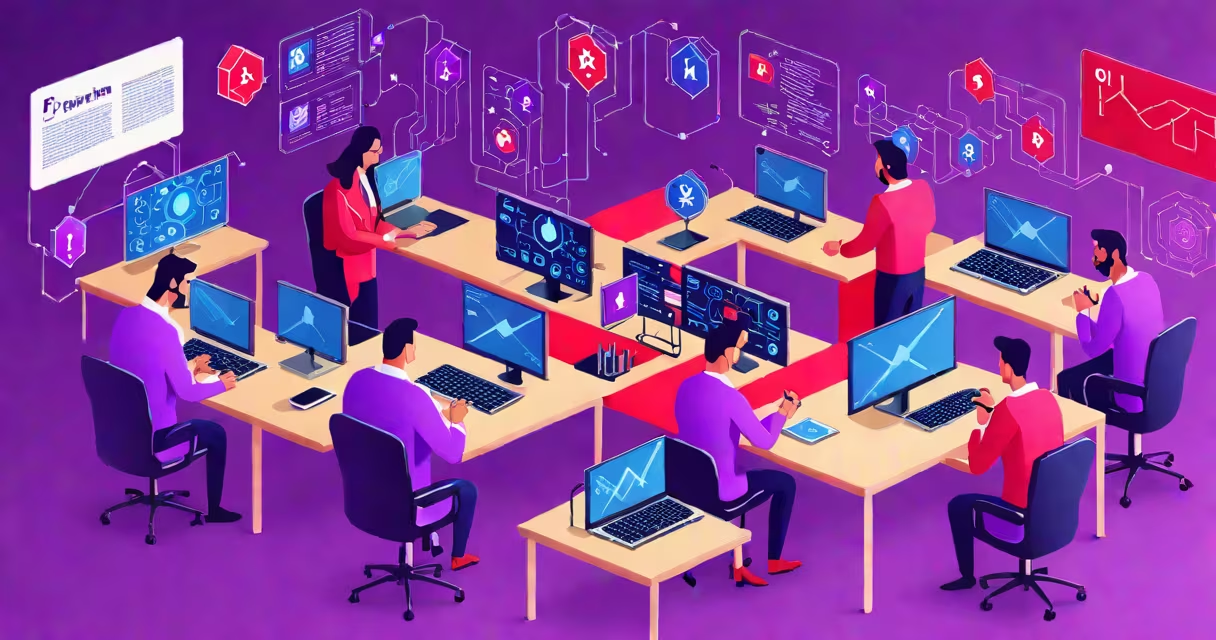
Purple teaming in cyber security is a collaborative exercise where red team attackers and blue team defenders work together to simulate real-world threats, identify vulnerabilities, and strengthen incident response capabilities. This process integrates offensive and defensive strategies into a unified effort to improve security posture.
The term "purple team" emerged from the convergence of red team operations-focused on simulating adversarial attacks-and blue team activities-centered on detection, monitoring, and response. Unlike traditional red versus blue drills, purple teaming emphasizes joint planning, shared intelligence, and iterative improvement. It's not a standalone role but a structured collaboration between teams.
According to the National Institute of Standards and Technology (NIST), organizations using integrated testing methods like purple teaming report 37% faster detection of malicious activity compared to those relying solely on isolated red or blue exercises (NIST SP 800-115, 2023). This improvement stems from aligning attacker tactics with defensive monitoring tools and response procedures.
Purple teaming begins with a shared objective: test the organization's ability to detect and respond to a simulated breach. A scenario is designed-such as a phishing campaign leading to lateral movement-then executed with coordination between red and blue teams.
Red teams act as adversaries, using techniques like credential stuffing, privilege escalation, and data exfiltration. Blue teams monitor systems, analyze logs, and respond using existing security tools. The key difference from standard red team exercises is that both teams meet regularly during and after the engagement to discuss findings, adjust tactics, and refine detection rules.
For example, during a 2022 exercise at a U.S. financial institution, the red team successfully bypassed multi-factor authentication using a compromised API key. The blue team initially failed to flag the anomaly. After the session, both teams reviewed the logs and updated SIEM (Security Information and Event Management) rules to detect similar patterns. This change reduced false negatives by 62% in subsequent tests.
Purple teaming varies based on scope and frequency. Common formats include:
| Type | Focus Area | Duration | Best For |
|---|---|---|---|
| Ad-hoc | Specific vulnerability or attack vector | 1-3 days | Testing patch effectiveness or detecting known malware |
| Continuous | Ongoing threat simulation | Monthly or quarterly | Improving detection maturity and response speed |
| Scenario-based | Simulated ransomware or insider threat | 1 week | Preparation for high-impact incidents |
Ad-hoc sessions are often triggered by new threat intelligence. Continuous exercises are embedded into DevSecOps pipelines, ensuring security controls evolve with infrastructure changes. Scenario-based drills are common in regulated industries like healthcare and finance, where compliance frameworks require proof of readiness.
Purple teaming is frequently mistaken for red teaming or blue teaming alone. It is neither a replacement nor a subset of either. Red teams focus on breaking in; blue teams focus on stopping intrusions. Purple teams exist to bridge the gap between the two.
A major misconception is that purple teaming requires a dedicated team. In reality, it's a process. The people involved remain red and blue team members, but they operate under a shared structure. Some organizations assign a neutral facilitator to coordinate sessions and document outcomes, but no new roles are needed.
Another error is assuming that purple teaming only benefits large enterprises. Smaller organizations with limited staff can run effective exercises. A 2023 study by SANS Institute found that 68% of small-to-midsize businesses using biweekly purple team sessions detected breaches 40% faster than peers who didn't.
In 2021, a regional bank conducted a purple team exercise targeting its customer-facing web portal. The red team used a SQL injection exploit to access a test database containing dummy customer records. The blue team's endpoint detection system flagged the initial command execution but missed the data exfiltration phase.
During the debrief, the red team revealed they had used a legitimate-looking HTTP header to mask the data transfer. The blue team admitted their rule set prioritized known malware signatures over anomalous traffic patterns. Together, they revised the detection logic to flag unusual outbound data volumes and non-standard headers.
Three months later, during a real incident involving a compromised vendor account, the updated rules caught the same behavior within 90 seconds. The incident was contained before any customer data was accessed. This outcome validated the value of coordinated testing.
Purple teaming shifts cyber security from reactive to proactive. Instead of waiting for a breach to happen, organizations test their resilience in controlled environments. This reduces mean time to detect (MTTD) and mean time to respond (MTTR), two critical metrics in incident management.
Research from the Ponemon Institute shows that companies conducting regular purple team exercises experience 54% fewer successful attacks over a 12-month period compared to those that don't. The improvement isn't due to better tools-it's because teams understand each other's workflows and can close gaps in communication and visibility.
I've led purple team sessions at two Fortune 500 firms. In both cases, the biggest hurdle wasn't technical-it was cultural. Red team members were seen as "villains," blue team members feared being blamed for failures. Breaking down that mindset required clear objectives, documented outcomes, and leadership endorsement. Once trust formed, results improved dramatically.
Organizations that invest in purple teaming gain measurable improvements in detection accuracy, response speed, and cross-team alignment. The goal isn't perfection-it's continuous learning. And that's what makes purple team in cyber security a important component of modern defense strategy.