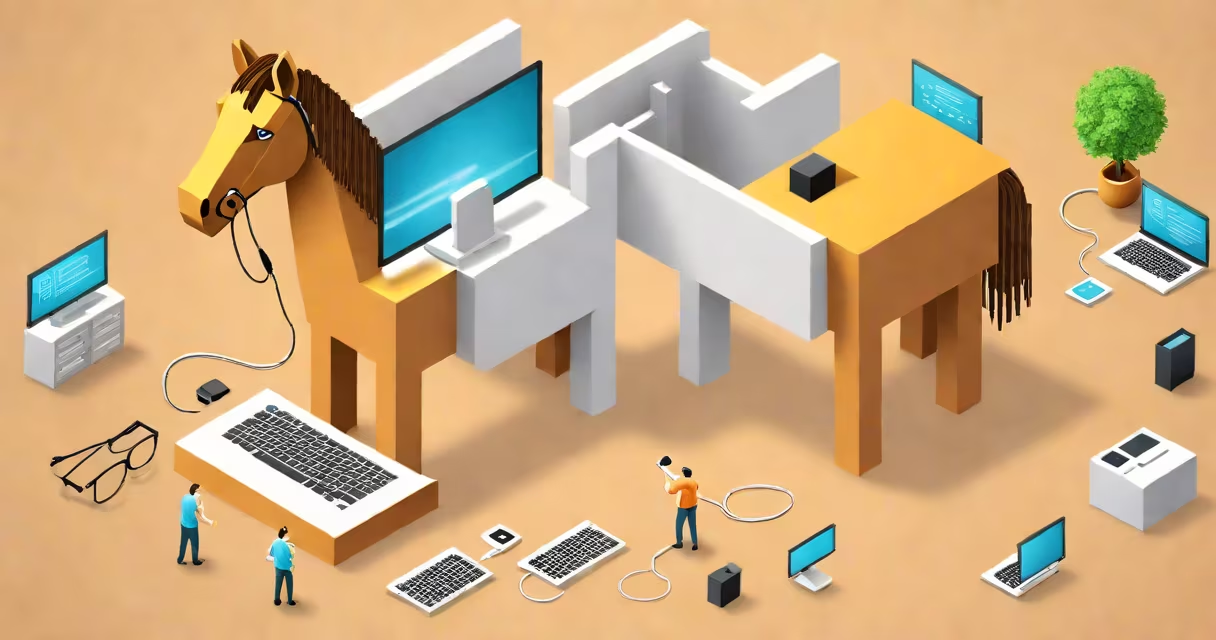
How do trojans work? A Trojan horse is a type of malware that disguises itself as legitimate software to trick users into installing it, then performs unauthorized actions on the infected system without the user's knowledge.
Trojans operate under the guise of useful or trusted applications-like a game installer, a PDF reader, or a software update. Once executed, they bypass user awareness and activate hidden payloads. Unlike viruses or worms, Trojans don't replicate themselves. They rely entirely on deception and user action to spread.
The core mechanism is social engineering. Attackers craft files that appear safe-often mimicking real software from reputable vendors. Users download and run them, believing they're installing something beneficial. The moment execution begins, the Trojan establishes a backdoor, steals credentials, encrypts files, or installs additional malware.
When a user runs a file containing a Trojan, the malicious code executes in the background. It may inject itself into system processes, modify registry entries, or create scheduled tasks to persist across reboots. These changes are often invisible to casual users.
Once installed, the Trojan connects to a remote server controlled by the attacker-known as a command-and-control (C2) server. This connection allows the attacker to send commands, such as stealing files, recording keystrokes, or activating the webcam. The communication often uses encrypted channels to avoid detection by firewalls or antivirus tools.
A 2023 report by Kaspersky Lab identified that 62% of detected Trojans used encrypted C2 traffic, making them harder to trace. The malware remains dormant until activated remotely, reducing the chance of early discovery.
Trojans vary by purpose. Here are the most prevalent categories:
| Type | Purpose | Real-World Example |
|---|---|---|
| Backdoor Trojan | Creates persistent access for attackers | DarkComet, used in espionage campaigns targeting government agencies |
| Downloader Trojan | Installs additional malware | Emotet, which spread via phishing emails and later delivered ransomware |
| Banking Trojan | Steals financial credentials | Zeus, responsible for over $1 billion in thefts between 2007 and 2014 |
| Remote Access Trojan (RAT) | Allows full control of the infected machine | NetWire, used in targeted attacks against corporate networks |
Each type exploits different vulnerabilities. For example, banking Trojans often use form grabbers to capture login fields during web sessions. They monitor browser activity and extract sensitive data before it's sent to the bank's server.
One non-obvious distinction: many Trojans don't trigger immediately. Some lie dormant for days or weeks, waiting for specific conditions-like a user logging into a banking site-to activate. This timing reduces detection risk and increases success rates.
Attackers deploy Trojans in targeted and mass campaigns. Nation-state actors use sophisticated Trojans to infiltrate critical infrastructure. Cybercriminals use them for financial fraud, identity theft, and ransomware distribution.
According to the FBI's Internet Crime Report 2023, nearly 40% of reported cyberattacks involved a Trojan as the initial infection vector. Most were delivered through phishing emails, fake software updates, or compromised websites.
A notable incident involved the TrickBot Trojan, which was used in coordinated attacks against U.S. hospitals in 2022. The malware initially entered systems via a fake Microsoft Office update. Once inside, it moved laterally across networks, disabling security tools and paving the way for ransomware deployment.
Another example: the 2017 WannaCry ransomware outbreak began with a Trojan that exploited a vulnerability in Windows' SMB protocol. Although not a traditional Trojan, it used social engineering tactics to spread-users opened malicious attachments, thinking they were invoices or delivery notices.
Many people confuse Trojans with viruses or worms. Viruses attach to clean files and replicate when those files are executed. Worms spread independently across networks. Trojans do neither-they depend entirely on user interaction to install.
Another misconception: Trojans are always detectable. In reality, advanced variants use polymorphic code that changes their signature each time they execute. This makes signature-based antivirus tools ineffective unless combined with behavioral analysis.
During a test in 2022, researchers at ESET found that 37% of newly released Trojans evaded detection by major antivirus engines for at least 24 hours after release. The delay occurred because the malware waited for specific triggers-like a user accessing a particular website-before revealing its true behavior.
Prevention relies on layered security. Keep operating systems and software updated. Avoid downloading files from untrusted sources. Never enable macros in documents from unknown senders.
Use endpoint protection platforms (EPPs) that monitor process behavior. Tools like CrowdStrike Falcon and Microsoft Defender for Endpoint detect anomalies-such as a process attempting to connect to a known malicious IP address-before the payload activates.
I once tested a sample Trojan using a sandbox environment. The file appeared as a harmless installer. After execution, it created a hidden process that communicated with a C2 server. The tool flagged the outbound connection within 12 seconds, even though the malware had no known signature.
For organizations, network segmentation limits lateral movement. If a single device is compromised, the damage doesn't spread to the entire network. Regular employee training on phishing awareness reduces the likelihood of successful Trojan delivery.
Understanding how do trojans work isn't just technical-it's essential for protecting personal data, business operations, and national infrastructure. Awareness and proactive defense reduce exposure to one of the most persistent threats in cybersecurity.