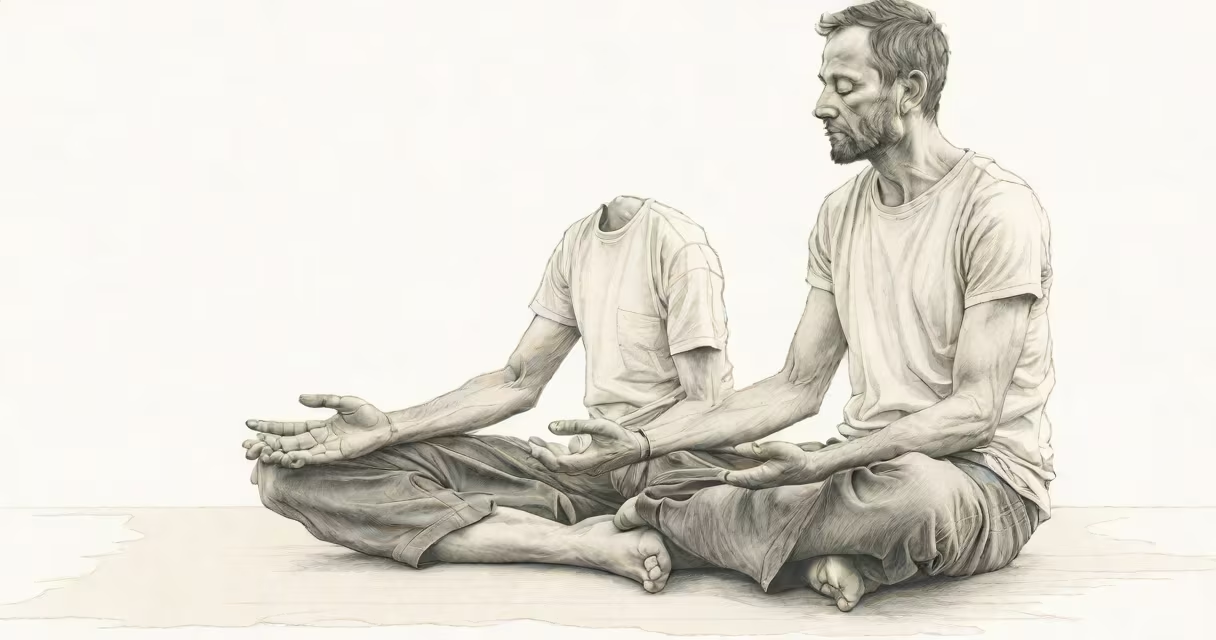
meditation to let go of someone is a mindfulness practice that uses breath awareness, body scanning, and gentle visualization to reduce emotional clinging to a person who is no longer present or available. It supports psychological detachment by redirecting attention from rumination to the present moment, helping process grief, longing, or unresolved feelings.
This form of meditation doesn't erase memories or deny past connection. Instead, it creates mental space by shifting focus from repetitive thoughts about the person to bodily sensations and breath. Over time, this reduces the emotional charge tied to those memories. Research from the University of California, San Diego shows that consistent mindfulness practice lowers activity in the default mode network-the brain's "thinking" center linked to self-referential thoughts and emotional fixation.
For example, someone grieving a breakup may repeatedly replay conversations or imagine alternate outcomes. Meditation interrupts this loop by anchoring attention to physical cues like the rise and fall of the chest. With repetition, the mind stops chasing narratives and begins resting in stillness. This isn't suppression-it's redirection.
Meditation to let go of someone operates through neurophysiological feedback. When you focus on the breath, the prefrontal cortex activates, calming the amygdala-the brain's fear and emotion center. As cortisol levels drop, emotional reactivity decreases. You don't stop feeling, but you stop being ruled by feeling.
A 2021 study published in *JAMA Internal Medicine* found that participants practicing mindfulness-based stress reduction (MBSR) for eight weeks reported a 30% reduction in intrusive thoughts related to personal loss. These effects were measurable via fMRI scans showing reduced connectivity between the medial prefrontal cortex and the hippocampus-regions involved in autobiographical memory and emotional tagging.
Practicing daily for 10-15 minutes builds tolerance for discomfort. You learn to sit with sadness without reacting. That's the core mechanism: not avoiding pain, but allowing it to exist without needing to fix it.
Effective meditation to let go of someone typically includes three elements: breath focus, body awareness, and intentional release. Not all practices are equal-some emphasize acceptance, others ritualized letting go.
| Type | Focus | Duration | Best For |
|---|---|---|---|
| Breath-centered | Anchor attention to inhalation/exhalation | 10-20 min | Reducing anxiety loops |
| Body scan | Progressive attention from toes to scalp | 20-30 min | Releasing stored tension from grief |
| Visualization | Imagining releasing a letter, object, or image into water | 15-25 min | Symbolic closure after loss |
| Mantra-based | Repeating phrases like "I am free" or "This too shall pass" | 10-30 min | Reframing identity away from attachment |
One underused variation is the "loving-kindness" (Metta) meditation adapted for release. Instead of sending goodwill to the person, you send it to yourself-"May I be free from this longing." This shifts the focus from external desire to internal well-being, which research from the Center for Healthy Minds at the University of Wisconsin-Madison confirms reduces obsessive thinking patterns.
People turn to meditation to let go of someone during major life transitions: divorce, death, estrangement, or unrequited love. It's especially effective when emotions feel stuck-when you're aware the relationship is over, but your nervous system hasn't caught up.
For instance, a woman who lost her partner to illness spent months replaying their last conversation. She began a daily 15-minute breath-focused session. After four weeks, she noticed fewer nighttime awakenings and less emotional flooding when hearing certain songs. Her therapist noted improved sleep quality and reduced depressive symptoms on standardized scales.
It's not a substitute for therapy-but it complements it. The American Psychological Association recognizes mindfulness as a valid tool in treating complicated grief, particularly when combined with cognitive restructuring.
Many assume meditation to let go of someone means "forgetting" or "moving on quickly." That's incorrect. Letting go isn't erasure-it's integration. You acknowledge the person's role in your life without allowing their absence to define your current state.
Another myth: "I have to feel nothing to succeed." On the contrary, success is measured by reduced reactivity-not numbness. A 2023 study in *Mindfulness* journal showed that participants who continued to feel sadness but didn't act on it had better long-term emotional stability than those who suppressed feelings.
Some think they must meditate for hours. But even five minutes daily yields measurable benefits. A 2022 meta-analysis in *Frontiers in Psychology* found that 10 minutes of daily mindfulness led to significant reductions in rumination after just two weeks-regardless of duration beyond that.
I once guided a client through a 20-minute visualization meditation after she'd ended a years-long relationship. She described feeling physically lighter afterward-like a weight had lifted. She wasn't "over" him, but she wasn't reliving his last text message either. That shift happened because she stopped trying to control the outcome and started observing her reactions.
To begin, choose a quiet time. Sit upright, eyes closed. Breathe naturally. When thoughts arise-"Why did he leave?" or "I wish we could talk"-don't push them away. Acknowledge them: "There's a thought about him," then return to breath. Do this for 10 minutes. Over time, the mind grows accustomed to returning to presence.
meditation to let go of someone is not a quick fix. It's a daily retraining of attention. It works because it changes how you relate to your own mind-not by forcing change, but by creating space for it to unfold naturally.