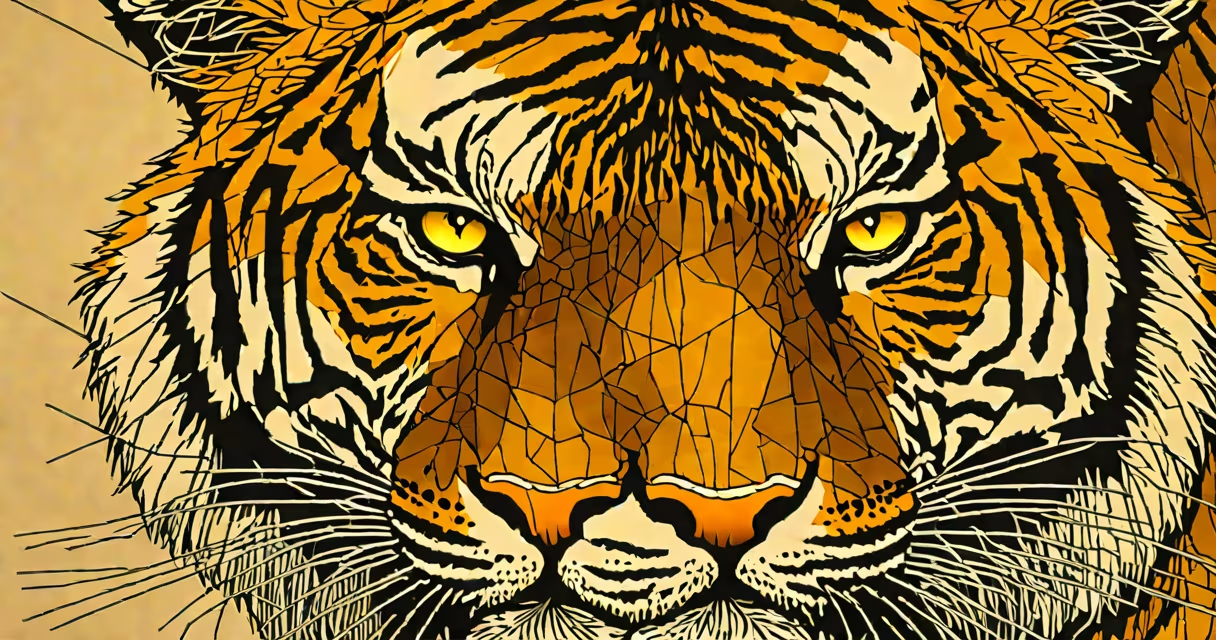
The phrase "tiger tiger burning bright" appears in William Blake's 1794 poem "The Tyger," a lyrical meditation on the nature of creation, divine power, and the coexistence of beauty and terror in the universe. It is not a standalone concept but a line within a larger work that interrogates the origin and purpose of fierce, awe-inspiring beings.
Blake wrote "The Tyger" during the late 18th century, a period marked by Enlightenment rationalism and emerging Romantic ideals. The poem uses intense visual and auditory imagery-fire, forge, hammer, and the "fearful symmetry" of the tiger-to explore the paradox of a creator who designs both gentle lambs and terrifying tigers. The speaker asks repeatedly, "Did he who made the lamb make thee?" suggesting a deep unease about whether the same divine force responsible for innocence also crafted destruction.
The line itself combines metaphor and sensory detail. "Burning bright" evokes both physical fire and spiritual intensity. Tigers in Blake's time were exotic, rarely seen in Europe, and often symbolized primal energy, danger, and untamed nature. The repetition of "tiger" emphasizes the creature's overwhelming presence. This is not a passive animal-it is active, radiant, and unnerving.
"Tiger tiger burning bright" opens the poem's central stanza and sets the tone for the entire piece. It is not merely descriptive-it is interrogative. The speaker doesn't just see the tiger; they confront it. The line acts as a rhetorical challenge: How can such a being exist?
Blake structures the poem in four-line stanzas with a strict rhyme scheme (AABB), creating a chant-like rhythm. This form mimics incantation or prayer, reinforcing the religious undertones. The repetition of "tiger" mirrors liturgical repetition, drawing attention to the creature's symbolic weight. The word "burning" suggests not just heat but transformation-like fire in alchemical tradition, which purifies and changes matter.
Consider the full stanza:
Tiger, tiger, burning bright
In the forests of the night;
What immortal hand or eye
Could frame thy fearful symmetry?
Each line builds tension. The tiger is not in a zoo or a jungle-it is in "forests of the night," a liminal space between light and dark. The question "What immortal hand or eye..." implies a creator with godlike power. Yet the speaker does not assume benevolence. The tiger's "fearful symmetry" suggests balance, order-but also dread. Symmetry in Blake's work often signals divine design, but here it feels ominous.
Blake employs several devices to deepen the line's impact. Alliteration ("tiger tiger") creates a rhythmic pulse, mimicking a heartbeat or a predator's tread. Assonance in "burning bright" reinforces the sense of flame and urgency. The repetition of "tiger" functions as anaphora-a deliberate return that forces attention on the subject.
Blake's use of enjambment allows lines to flow into each other without pause, mirroring the unstoppable force of the tiger. The lack of punctuation in the original manuscript (printed in Blake's illuminated style) gives the lines a breathless quality. Readers feel the rush of awe and fear simultaneously.
Visual art also plays a role. Blake designed and printed his poems himself using relief etching, combining text and images. In the original edition of *Songs of Experience*, the tiger is depicted with fiery eyes and a muscular form, reinforcing the idea of a living, breathing force of nature. The artwork and text are inseparable.
"Tiger tiger burning bright" is widely quoted in popular culture, often stripped of context. It appears in films, music lyrics, and advertising. For example, the 2014 film *Interstellar* references the line in a scene where a child recites it, echoing themes of cosmic wonder and existential fear.
But in academic circles, the line remains a touchstone for literary analysis. Scholars examine it through lenses of theology, psychology, and environmental ethics. Some argue the tiger represents the industrial revolution's destructive potential-the "burning" symbolizing both progress and pollution. Others interpret it as a metaphor for human ambition, particularly in science and war.
Teachers use the line to introduce students to close reading. Its brevity belies complexity. A single phrase contains questions about God, nature, violence, and beauty. It's a model of how concise language can carry profound meaning.
Many people assume "tiger tiger burning bright" is a standalone quote or a proverb. It is not. It is part of a longer poem with a specific structure and intent. Misquoting it out of context distorts Blake's message.
Another misconception is that the tiger symbolizes evil. Blake never explicitly calls the tiger evil. Instead, he presents it as a mystery-its existence demands explanation. The poem doesn't conclude with certainty. The final stanza ends with "Did he smile his work to see? / Did he who made the Lamb make thee?"-a question left unresolved.
A less obvious point: Blake wrote "The Tyger" as a companion piece to "The Lamb," published in *Songs of Innocence*. The contrast between the two poems highlights duality in human experience. The lamb represents gentleness, purity, and Christian humility. The tiger embodies strength, fear, and the unknown. Together, they form a theological inquiry: Can a single creator produce both? That tension is central to Blake's worldview.
Take the full first stanza:
Tiger, tiger, burning bright
In the forests of the night;
What immortal hand or eye
Could frame thy fearful symmetry?
Break it down:
This line is not about admiration. It's about awe mixed with anxiety. The speaker doesn't praise the tiger-they question its origin. The brilliance is not comforting. It's unsettling.
Blake was a dissident Christian. He rejected mainstream church doctrine and believed in direct spiritual vision. His poems were not devotional exercises but radical challenges to institutional religion. The tiger is not a symbol of God's goodness-it's a test of belief. The poem doesn't offer answers. It insists on asking.
As scholar Kathleen Raine noted in her 1972 biography of Blake, "Blake did not seek to comfort. He sought to awaken." The tiger is not meant to be tamed or understood easily. Its brightness is not warmth-it is threat.
I once read the poem aloud in a dimly lit classroom. As I reached "tiger tiger burning bright," a student leaned forward. The room went quiet. No one spoke for ten seconds. That silence wasn't boredom-it was recognition. The line didn't explain itself. It demanded something from the listener. That's the power of Blake's language.
| Feature | The Tyger | The Lamb |
|---|---|---|
| Opening line | Tiger, tiger, burning bright | Lamb, lamb, who made thee? |
| Imagery | Fire, forge, hammer, night forest | Spring, meadow, wool, shepherd |
| Speaker's tone | Reverent, anxious, questioning | Simple, trusting, joyful |
| Theme | Duality, creation, fear | Innocence, divinity, peace |
Together, these poems form a pair. They don't contradict-they complement. One asks, "Who made this?" The other answers, "He made me." But the tiger's maker remains unknown.
"Tiger tiger burning bright" is not a metaphor for success, motivation, or personal power. It is a line that resists easy interpretation. It belongs to a poem that refuses closure. To understand it, you must sit with the question: What kind of creator would make something so beautiful and so terrifying?