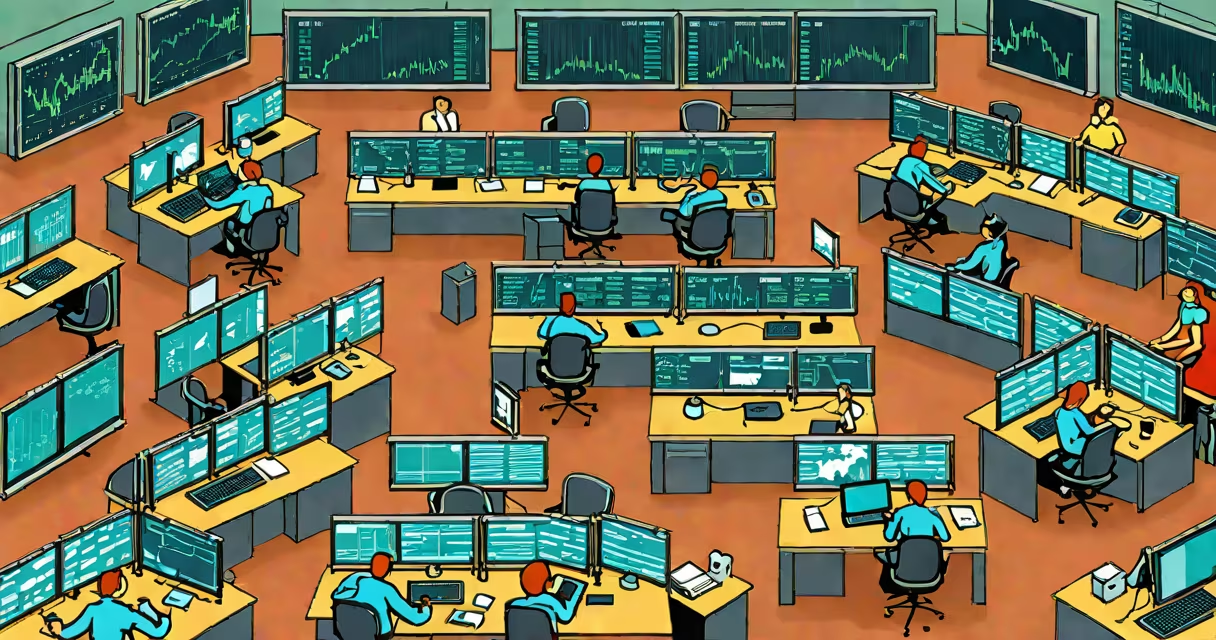
Global finance refers to the interconnected system of financial institutions, markets, and policies that enable the movement of capital, goods, and services across national borders. It operates through currencies, debt instruments, equity markets, and regulatory frameworks that coordinate economic activity on a worldwide scale.
At its core, global finance enables countries to borrow, invest, and trade beyond domestic boundaries. For example, a Japanese pension fund may purchase U.S. Treasury bonds, while a German company finances a factory expansion in Vietnam using loans from a Singapore-based bank. These transactions rely on standardized rules, trusted intermediaries, and consistent valuation methods across jurisdictions.
The system emerged from post-WWII agreements like the Bretton Woods Accords, which established the International Monetary Fund (IMF) and the World Bank to stabilize exchange rates and fund reconstruction. Today, global finance includes private actors such as multinational corporations, hedge funds, and central banks, all operating under overlapping legal and technical standards.
Capital moves across borders via foreign exchange markets, international bond issuance, and cross-border banking. Exchange rates determine how much one currency is worth relative to another. A fluctuation in the euro-to-dollar rate affects import costs for European retailers buying American electronics.
Financial institutions act as intermediaries. A U.S. investment bank may underwrite a sovereign bond issue for Nigeria, then sell it to institutional investors in Japan. This process involves credit assessments, compliance checks, and risk modeling. The bank earns fees and assumes some default risk, while the Nigerian government gains access to foreign capital.
Regulatory coordination is essential. Without shared reporting standards, fraud and mispricing could go undetected. The Basel III accords, developed by the Bank for International Settlements, set minimum capital requirements for banks globally. These rules reduce systemic risk by ensuring banks hold enough reserves to absorb losses during downturns.
Global finance rests on four pillars: financial markets, institutions, regulations, and information systems.
| Component | Function | Example |
|---|---|---|
| Foreign Exchange Markets | Enable currency conversion for trade and investment | Trading $1 billion daily between USD and JPY |
| International Financial Institutions | Provide funding and oversight for development and crisis response | IMF loan to Argentina in 2023 to stabilize inflation |
| Global Regulatory Frameworks | Standardize accounting, disclosure, and risk management | IFRS accounting standards adopted by 140+ countries |
| Clearinghouses and Payment Systems | Process large-value cross-border transfers securely | SWIFT network handles 40 million messages daily |
These systems operate under shared protocols. SWIFT, for instance, is not a bank but a cooperative owned by member banks. It transmits payment instructions in a secure format, reducing settlement delays. A transfer from a French exporter to a Brazilian importer takes seconds because both sides use the same messaging standard.
One overlooked fact: most global finance transactions do not involve physical money. Nearly 95% of daily forex volume is speculative or hedging activity, not trade-related. This means that the value of currencies often shifts based on expectations rather than actual goods movement.
People often confuse global finance with globalization itself. While related, they are distinct. Globalization refers to the integration of cultures, supply chains, and labor markets. Global finance focuses specifically on capital flows, asset pricing, and monetary coordination.
Another error is assuming that global finance is entirely driven by private markets. In reality, public institutions play a major role. The IMF provides emergency financing during balance-of-payments crises. In 2022, it approved a $6 billion loan to Sri Lanka amid a debt default threat. This intervention helped stabilize the rupee and prevent a regional contagion.
Some believe that emerging markets are passive recipients of capital. But data shows that China's Belt and Road Initiative has directed over $1 trillion in infrastructure investment abroad since 2013. These projects are funded through state-owned banks and structured as long-term debt, not equity. They reflect strategic financial planning, not just borrowing.
Consider how global finance failed during the 2008 crisis. U.S. mortgage-backed securities were sold to banks in Germany, Japan, and Australia. These institutions assumed the assets were safe due to triple-A ratings from agencies like Standard & Poor's.
When housing prices dropped, defaults surged. The value of those securities collapsed. Banks in London and Zurich reported massive losses. Central banks around the world had to inject liquidity to prevent a total freeze in interbank lending.
Central banks responded with coordinated interest rate cuts. The Federal Reserve lowered rates to near zero. The European Central Bank followed suit. These actions were not isolated-they reflected a synchronized effort to stabilize global credit markets.
Afterward, reforms like Dodd-Frank in the U.S. and MiFID II in Europe were introduced to increase transparency and reduce use. These changes illustrate how global finance adapts after systemic breakdowns.
I once observed a live simulation of a currency shock during a training session at a central bank. A fictional country experienced a sudden drop in oil exports. Within minutes, its currency fell 15% against the dollar. Traders in New York and Tokyo adjusted positions automatically. The event showed how quickly global finance reacts to real-world disruptions-even when the trigger is hypothetical.
What is global finance? It is the network of institutions, markets, and rules that allow money to flow across borders, enabling economic growth, risk sharing, and development. It functions through standardized systems, regulated institutions, and real-time data exchange. Its failure can trigger recessions; its success supports millions of jobs and stable living standards worldwide.