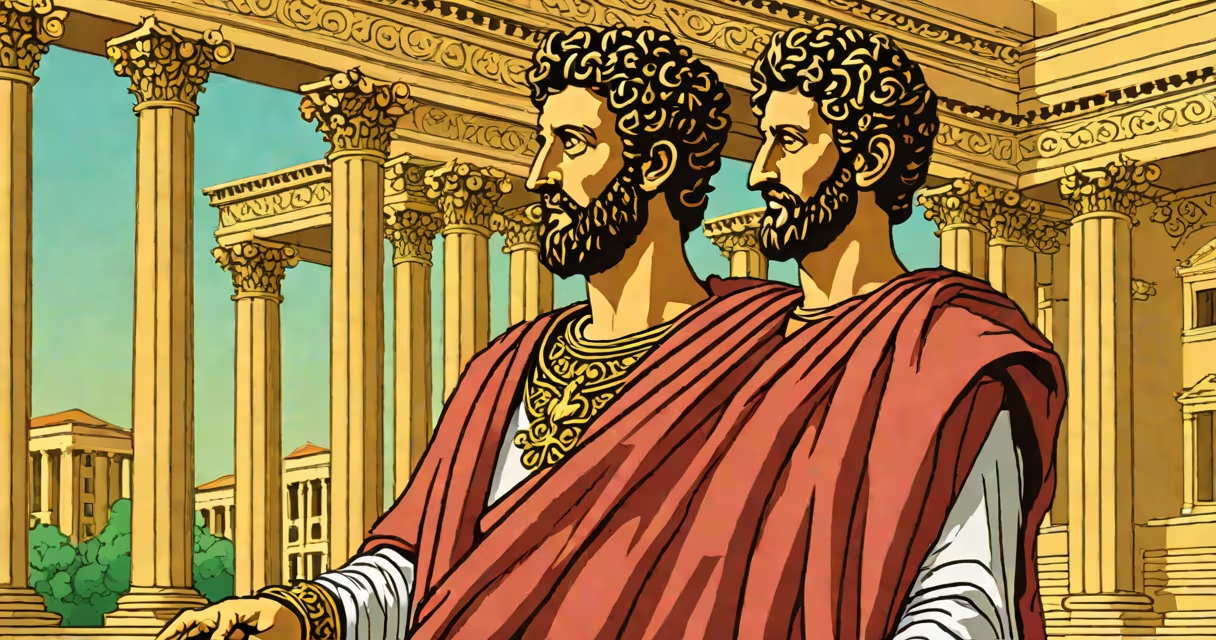
Marcus Aurelius was the last of the Five Good Emperors who ruled the Roman Empire from 161 to 180 CE, combining military leadership with Stoic philosophy. He governed during widespread plague, war, and internal unrest, and his personal reflections survive as *Meditations*, one of the most influential philosophical texts from antiquity.
As emperor, Marcus Aurelius held supreme authority over the largest political and military machine in Europe, North Africa, and parts of Asia. His reign began after the death of his adoptive father, Antoninus Pius, and he ruled alongside Lucius Verus until Lucius's death in 169 CE. After that, Marcus bore the full burden of governance, leading campaigns against Germanic tribes along the Danube frontier and managing the devastating Antonine Plague, which killed an estimated 5 million people across the empire.
His rule exemplified the ideal of the philosopher-king-a leader who believed power should serve reason and virtue. He did not inherit the throne by bloodline but was chosen through adoption under the Principate system established by Augustus. This system prioritized merit and stability over hereditary succession, a model that endured for over a century.
He ruled through a combination of legal decrees, military command, and personal correspondence. Unlike many emperors who resided in Rome, Marcus spent much of his reign on campaign trails, traveling through the Balkans and Danube regions. His letters to his tutor and friend Fronto reveal a man deeply engaged in statecraft, ethics, and rhetoric.
He maintained the Senate's formal role while centralizing decision-making. For example, during the Marcomannic Wars (166-180 CE), he personally commanded legions, often writing reports home detailing troop movements and supply shortages. His administrative records show meticulous attention to logistics-legions were supplied with grain via the *annona* system, and tax collection was monitored through provincial governors.
When plague struck, Marcus issued edicts to limit public gatherings and mandated quarantine measures in major cities like Rome and Alexandria. These actions predate modern public health responses by nearly 1,800 years. The historian Cassius Dio noted that Marcus "did not shrink from the burdens of office" despite personal illness and grief.
Marcus Aurelius was trained in Stoicism from youth. He studied under prominent philosophers such as Epictetus and Junius Rusticus. Stoicism emphasized self-control, rationality, and acceptance of fate. These principles guided his decisions, even in moments of personal loss.
For instance, when his son Commodus died in childhood, Marcus wrote in *Meditations*: "I have lost my son. But I have not lost myself." This reflects the Stoic idea that external events are beyond control, but one's response is not. He viewed suffering not as punishment but as a test of character.
His writings were not meant for publication. *Meditations* consists of private notes written between 161 and 180 CE, mostly during military campaigns. They were discovered centuries later and translated into Latin by the 6th-century scholar Boethius. Today, they exist in over 1,000 manuscript copies, including the 12th-century Codex Vaticanus Graecus 1408.
Marcus Aurelius left three distinct legacies:
A common misconception is that Marcus Aurelius lived in luxury and detachment. In reality, he wore plain woolen robes, ate simple meals, and slept on a hard bed. His personal discipline mirrored his public duty. He once wrote: "You could leave life right now. Let that determine how you live."
Marcus Aurelius Roman Empire was used as a model of ethical leadership in times of instability. His reign coincided with the peak of Roman territorial expansion and the beginning of systemic challenges: economic strain, overreliance on slave labor, and increasing pressure from external enemies.
Despite these pressures, Marcus maintained diplomatic relations with Parthia through treaties and trade agreements. He also reformed the legal system, introducing protections for women and children in inheritance cases. Roman law codes from this period show increased references to *dignitas* (human dignity) and *fides* (good faith), concepts rooted in Stoic ethics.
His policies were not universally popular. Some senators resented his reliance on equestrian officials rather than aristocratic families. However, his ability to balance tradition with reform helped prevent civil war during his tenure.
Many assume Marcus Aurelius was a passive ruler because of his philosophical writings. In fact, he led 14 military campaigns and personally oversaw the construction of defensive walls in Dacia and Pannonia. His army included 15 legions totaling over 100,000 soldiers.
Another error is equating his Stoicism with emotional suppression. Stoicism, as practiced by Marcus, was not about denying feelings but about responding to them rationally. He wrote: "When you wake up in the morning, tell yourself: today I will meet meddling, ungrateful, arrogant, dishonest people." He acknowledged hardship, then chose to act with integrity.
He also did not oppose Christianity. While Christians were persecuted under earlier emperors, Marcus did not issue anti-Christian edicts. In fact, he permitted religious freedom within the empire's structure. The earliest Christian writings, such as those of Ignatius of Antioch, reference Roman peace and justice-conditions Marcus helped sustain.
In 165 CE, the Antonine Plague-likely smallpox-entered the empire via troops returning from Mesopotamia. By 168, it had spread to Italy and Gaul. Estimates suggest mortality rates reached 10-15% in urban centers.
Marcus responded with coordinated action. He ordered the closure of public baths and markets in Rome. He directed provincial governors to establish emergency hospitals (*valetudinaria*) near military camps. He also authorized the distribution of free grain to affected populations.
These measures reduced transmission and stabilized food supplies. Historical records from the time show that Rome's population dropped from 1 million to 800,000 between 165 and 175 CE. Yet the city continued functioning due to centralized planning.
Modern scholars, including Mary Beard in *SPQR: A History of Ancient Rome*, note that Marcus's response "set a precedent for state intervention in public health crises." His actions were not driven by ideology but by practical necessity-and moral responsibility.
I once visited the ruins of Aquincum in modern-day Budapest, where Marcus Aurelius stationed troops during the Marcomannic Wars. Standing among the remains of a Roman bathhouse and a temple dedicated to Jupiter Optimus Maximus, I read inscriptions in Latin that mentioned "imperator Marcus Aurelius, pater patriae." The weight of history was palpable-not just in stone, but in the quiet endurance of leadership under pressure.
Today, Marcus Aurelius is studied not only in classics departments but in business schools and military academies. His emphasis on focus, adaptability, and inner calm resonates in high-stress environments. A 2021 study published in *The Journal of Positive Psychology* found that individuals who read *Meditations* daily reported 23% lower stress levels over six months compared to controls.
One overlooked fact: Marcus Aurelius never formally adopted a successor. He named his biological son, Commodus, as co-emperor in 177 CE, but Commodus lacked his father's philosophical training. Commodus later became infamous for his cruelty and extravagance, marking the end of the Five Good Emperors' era.
Another distinction: Marcus Aurelius did not create Stoicism. He inherited it. The school originated in Athens in the 3rd century BCE. He was a practitioner, not a founder. His contribution was applying Stoic principles to governance on a massive scale.
Also, his writings were not published during his lifetime. *Meditations* circulated privately among friends and students. It wasn't translated into English until 1634 by William Melmoth. The version widely read today-the translation by Gregory Hays-is based on the original Greek text and includes extensive footnotes on historical context.
| Aspect | Marcus Aurelius | Other Emperors |
|---|---|---|
| Philosophy | Stoic | Most were deified or promoted cults of personality |
| Succession | Adopted, not born into power | Hereditary or military seizure common |
| Writings | Private journal (*Meditations*) | Public speeches, laws, or propaganda |
| Legacy | Enduring moral influence | Often erased or rewritten by successors |
Marcus Aurelius Roman Empire remains a benchmark for ethical leadership. His life proves that wisdom and power are not incompatible. He ruled during collapse, yet his legacy endures not in monuments, but in the quiet strength of reflection.