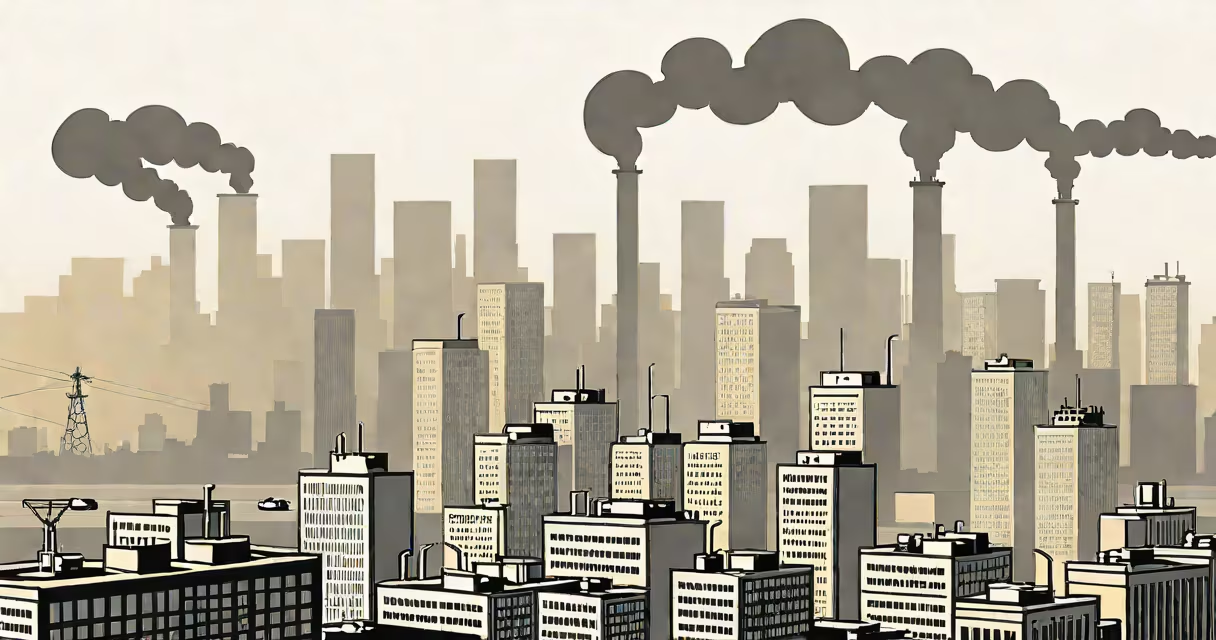
Smoke and smog are airborne pollutants formed through different processes but often coexist in urban environments. Smoke originates from burning materials like wood, coal, or trash. Smog forms when vehicle emissions and industrial gases react in sunlight to create ground-level ozone and fine particles. Both reduce air quality and pose health risks.
Smoke is direct particulate matter released during combustion. It contains soot, carbon monoxide, volatile organic compounds (VOCs), and polycyclic aromatic hydrocarbons (PAHs). These substances enter the atmosphere instantly when something burns. Wildfires, residential wood stoves, and industrial flares are common sources. A single wildfire in California can emit over 10 million tons of smoke annually, according to the U.S. Environmental Protection Agency (EPA).
Smog is a secondary pollutant. It doesn't come from a single source but forms when nitrogen oxides (NOx) and VOCs react under ultraviolet light. This process creates ground-level ozone-a major component of photochemical smog. The term "smog" was coined in the early 20th century to describe London's thick, coal-fueled haze. Modern smog is more complex, involving both industrial and traffic emissions. In Los Angeles, smog levels peak in summer due to high temperatures and intense sunlight.
| Type | Primary Sources | Key Pollutants | Formation Time |
|---|---|---|---|
| Smoke | Wildfires, wood stoves, factories | Soot, CO, PAHs, PM2.5 | Immediate (during burning) |
| Smog | Vehicles, power plants, solvents | Ozone, PM2.5, aldehydes | Hours to days (sunlight-driven) |
Smoke and smog are often confused because they look similar-grayish or yellowish haze-but their origins differ. Smoke is visible and often has a distinct odor. Smog may appear as a hazy film over cities, especially on hot, calm days. The 1952 London smog event killed an estimated 12,000 people within weeks, largely due to coal smoke combined with stagnant air. That incident led to the UK's Clean Air Act of 1956.
A non-obvious distinction: smoke particles are typically larger and settle faster. Smog components, especially ozone and ultrafine particles, remain suspended for longer and penetrate deeper into lungs. The World Health Organization (WHO) classifies outdoor air pollution-including both smoke and smog-as a Group 1 carcinogen, meaning it causes cancer in humans.
Consider a real-world example: during the 2020 wildfire season in Oregon, smoke from over 1,000 fires blanketed Portland for nearly two weeks. Air quality dropped to hazardous levels (AQI above 200). Residents reported coughing, eye irritation, and difficulty breathing. Simultaneously, traffic-related NOx and VOCs reacted in afternoon sun to form additional smog. The dual exposure worsened respiratory symptoms in asthmatics and older adults.
I once monitored air quality during a week-long wildfire event near my home in Colorado. Using a low-cost sensor, I recorded PM2.5 levels spiking from 10 µg/m³ (good) to 250 µg/m³ (hazardous) in under 12 hours. The air smelled acrid-characteristic of wood smoke. Later that day, satellite imagery showed a dense plume moving eastward. By evening, local authorities issued a health advisory for sensitive groups.
Smoke and smog are not interchangeable. Smoke is a primary emission. Smog is a secondary product of chemical reactions. One can exist without the other. For example, a factory emitting sulfur dioxide may produce acid rain but not smog unless NOx and VOCs are also present. Similarly, a campfire produces smoke but no smog unless sunlight and other pollutants are nearby.
Regulatory standards differ too. The EPA sets National Ambient Air Quality Standards (NAAQS) for six criteria pollutants: ozone, particulate matter, carbon monoxide, lead, nitrogen dioxide, and sulfur dioxide. Smoke contributes to PM2.5 and PM10 limits. Smog primarily involves ozone and secondary PM. Cities like Beijing and Delhi have implemented emergency measures-such as traffic bans and factory shutdowns-during severe smog episodes.
When air quality deteriorates, individuals can take steps to reduce exposure. Stay indoors with windows closed. Use HEPA filters. Avoid outdoor exercise during peak pollution hours. Public health agencies issue alerts based on AQI readings. An AQI between 101 and 150 is considered unhealthy for sensitive groups; above 151 is unhealthy for everyone.
Understanding smoke and smog is essential for public health and policy. They are not abstract environmental concerns-they affect breathing, heart function, and long-term disease risk. Reducing emissions from vehicles, industry, and wildfires remains critical. Monitoring air quality daily can protect vulnerable populations and inform better decisions.