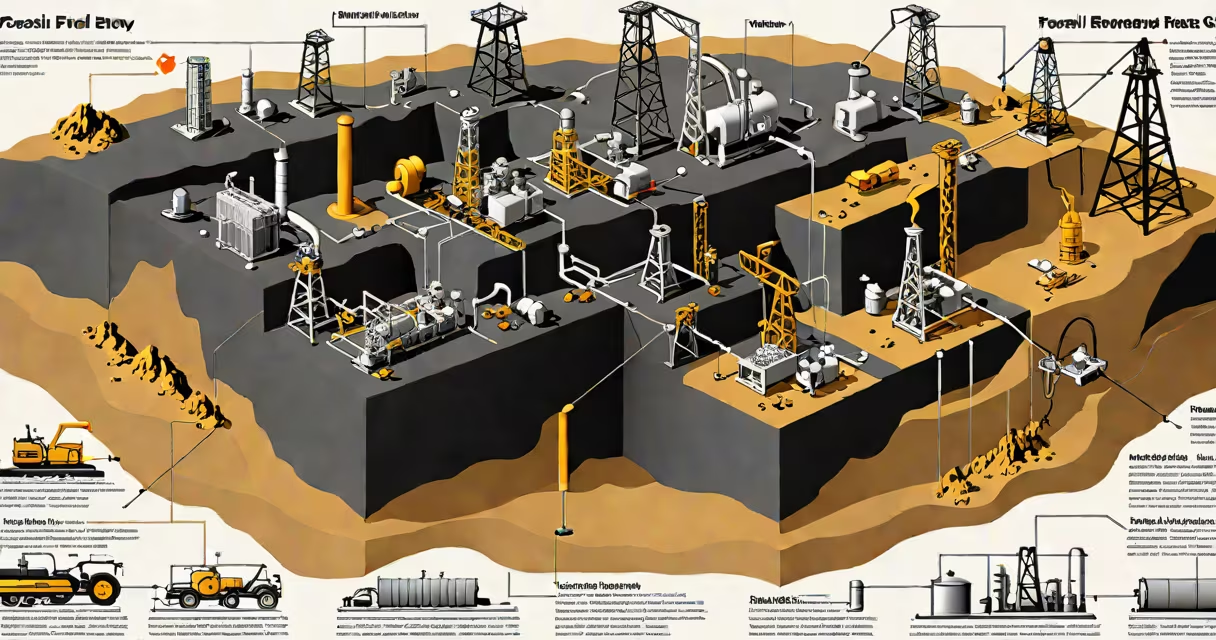
Fossil fuel energy is nonrenewable because it forms over millions of years from buried organic matter and cannot be regenerated within a human lifetime. Once extracted and burned, these resources are gone permanently.
Fossil fuels include coal, oil, and natural gas. They originate from ancient plants and microorganisms buried under sediment and compressed over geological time. Heat and pressure transformed this organic material into hydrocarbons. This process takes between 10 million and 300 million years, depending on conditions.
The U.S. Energy Information Administration (EIA) defines nonrenewable resources as those that "cannot be replenished in a short period of time." Fossil fuels meet this definition precisely. Their formation rate is negligible compared to global consumption. The EIA reports that the world consumes about 36 billion barrels of oil annually-enough to deplete known reserves in less than 50 years at current rates.
When fossil fuels burn, they release stored chemical energy as heat. This heat generates steam, which drives turbines connected to generators. The spinning magnets in the generator produce electricity through electromagnetic induction.
Coal-fired power plants operate by crushing coal into powder, then burning it in a boiler. The resulting high-pressure steam spins a turbine. Oil and natural gas follow similar paths, though gas-fired plants often use combustion turbines directly, bypassing the steam cycle.
A single 500-megawatt coal plant burns approximately 1.5 million tons of coal per year. That's equivalent to 300 freight trains loaded with coal, each train carrying 50 cars. Once burned, the carbon in that coal becomes CO₂ emissions released into the atmosphere.
There are three primary fossil fuels, each formed under different environmental conditions:
| Type | Formation Time | Primary Source Material | Energy Density (MJ/kg) |
|---|---|---|---|
| Coal | 300 million years | Terrestrial plants from swamps | 24-35 |
| Oil | 100-200 million years | Marine plankton and algae | 42-46 |
| Natural Gas | 100-300 million years | Decomposed marine organisms | 50-55 |
Each type varies in energy yield and environmental impact. Natural gas produces roughly half the CO₂ per unit of energy compared to coal. However, methane leaks during extraction and transport offset some of this advantage-methane is 80 times more potent than CO₂ over 20 years, according to the Intergovernmental Panel on Climate Change (IPCC).
Some people confuse fossil fuel energy with "carbon-neutral" or "clean" energy due to technological advances like carbon capture and storage (CCS). But CCS does not make fossil fuels renewable-it only reduces emissions from their use.
Another misconception is that fossil fuels are "infinite" because new deposits are still being discovered. While exploration continues-such as offshore drilling in the Gulf of Mexico or Arctic oil projects-these discoveries do not reverse the fundamental issue: formation time exceeds human lifespan by orders of magnitude.
Even synthetic fuels derived from fossil sources remain nonrenewable. For example, Fischer-Tropsch synthesis converts coal or natural gas into liquid fuels. These processes extend the utility of fossil feedstocks but do not create new ones. The U.S. Department of Energy confirms that synthetic fuels based on fossil inputs are classified as nonrenewable under federal energy standards.
Consider the North Sea oil fields, which began production in the 1970s. The UK government projected peak output around 2000. By 2023, production had declined by over 70% from its peak. Despite advanced drilling techniques, the reservoirs are depleting. Once depleted, they won't refill in any meaningful timeframe.
Similarly, the Powder River Basin in Wyoming holds one of the largest coal reserves in the U.S. Over 200 million tons were mined annually in the early 2000s. Projections suggest remaining recoverable reserves will last about 200 years at current usage. But that timeline assumes no increase in demand-and no climate policy changes.
I once visited a coal mine in West Virginia where the manager showed me a core sample from a seam dated 300 million years old. He said, "This layer was laid down when dinosaurs roamed. We're using it now-but we didn't create it. We're just spending it." That moment clarified the nonrenewable nature of fossil fuel energy: it's not a resource we control, but one we consume.
Fossil fuel energy differs sharply from truly renewable sources like solar, wind, and hydropower. These renew daily or seasonally. Solar energy, for example, arrives continuously from the sun-over 173,000 terawatts strike Earth every second, far exceeding global energy demand.
Renewables are not limited by geological time. A solar panel installed today will generate electricity for 25-30 years. After that, it can be recycled. Fossil fuels have no such lifecycle reversal. Once burned, they are gone.
For context, the International Renewable Energy Agency (IRENA) reports that solar and wind capacity grew by 12% globally in 2023 alone. Meanwhile, fossil fuel use rose slightly in some regions due to economic recovery post-pandemic. This divergence underscores the irreversible nature of fossil fuel consumption.
Some argue that fossil fuels are better than renewable energy for grid stability and industrial use. While they offer consistent output, this argument ignores long-term risks. The IPCC warns that continued reliance on fossil fuels increases climate instability, leading to higher costs in adaptation and disaster response. The trade-off is not efficiency-it's survival.
Fossil fuel energy is nonrenewable. Its origins lie in ancient ecosystems, and its depletion is irreversible on human timescales. Transitioning to renewable systems is not optional-it's necessary for planetary resilience.