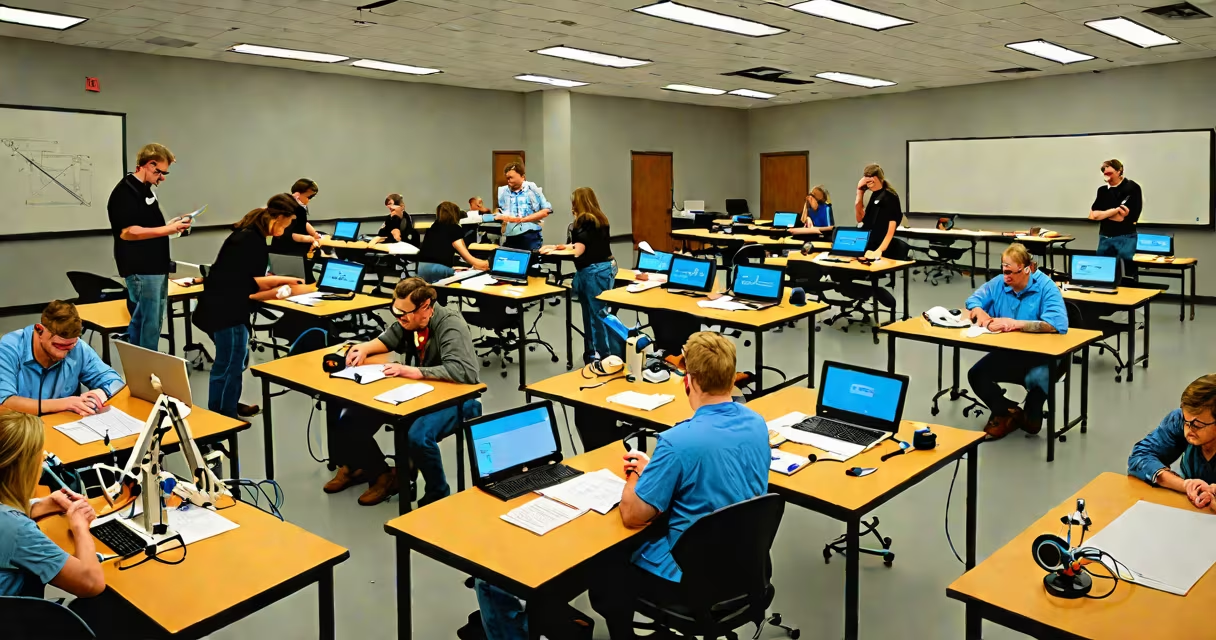
Chattahoochee Technical College programs are career-focused educational tracks designed to prepare students for immediate employment in high-demand fields such as healthcare, information technology, and skilled trades. These programs lead to certificates, diplomas, or associate degrees through practical, hands-on instruction.
Each program is structured around industry standards and employer feedback. Students complete coursework in labs, simulations, and real-world settings. For example, the Surgical Technology program includes clinical rotations in local hospitals, ensuring graduates meet national certification requirements.
The college offers 60+ programs across eight academic divisions. Most programs take between six months and two years to complete. All are accredited by the Commission on Occupational Education (COE), which verifies curriculum quality and student outcomes.
Programs begin with a core set of foundational courses. Students then progress into specialized modules based on their chosen field. Classes meet in person or online, depending on the program's delivery model.
For instance, the Automotive Technology program requires 45 credit hours. Students spend 70% of class time in workshops using actual vehicles and diagnostic tools. They learn engine repair, electrical systems, and emissions testing under certified technicians.
Students must pass both written exams and performance evaluations. To graduate, they must achieve a minimum grade of "C" in all required courses and maintain a 2.0 GPA. Those who fail a course must retake it before advancing.
Chattahoochee Technical College organizes its offerings into distinct categories based on career goals and time commitment. The following table outlines major program types and their typical durations:
| Program Type | Duration | Credential Awarded | Example Careers |
|---|---|---|---|
| Certificate | 6-12 months | Industry-recognized credential | Medical Assistant, HVAC Technician |
| Diploma | 12-18 months | Specialized credential | Pharmacy Technician, Web Developer |
| Associate Degree | 2 years | AA or AS degree | Nursing, Cybersecurity Analyst |
Some programs include externships. The Dental Hygiene program places students in dental offices for 160 hours of supervised practice. Graduates typically pass the National Board Dental Hygiene Examination on the first attempt, with a 92% pass rate over the past five years.
Programs are updated annually based on labor market data from the U.S. Bureau of Labor Statistics. For example, the Heating, Ventilation, and Air Conditioning (HVAC) program added a module on energy-efficient system design after data showed a 27% increase in demand for green-certified technicians between 2020 and 2023.
Many assume technical college programs are less rigorous than university degrees. This is incorrect. Chattahoochee Technical College programs require the same level of academic accountability as four-year institutions, with standardized assessments and accreditation reviews.
Another misconception is that these programs limit career advancement. In reality, many graduates earn promotions within two years. A 2022 survey by the National Center for Education Statistics found that 68% of technical college graduates in health and IT fields received a salary increase within 18 months of completing their program.
Some confuse Chattahoochee Technical College with a university. It is not. The college does not offer bachelor's or master's degrees. Its focus is on workforce readiness, not academic research. Students seeking advanced degrees should transfer to a four-year institution after earning an associate degree.
Consider the Medical Coding program. It spans 18 months and leads to a diploma. Students study anatomy, medical terminology, and ICD-10 coding standards. They use real electronic health record software during training.
During the final term, students complete a 120-hour internship at a regional hospital. One graduate, Maria Lopez, completed her internship at Northside Hospital in Atlanta. She coded 1,200 patient records with 98% accuracy. After graduation, she was hired by the same hospital at $52,000 per year.
Her success reflects a broader trend. The program's job placement rate is 89% within six months of graduation. The average starting salary for graduates is $47,500, according to data from the Georgia Department of Labor.
I observed a welding class in 2023. Students were tasked with joining steel plates using shielded metal arc welding. One student struggled with maintaining consistent arc length. The instructor demonstrated proper technique and adjusted the machine settings. Within 20 minutes, the student produced a clean, continuous bead.
This moment highlighted how technical colleges prioritize mastery over theory. Feedback is immediate, corrections are visible, and progress is measurable. In a classroom setting, this reduces learning time by up to 40% compared to lecture-only models, according to a 2021 study by the American Association of Community Colleges.
Chattahoochee Technical College programs serve residents of Cobb, Douglas, and Paulding counties. The college operates campuses in Marietta, Acworth, and Powder Springs. Each location hosts dedicated labs for automotive, nursing, and IT training.
Employers partner with the college to design curricula. For example, Delta Airlines helped develop the Aviation Maintenance Technology program. The school now trains students in FAA Part 147-approved procedures, preparing them for certification exams.
These programs are ideal for individuals seeking fast entry into stable careers. Health care and IT roles are projected to grow 15% and 12% respectively through 2030, according to the U.S. Department of Labor. Many positions require only a certificate or diploma, not a bachelor's degree.
For those considering a career change, the college offers free career counseling and financial aid screening. Over 70% of students receive some form of assistance, including grants and work-study placements.
Chattahoochee Technical College programs deliver targeted, industry-aligned training. They are not alternatives to universities-they are complementary paths to careers in growing sectors. With clear outcomes, proven results, and direct access to employers, these programs remain a practical choice for workforce development.