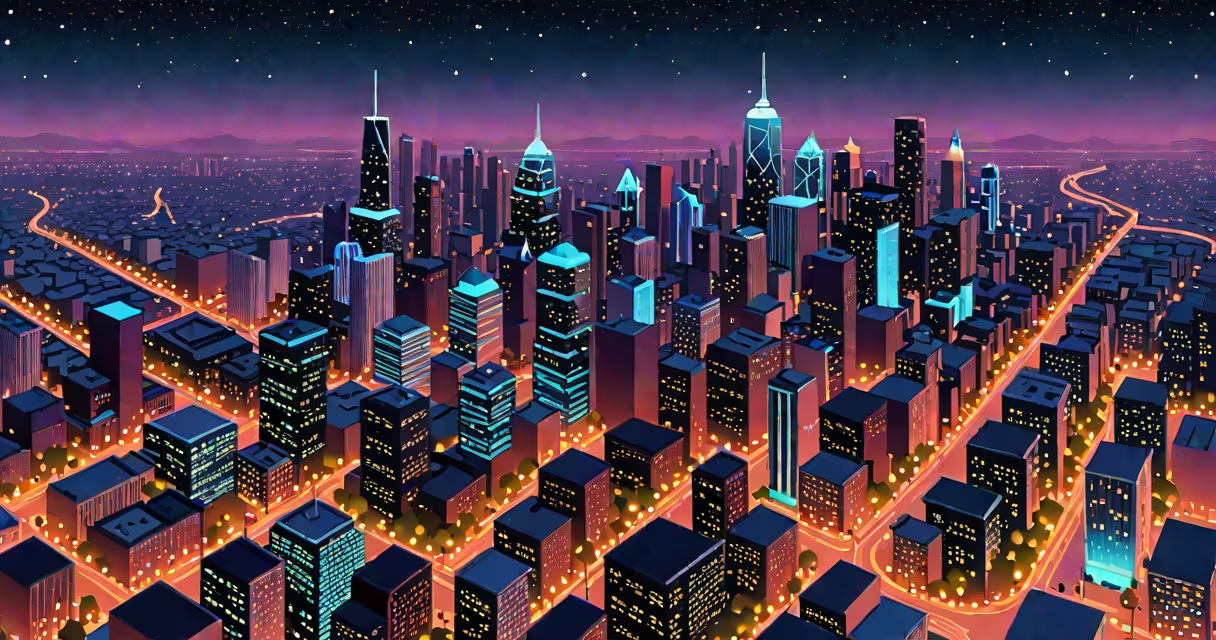
Light pollution arises from poorly designed or excessive artificial lighting that spills into the night environment, degrading visibility of the night sky and disrupting natural systems. It results from urban development, inadequate shielding on outdoor fixtures, and over-illumination of public and private spaces.
The core issue lies not in light itself, but in how it's emitted. When lights shine upward or sideways instead of downward, they scatter in the atmosphere and create skyglow-the luminous haze seen over cities. This phenomenon begins with streetlights, building facades, parking lots, and signage that lack proper shielding or are left on unnecessarily.
According to the International Dark-Sky Association, over 80% of the global population lives under light-polluted skies, with nearly 100% of people in North America and Europe exposed. These figures reflect widespread human activity rather than natural conditions. Light pollution is not a single source-it's a cumulative outcome of infrastructure choices made over decades.
Artificial light becomes pollution when it escapes its intended purpose. A streetlamp meant to explain a sidewalk emits light upward and sideways due to poor design. That light scatters in the atmosphere, bouncing off particles and clouds, and returns to ground level as diffuse brightness. This scattered light is skyglow-the most visible form of light pollution.
Another form is glare, which occurs when intense light sources overwhelm the eye. Glare reduces visibility and increases accident risk. For example, unshielded high-intensity discharge (HID) lamps on highways create blinding reflections that impair drivers' ability to see obstacles.
Light trespass happens when light crosses property lines. A neighbor's security floodlight shining into your bedroom window is a common example. This disrupts sleep patterns and violates personal privacy. The U.S. National Park Service reports that 90% of national parks now suffer from significant light intrusion, affecting both wildlife and visitor experience.
Light pollution originates from several categories of artificial lighting:
| Type | Source | Impact |
|---|---|---|
| Skyglow | Streetlights, stadiums, large buildings | Obscures stars; affects nocturnal animals |
| Glare | Unshielded LED or HID fixtures | Impairs vision; causes discomfort |
| Light Trespass | Security lights, residential LEDs | Disrupts sleep; invades privacy |
| Clutter | Over-lit commercial zones, billboards | Confuses navigation; wastes energy |
LEDs have intensified the problem. While efficient, white LEDs emit high levels of blue light-around 450 nanometers-which scatters more easily in the atmosphere than longer wavelengths. This increases skyglow by up to 20% compared to older sodium-vapor lamps, according to a 2021 study published in *Science Advances*.
Urban expansion compounds the issue. Cities grow outward, adding more lighting infrastructure. In Los Angeles, satellite data shows a 12% increase in nighttime brightness between 2012 and 2020, despite city efforts to reduce emissions. This growth is driven by new construction, retail developments, and expanded road networks.
Many assume light pollution is only a concern in big cities. In reality, rural areas face rising threats. Suburban sprawl brings streetlights and home security systems to previously dark regions. A 2020 report from the University of Exeter found that 60% of UK countryside areas now show measurable skyglow, primarily due to nearby towns expanding.
Another misconception is that turning off lights at night solves the problem. Simply switching off lights doesn't eliminate existing skyglow, which persists for minutes to hours after emission stops. The atmosphere retains scattered light., many lights remain on 24/7 for safety or convenience, contributing to continuous pollution.
A lesser-known fact: light pollution alters animal behavior at scale. Sea turtles hatch on beaches and instinctively move toward the brightest horizon-usually the ocean. But coastal lighting confuses them. In Florida, researchers documented a 40% reduction in successful hatchling releases in areas with high light exposure. Similar disruptions occur in birds, bats, and insects.
Flagstaff, Arizona, is a model for light pollution control. Designated a UNESCO International Dark Sky City in 2001, it implemented strict lighting ordinances requiring full cutoff fixtures and limiting brightness to 20 candela per square meter.
Before the regulations, Flagstaff's night sky was dimmed by outdated streetlights and unshielded signs. After implementation, skyglow decreased by 35% within five years. The Lowell Observatory reported a 50% improvement in visibility of faint celestial objects.
The city did not sacrifice safety. Crime rates remained stable, and emergency response times were unaffected. This proves that effective lighting design can balance safety, energy efficiency, and ecological protection.
When I visited Flagstaff in 2022, I stood on a hillside near the town center and saw the Milky Way -something impossible in most major cities. The contrast was striking. I had to remind myself that this view wasn't natural; it was restored through policy.
Exposure to artificial light at night suppresses melatonin production in humans. The World Health Organization classifies shift work involving night light as a probable carcinogen due to disrupted circadian rhythms. Long-term exposure correlates with higher risks of breast and prostate cancer, according to a 2018 meta-analysis in *The Lancet Oncology*.
Ecologically, light pollution disrupts migration. Birds using star patterns for navigation collide with illuminated buildings. The Cornell Lab of Ornithology estimates that up to 1 billion birds die annually in North America from such collisions-many during spring and fall migrations when skies are lit by cities.
Plants also suffer. Some species rely on darkness to trigger flowering. Artificial light can delay or prevent blooming, affecting pollinators and food chains. A 2023 study in *Nature Ecology & Evolution* showed that urban trees flowered up to three weeks earlier than rural counterparts due to nearby lighting.
Fixing the root causes of light pollution requires engineering, regulation, and public awareness. Full cutoff fixtures-those that direct light downward-reduce skyglow by up to 90%. Using warmer color temperatures (below 3000K) minimizes blue light emission, reducing atmospheric scattering.
Smart controls like motion sensors and timers prevent unnecessary lighting. Cities like Tucson and San Diego have adopted curfews on non-essential outdoor lighting after midnight. These policies cut energy use by 15-25% while improving nighttime quality.
The cause of light pollution is not a single device or behavior. It's a system failure: lighting designed for visibility without regard for context, duration, or direction. Solving it demands intentional design, better standards, and cultural shifts toward respecting darkness as a resource.