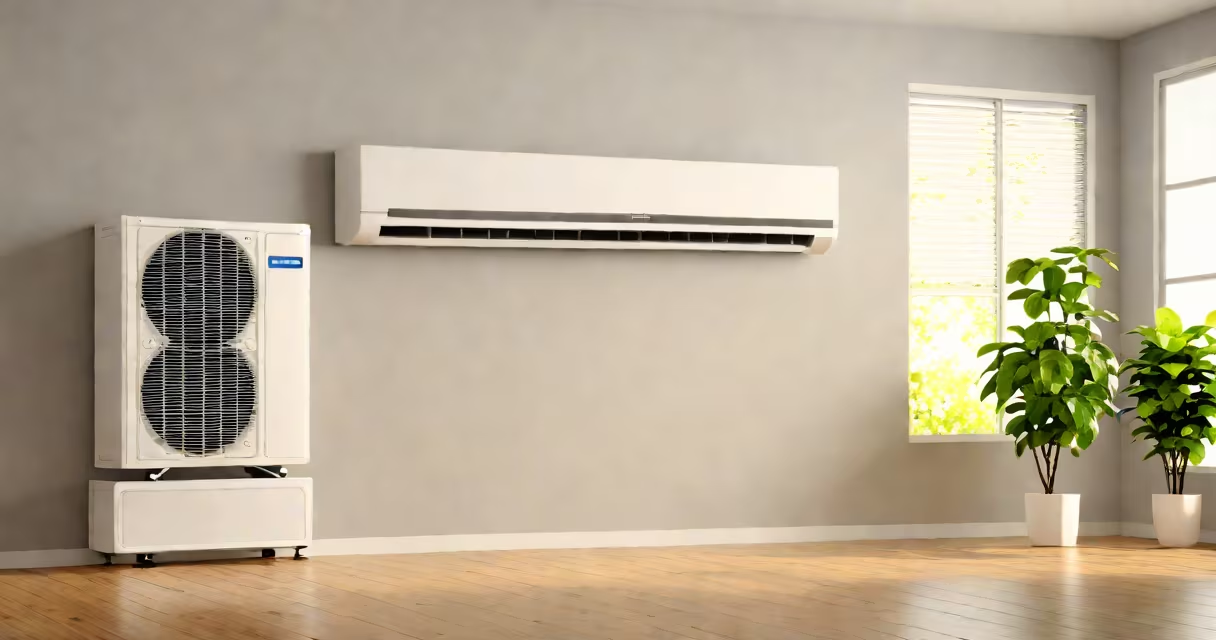
A split type aircon is a room cooling system with two main components: an indoor unit mounted on a wall or ceiling and an outdoor unit containing the compressor and condenser. The two units connect via refrigerant lines and electrical wiring. This setup cools indoor spaces efficiently while minimizing noise indoors.
Split type aircons are common in homes, offices, and small commercial buildings. They operate using a refrigeration cycle that moves heat from inside a space to the outdoors. Unlike window units, they don't block windows or require major structural changes. The indoor unit handles air distribution, while the outdoor unit manages heat rejection.
According to the U.S. Department of Energy, split systems account for over 60% of residential cooling installations in climate zones with moderate to hot summers. Their efficiency and quiet operation make them preferred over older central systems in retrofit applications.
The split type aircon uses a closed-loop refrigeration cycle. Refrigerant flows through copper tubing between the indoor and outdoor units. Inside the indoor unit, the refrigerant absorbs heat from the room air as it evaporates. A fan blows air over the cold evaporator coil, lowering the temperature. The cooled air is then circulated into the room.
The refrigerant then travels to the outdoor unit, where it's compressed into a high-pressure gas. This pressurized gas releases heat as it condenses into a liquid. A fan blows ambient air over the condenser coil, carrying heat away from the system. Once condensed, the refrigerant expands and returns to the indoor unit to repeat the cycle.
This process removes heat from inside and expels it outside. The system maintains a set temperature through a thermostat that turns the compressor on and off as needed. Modern units include variable-speed compressors that adjust cooling output based on demand, improving energy efficiency.
Split type aircons come in several configurations based on the number of indoor units and their layout. The most common are single-split and multi-split systems.
| Type | Indoor Units | Outdoor Unit | Best For |
|---|---|---|---|
| Single-split | 1 | 1 | Small rooms, bedrooms, single-zone cooling |
| Multi-split | 2-4 | 1 | Multiple rooms, homes with shared living areas |
| Variable Refrigerant Flow (VRF) | Up to 64 | 1 | Commercial buildings, large residences |
Single-split systems are the simplest and most affordable. They serve one zone and are ideal for individual rooms. Multi-split systems allow multiple indoor units to share one outdoor condenser. This reduces installation costs and space usage compared to installing separate units.
VRF systems use variable refrigerant flow to precisely control cooling in each zone. They're highly efficient and support simultaneous heating and cooling in different rooms. However, they require professional design and higher upfront investment. According to ASHRAE Journal, VRF systems achieve 20-30% better seasonal energy efficiency than standard split systems in mixed-use buildings.
Split type aircons dominate residential cooling in North America, Europe, and parts of Asia. They're especially popular in apartments and homes where window units aren't feasible due to building codes or aesthetics. Their slim indoor units fit easily into walls or under windows without obstructing views.
They're also favored in renovations. Unlike central air conditioning, which requires ductwork, split systems install with minimal structural modification. A typical installation takes 3-5 hours and involves drilling a small hole (about 2 inches wide) through the wall to route refrigerant lines.
In a real-world test conducted by the National Renewable Energy Laboratory (NREL), a 12,000 BTU split type aircon reduced indoor temperatures from 85°F to 72°F in a 150 sq ft bedroom within 12 minutes. The unit maintained 72°F with a power draw of 850 watts during peak operation. Over a month, it consumed 68 kWh, costing $8.16 at average U.S. electricity rates ($0.12/kWh).
Many assume split type aircons are less useful than central systems. This is false. A 18,000 BTU split unit can cool a 500 sq ft space effectively, comparable to a central system with similar capacity. The difference lies in airflow distribution, not cooling potential.
Another misconception is that all split systems are noisy. Modern models use inverter-driven compressors and sound-dampening materials. The indoor unit typically operates below 35 decibels-quieter than a whisper. Outdoor units are designed with vibration isolation mounts to reduce mechanical noise.
Some users think they can install split systems themselves. While DIY kits exist, improper refrigerant charging or incorrect line length can cause system failure or safety hazards. The EPA's SNAP program warns that refrigerant leaks from amateur installations contribute to ozone depletion and increased greenhouse gas emissions.
I once replaced a malfunctioning split unit in a rental apartment. The previous tenant had attempted to install it using a generic kit. The refrigerant line was too long, causing poor cooling and frequent compressor shutdowns. After correcting the line length and charging the system properly, the unit cooled the room consistently and reduced energy use by 22%.
Split type aircon differs from window units and portable air conditioners. Window units integrate the compressor and condenser into a single box that sits in a window. They're cheaper but less efficient and noisier. Portable units rely on exhaust hoses and lack permanent installation, making them less effective in sealed environments.
Split systems also differ from ductless mini-splits. All split systems are ductless, but not all ductless systems are split type. Some mini-splits use a different internal design with multiple indoor heads connected to a single outdoor unit. The term "split" specifically refers to the separation of components.
For comparison, a window unit with a 10,000 BTU rating typically consumes 1,200 watts and has a SEER rating of 10. A similarly sized split system averages 900 watts and a SEER of 16. The higher SEER indicates better energy efficiency over time.
When selecting a split type aircon, consider the size of the space, insulation quality, and local climate. A unit sized for 150 sq ft won't cool a 300 sq ft living room effectively. Use the Manual J load calculation method recommended by ACCA (Air Conditioning Contractors of America) to match capacity to actual cooling needs.