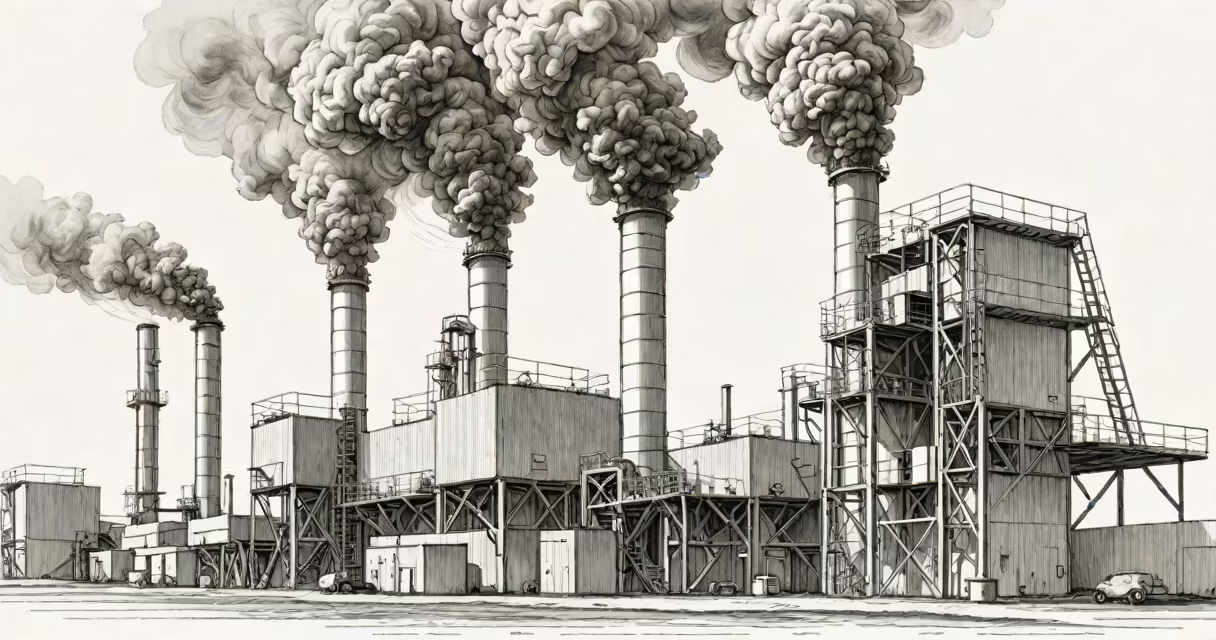
Waste heat is thermal energy produced as a byproduct of industrial, mechanical, or electrical processes that is not used for its intended purpose and is typically released into the environment. It arises from inefficiencies in energy conversion, such as in engines, power plants, and manufacturing systems.
Every time energy changes form-mechanical to thermal, electrical to heat-some energy escapes as heat. This heat often goes unused. For example, a car engine converts only about 30% of fuel energy into motion; the rest becomes waste heat expelled through the exhaust and radiator. The U.S. Department of Energy estimates that nearly 20% of industrial energy use ends up as waste heat, equivalent to 1.5 quadrillion BTUs annually-enough to power millions of homes.
Waste heat is not inherently harmful, but its release represents lost opportunity. Unlike useful work, waste heat cannot be fully converted back into mechanical or electrical energy due to the laws of thermodynamics. The Second Law of Thermodynamics states that entropy-the measure of disorder-always increases in isolated systems. As a result, energy transformations are irreversible, and some heat must be discarded.
Waste heat emerges whenever energy is transformed. Common sources include internal combustion engines, electric motors, refrigeration systems, and power generation. In a typical gas turbine power plant, only 40-60% of fuel energy becomes electricity; the remainder exits as hot exhaust gases.
Even electronic devices generate waste heat. A computer's CPU can reach 80°C under load, requiring cooling fans or liquid cooling systems to prevent damage. Without active cooling, components degrade faster and fail prematurely. Data centers, which house thousands of servers, consume vast amounts of electricity and emit enormous quantities of waste heat-up to 50% of their total energy input.
Thermal losses occur due to resistance, friction, and imperfect insulation. In a motor, electrical resistance in windings generates heat. In a transmission, gear meshing creates friction. These losses are unavoidable but manageable. Engineers design systems to minimize them, yet some waste heat remains inevitable.
Waste heat varies by temperature and application. High-grade waste heat exceeds 150°C and is suitable for direct reuse. Medium-grade ranges from 60-150°C. Low-grade is below 60°C and harder to recover efficiently.
| Type | Temperature Range | Common Sources | Recovery Potential |
|---|---|---|---|
| High-grade | ≥150°C | Steel mills, glass furnaces, gas turbines | High-can drive steam turbines or provide process heating |
| Medium-grade | 60-150°C | Food processing, paper mills, HVAC systems | Moderate-ideal for absorption chillers or drying |
| Low-grade | <60°C | Computer servers, air conditioners, water heaters | Low-requires specialized tech like heat pumps |
For example, a cement kiln operates at 1,400°C. Exhaust gases leave at around 300°C-high-grade waste heat. Modern plants capture this via heat exchangers to preheat incoming raw materials, reducing fuel use by 15-20%. The International Energy Agency reports that such recovery can cut CO₂ emissions by up to 10% in heavy industry.
A lesser-known fact: waste heat from data centers is increasingly being repurposed. In Stockholm, Sweden, a data center near the city's central district feeds excess heat into the local district heating network. Over 100,000 residents receive warmth from server racks that would otherwise cool with massive fans and chillers. This system saves 12,000 tons of CO₂ annually-equivalent to removing 2,500 cars from the road.
Several technologies reclaim waste heat. Heat exchangers transfer thermal energy between fluids without mixing them. They're used in HVAC systems, industrial boilers, and power plants. A shell-and-tube heat exchanger in a refinery transfers heat from hot oil to cooler feedstock, improving efficiency.
Organic Rankine Cycle (ORC) systems convert low- to medium-grade waste heat into electricity. They use organic fluids with low boiling points, such as pentane or R-134a, instead of water. When heated, these fluids vaporize and spin a turbine. ORC units can operate at temperatures as low as 100°C. A 50-kW ORC system installed at a brewery in Germany recovers heat from fermentation tanks, generating enough electricity to power 15 homes annually.
Heat pumps reverse the cooling cycle to move heat from low-temperature sources to higher ones. They're effective for low-grade waste heat. A commercial building in Seattle uses a ground-source heat pump to extract warmth from wastewater at 12°C and deliver it at 45°C for space heating. The system cuts annual heating costs by 40%.
Despite these advances, recovery rates remain low. The U.S. Energy Information Administration notes that less than 10% of industrial waste heat is currently captured. Barriers include high upfront costs, lack of standardized integration, and fragmented ownership models in multi-tenant facilities.
Many assume waste heat is purely a problem. But it's not. It's a resource. Some view it as "free" energy, but that's misleading. Capturing it requires infrastructure, maintenance, and energy for pumping or compressing fluids. The cost-benefit ratio must be positive for recovery to make sense.
Another misconception: waste heat is always low-quality. Not true. High-grade waste heat can replace fossil fuels in industrial processes. A steel mill in Ohio replaced natural gas burners with waste heat from blast furnaces, cutting fuel consumption by 28% and saving $1.2 million annually.
Some confuse waste heat with thermal pollution. While both involve heat discharge, they differ in intent and impact. Thermal pollution refers to environmental harm from heated water discharged into rivers-like from power plants. Waste heat is a byproduct of energy use, not necessarily a pollutant. However, unchecked release contributes to urban heat islands and climate change.
Consider a food processing plant in Wisconsin that produces 10,000 kg/hour of pasteurized milk. The pasteurization process uses steam at 130°C. After heating, the milk cools from 75°C to 4°C using chilled water. The cooling water absorbs heat and exits at 35°C-medium-grade waste heat.
The plant installs a plate heat exchanger to transfer heat from the cooling water to incoming raw milk. The raw milk enters at 4°C and exits at 30°C-preheated by 26°C. This reduces the steam required for pasteurization by 35%. Annual savings: 120,000 kWh of electricity and 180,000 MJ of steam. Payback period: 2.3 years.
Without this system, the cooling water would flow to a drain or cooling tower. Now, it's reused to reduce energy demand. The facility also avoids 150 metric tons of CO₂ emissions yearly-equal to planting 3,700 trees.
I've seen this setup firsthand during a site visit. The heat exchanger was compact, mounted beside the cooling loop. Operators monitored temperature differentials in real time. One engineer noted: "We didn't think we'd save much. But the numbers added up fast."
Waste heat represents a major untapped energy stream. Recovering it improves energy efficiency, reduces greenhouse gas emissions, and lowers operating costs. The European Union's Horizon 2020 program funds projects to scale waste heat recovery in manufacturing. The U.S. Department of Energy's Advanced Manufacturing Office supports pilot programs in sectors like chemicals and textiles.
When waste heat is ignored, energy is wasted. When it's captured, systems become smarter and more sustainable. For example, a factory that recovers 20% of its waste heat can reduce its carbon footprint by 10-15%, depending on the fuel mix.
Waste heat is not just leftover energy. It's a signal of inefficiency-and an opportunity for improvement.