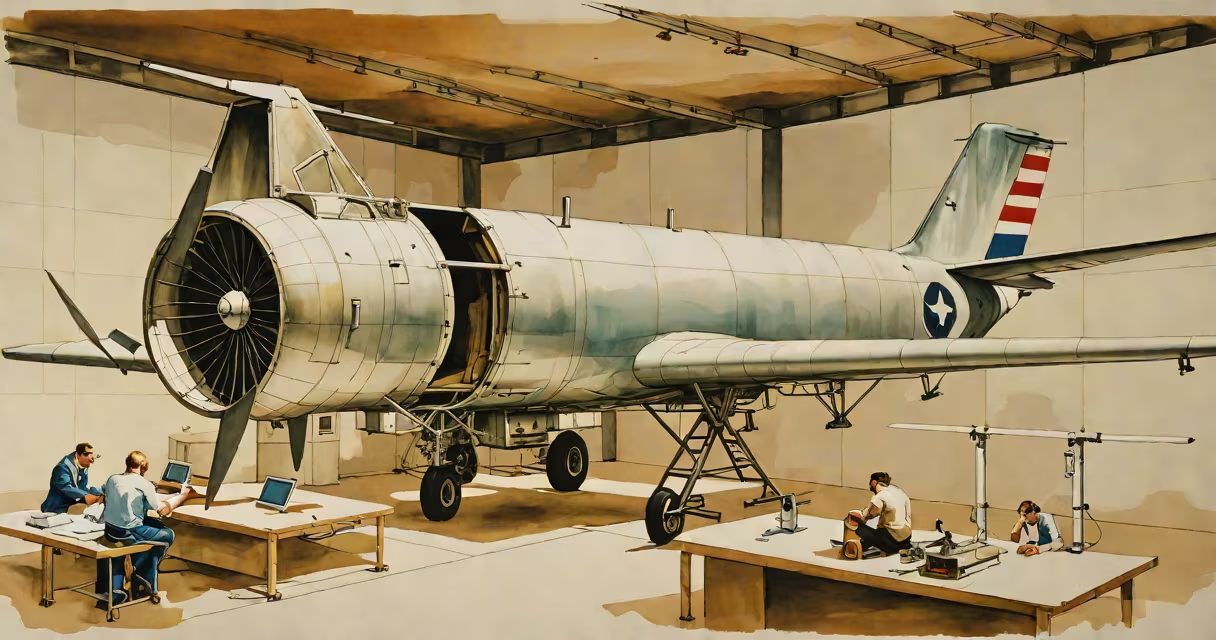
Aerospace engineers study the principles of aerodynamics, propulsion, materials science, structural analysis, and orbital mechanics to design, test, and improve aircraft and spacecraft. Their work spans both atmospheric flight and space travel, requiring deep expertise in physics, mathematics, and engineering systems.
These professionals analyze how air moves around objects at high speeds, determine how engines generate thrust, evaluate how materials withstand extreme forces and temperatures, and calculate trajectories through Earth's atmosphere and beyond. They apply computational models, physical testing, and iterative design to solve complex problems in flight safety, efficiency, and performance.
The field integrates knowledge from multiple domains. A single project-like designing a reusable rocket-requires understanding fluid dynamics for engine nozzles, thermodynamics for heat shielding, and control theory for guidance during descent. This multidisciplinary nature defines the scope of what aerospace engineers study.
Aerospace engineers begin with foundational sciences: calculus, differential equations, and classical mechanics. These tools allow them to model forces acting on vehicles in motion. For example, Newton's second law (F = ma) is used daily to predict acceleration under varying thrust and drag conditions.
Fluid dynamics, particularly compressible flow, governs how air behaves around wings and fuselages. Engineers use Navier-Stokes equations to simulate airflow over a wing profile. A 2022 NASA report noted that accurate modeling of boundary layer separation improves fuel efficiency by up to 12% in commercial airliners.
Thermodynamics and heat transfer are critical for engine design. Jet engines rely on Brayton cycles, where compressed air mixes with fuel and ignites. Engineers calculate combustion efficiency and thermal stress on turbine blades using finite element analysis software. The GE9X engine, used in Boeing 777X aircraft, underwent 1,200 hours of wind tunnel testing to validate its thermal performance under cruise conditions.
Aerospace engineering splits into two primary branches: aeronautics (aircraft) and astronautics (spacecraft). Each focuses on distinct challenges shaped by environment and mission goals.
| Specialization | Focus Areas | Real-World Example |
|---|---|---|
| Aeronautics | Aerodynamic stability, noise reduction, fuel efficiency | Designing the Boeing 787 Dreamliner's composite wing to reduce drag by 20% |
| Astronautics | Orbital mechanics, radiation shielding, re-entry heating | Developing SpaceX's Dragon capsule heat shield for safe return from low Earth orbit |
Materials science is central to both areas. Modern aircraft use carbon-fiber-reinforced polymers for lightweight strength. The F-35 Lightning II fighter jet uses advanced composites in 35% of its structure, reducing weight by 30% compared to aluminum alloys.
Control systems ensure stable flight. Autonomous drones use feedback loops based on sensor inputs to maintain altitude and direction. The Mars 2020 Perseverance rover's sky crane landing system relied on real-time adjustments to slow descent and lower the rover safely onto the surface.
Many assume aerospace engineers only design planes or rockets. In reality, they develop software for simulation, oversee manufacturing processes, manage risk assessments, and contribute to regulatory compliance. The Federal Aviation Administration (FAA) requires engineers to certify that every new aircraft meets strict safety standards before certification.
Another misconception is that all aerospace engineers work in defense or space agencies. While roles exist at NASA, ESA, and Lockheed Martin, many work in commercial aviation, drone startups, or renewable energy sectors. For example, engineers at Airbus are developing hydrogen-powered regional jets for 2035 delivery, focusing on zero-emission flight.
A lesser-known fact: aerospace engineers often specialize in systems integration. A single aircraft involves over 1 million parts, each designed by different teams. Engineers coordinate between avionics, hydraulics, and environmental control systems to ensure smooth operation. The Boeing 737 MAX grounding in 2019 highlighted how software flaws in automated flight control systems can lead to catastrophic failures-underscoring the need for rigorous systems-level training.
Consider a team at MIT's Space Systems Laboratory tasked with building a CubeSat for Earth observation. The process begins with defining mission parameters: orbit altitude (500 km), lifespan (18 months), and payload (a multispectral camera).
Step 1: Aerodynamics and orbital mechanics. Engineers calculate launch window timing and required delta-v (change in velocity) to reach orbit. Using the vis-viva equation, they determine that a burn of 3.2 km/s is needed to achieve a stable circular orbit.
Step 2: Structural integrity. The satellite's frame must withstand launch vibrations. Finite element models show stress concentrations near mounting points. Engineers reinforce those areas with titanium brackets and conduct vibration tests in a shaker table.
Step 3: Thermal management. In low Earth orbit, sunlight exposure varies rapidly. Engineers simulate temperature swings using thermal vacuum chambers. They install multi-layer insulation and passive radiators to maintain internal components within operating limits (−20°C to +60°C).
Step 4: Power and communication. Solar panels provide 120 watts during sunlight. Engineers size batteries to sustain operations during eclipse periods. Data transmission uses S-band radio at 2 Mbps, with error-correcting codes to handle signal degradation.
This project illustrates how aerospace engineers combine physics, materials, and systems thinking to deliver functional hardware under tight constraints.
My own experience involved working on a student-built rocket at Caltech. We used MATLAB simulations to predict trajectory and improve fin placement. During the static fire test, we detected a pressure spike in the combustion chamber. After analyzing waveforms from pressure transducers, we identified a resonance frequency mismatch. Adjusting the nozzle geometry reduced oscillations by 70%. That moment taught me that what aerospace engineers study isn't just theory-it's applied problem-solving under real-world uncertainty.
Understanding the breadth of topics covered in aerospace engineering helps clarify why programs require four years of rigorous coursework. Students take courses in continuum mechanics, orbital dynamics, and control theory. They learn to use tools like ANSYS for structural analysis and Simulink for changing modeling. The curriculum prepares them to tackle challenges ranging from supersonic flight to interplanetary navigation.
What aerospace engineers study is not a list of subjects but a mindset: solving complex problems in environments where failure is costly, time is limited, and precision is non-negotiable.