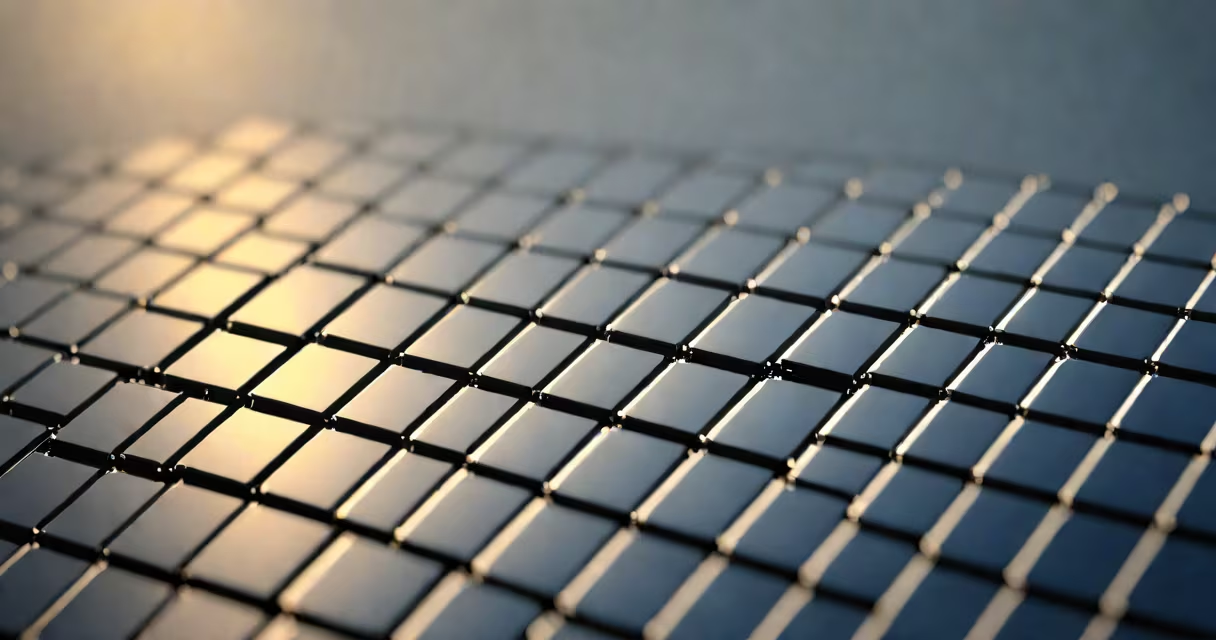
Photovoltaic cells generate electricity directly from sunlight by exploiting the photoelectric effect in semiconductor materials. They are the core components of solar panels used in residential, commercial, and utility-scale installations.
When photons from sunlight strike the surface of a photovoltaic cell, they transfer energy to electrons in the semiconductor material-typically silicon. This energy excites electrons, freeing them from atomic bonds and creating electron-hole pairs. Built-in electric fields within the cell's structure then drive these free electrons toward metal contacts, producing a flow of direct current (DC) electricity.
The process requires no moving parts, emits no greenhouse gases during operation, and functions continuously as long as light is available. Modern cells operate at 15% to 22% efficiency under standard test conditions, meaning they convert roughly one-fifth of incident sunlight into usable electrical power.
Each photovoltaic cell consists of two layers of silicon doped with different elements to create a p-n junction. The top layer is doped with boron (p-type), creating a positive charge, while the bottom layer is doped with phosphorus (n-type), creating a negative charge. Where the two meet, an electric field forms.
When sunlight hits the cell, photons with sufficient energy (greater than the bandgap of silicon, ~1.1 eV) dislodge electrons from atoms in the silicon lattice. These freed electrons move through the n-type layer toward the front contact, while holes (positive charges) travel through the p-type layer to the back contact. Connecting the two sides via a wire allows current to flow, powering devices or feeding into a grid.
A single cell produces about 0.5 volts and 3 to 5 amps under full sun-enough for small applications like calculators or garden lights. Multiple cells are wired together into modules (panels), which are then connected into arrays to scale output.
Photovoltaic cells fall into three main categories based on material composition and manufacturing process:
| Type | Material | Efficiency Range | Use Cases |
|---|---|---|---|
| Monocrystalline | Pure silicon, single-crystal ingot | 18%-22% | Residential rooftops, high-efficiency needs |
| Polycrystalline | Melted silicon fragments, multiple crystals | 15%-17% | Cost-effective installations, commercial roofs |
| Thin-Film | Cadmium telluride (CdTe), copper indium gallium selenide (CIGS), amorphous silicon | 10%-13% | Flexible surfaces, large-scale solar farms |
Monocrystalline cells are the most efficient and durable but also the most expensive. Polycrystalline offers a balance between cost and performance. Thin-film cells are lightweight and flexible, making them ideal for curved or unconventional surfaces, though they degrade faster over time.
Per the National Renewable Energy Laboratory (NREL), the highest lab-record efficiency for a single-junction silicon cell reached 26.8% in 2023, demonstrating ongoing improvements despite physical limits imposed by the Shockley-Queisser limit.
Many assume photovoltaic cells only work in direct sunlight. In reality, they generate electricity from diffuse daylight-cloudy days still yield 10% to 25% of peak output depending on cloud cover and panel tilt.
Another misconception is that solar panels stop working at night. While they don't produce power after sunset, paired systems with batteries or grid connection allow continuous access to electricity. A typical home system uses excess daytime production to charge lithium-ion batteries for nighttime use.
Some confuse photovoltaic cells with solar thermal collectors. The latter heat water or fluid using concentrated sunlight, whereas photovoltaic cells convert light directly into electricity. Solar thermal systems are used for heating, not for generating electrical power.
Photovoltaic cells power everything from satellites to streetlights. On Earth, they're installed on homes, schools, factories, and solar farms. The largest solar farm in the world, the Bhadla Solar Park in India, spans 14,000 acres and generates 2,245 megawatts (MW) of capacity-enough to supply over 1 million homes annually.
Consider a typical rooftop installation: a 5-kW system using 20 monocrystalline panels, each rated at 250 watts. On a sunny day with 5 hours of peak sunlight, the system produces 5 kW × 5 h = 25 kWh of electricity. That's enough to run a refrigerator (100 W), a washing machine (500 W), and several LED lights for a full day.
Over a year, such a system generates approximately 8,000 kWh. At an average U.S. electricity rate of $0.15/kWh, this saves around $1,200 annually in utility costs. The payback period for a $15,000 system (after federal tax credits) is typically 6 to 8 years, with continued savings beyond that.
I once installed a 3.5-kW system on my garage roof. After monitoring for 12 months, actual production was 4,800 kWh-slightly below the projected 5,200 kWh due to partial shading from nearby trees. Adjusting the range angle and trimming branches improved output by 12% the following year.
Photovoltaic cells do not require sunlight to function-they respond to any electromagnetic radiation above a certain frequency. However, visible and near-infrared light provides the most efficient conversion. Ultraviolet light contributes less because it's absorbed too deeply in the material, while infrared light lacks the energy to excite electrons effectively.
Contrary to popular belief, photovoltaic cells degrade slowly over time. Most manufacturers guarantee 80% output after 25 years. A study published by the National Renewable Energy Laboratory found that average degradation rates are 0.5% per year, meaning a 25-year-old panel still delivers ~87% of original output.
Another overlooked point: the environmental impact of manufacturing photovoltaic cells is significant. Silicon purification and wafer slicing consume substantial energy-about 10-15% of a panel's lifetime energy output. But this "energy payback time" is typically 1.5 to 3 years, after which the system produces net clean energy.
For context, a typical 300-watt panel made in China has a carbon footprint equivalent to 40 kg of CO₂. Over 25 years of operation, it avoids 1.5 tons of CO₂ emissions-over 30 times its own manufacturing footprint.
Photovoltaic cells convert sunlight into electricity through semiconductor physics. They are central to solar energy systems, enabling clean, decentralized power generation. Their performance depends on materials, design, location, and maintenance-but they remain among the most sustainable energy solutions available.