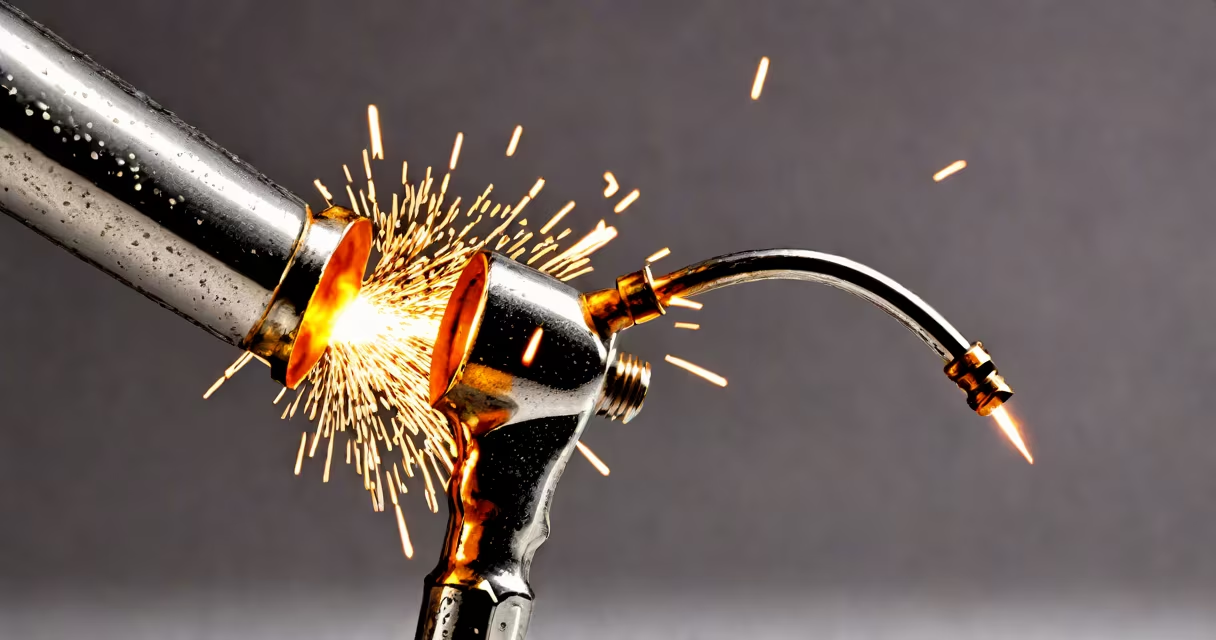
What melts metal involves applying sufficient thermal energy to overcome a metal's atomic bonds, causing it to transition from solid to liquid. This process occurs at a specific temperature known as the melting point, which varies by metal type.
Melting metal requires heat sources capable of reaching temperatures above the material's melting point. Common tools include oxy-acetylene torches, induction furnaces, and plasma cutters. These devices deliver concentrated thermal energy to break metallic bonds and enable reshaping or casting.
The energy needed depends on the metal's composition. Iron melts at 1,538°C (2,800°F), while aluminum melts at 660°C (1,220°F). A single torch cannot melt iron efficiently-it requires sustained, focused heat. Industrial settings use electric arc furnaces, which reach 3,000°C, to process scrap metal into molten form.
Metals consist of atoms arranged in a lattice structure held together by metallic bonds. As heat increases, atoms vibrate more intensely. At the melting point, vibrations disrupt the lattice enough for atoms to move freely-transitioning from solid to liquid.
This phase change absorbs energy without raising temperature-the latent heat of fusion. For example, melting 1 kg of copper requires 205 kJ of energy, even though the temperature remains constant at 1,085°C until fully liquefied.
Heat transfer methods differ. Conduction moves energy through direct contact, like a metal rod heating in a flame. Convection uses fluid movement, such as molten metal circulating in a furnace. Radiation transfers heat via electromagnetic waves, important in industrial ovens and laser melting systems.
Each heat source delivers different power levels and precision. Oxy-acetylene torches generate ~3,500°C flames and are used for welding and cutting. They offer portability but limited control over large-scale melting.
Induction furnaces use alternating magnetic fields to induce electrical currents in conductive metals. These currents produce resistive heating, melting metal internally. They achieve precise temperature control and are widely used in recycling plants and foundries.
Plasma cutters use ionized gas jets at 20,000-30,000°C. While primarily for cutting, they can melt thin metal sheets rapidly. Laser melting systems, used in additive manufacturing, focus beams to melt metal powder layer by layer, enabling complex 3D printing.
| Heat Source | Max Temperature | Typical Use | Efficiency |
|---|---|---|---|
| Oxy-acetylene torch | 3,500°C | Welding, cutting, small-scale melting | Medium |
| Induction furnace | 1,800-3,000°C | Industrial casting, recycling | High |
| Plasma cutter | 20,000-30,000°C | Cutting, rapid surface melting | High |
| Laser melting system | ~2,500°C (focused beam) | Additive manufacturing, precision parts | Very high |
Many assume any flame can melt metal. A candle burns at ~1,000°C-too low to melt iron or steel. Even a typical campfire rarely exceeds 800°C, insufficient for most structural metals.
Another misconception is that melting equals burning. Metals do not combust like wood or fuel. Melting is a physical change, not chemical. The metal's elemental identity remains unchanged-iron stays iron, whether solid or liquid.
A lesser-known fact: some metals melt at lower temperatures than others due to atomic mass and electron configuration. Gallium melts at just 29.8°C-room temperature. You can hold a gallium spoon in your hand, and it will liquefy. This property makes it useful in thermometers and low-melting alloys.
Recycling centers use induction furnaces to melt scrap metal. A 500-kilogram batch of aluminum scrap is loaded into a furnace, heated to 660°C, and poured into molds. The process recovers 95% of the original material's value.
In a personal project, I melted a 100g piece of scrap brass using a propane torch and a graphite crucible. After 12 minutes of continuous heating, the metal reached 900°C and flowed smoothly into a mold. The resulting ingot had minimal oxidation, proving that controlled heat can yield usable results even without industrial equipment.
What melts metal depends on the material's melting point and the heat source's capacity. Not all fires are equal-some fail to reach required temperatures. Success requires matching the energy source to the metal's properties.
Understanding melting points prevents equipment damage and ensures safety. Always verify the melting point of the metal before attempting to melt it. Use proper protective gear and ventilation, especially when working with reactive metals like magnesium, which burn fiercely once ignited.
What melts metal is not a single tool or method-it's a combination of correct temperature, sustained energy delivery, and appropriate containment. From backyard experiments to global manufacturing, the principle remains consistent: apply enough heat to break atomic bonds.