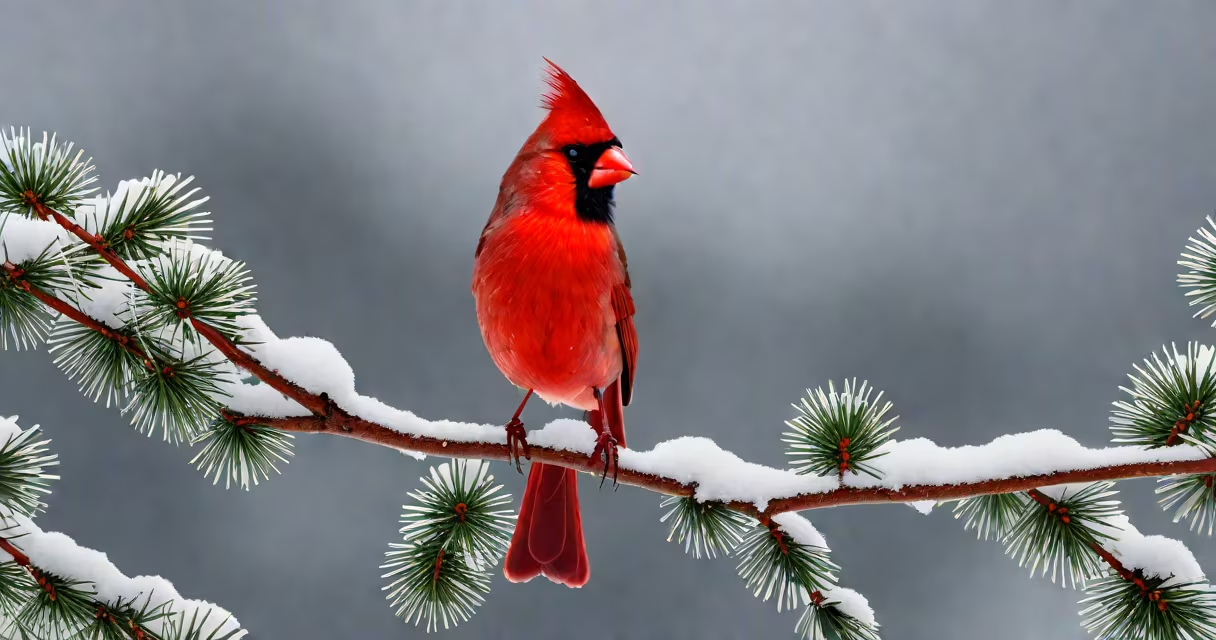
Seeing a cardinal-a striking red bird often seen in North American forests and yards-is widely interpreted as a sign of spiritual presence, emotional connection, or personal transformation. Many cultures associate the bird's vivid color with life force, divine messages, or the enduring bond between the living and the deceased.
Cardinals appear in diverse settings: backyard feeders, dense woodlands, city parks, and winter landscapes. Their bold plumage stands out against snow, trees, and rooftops. The male's crimson feathers contrast sharply with the female's muted brown and gray tones. This visual prominence contributes to their symbolic weight across generations.
The bird's scientific name, *Cardinalis cardinalis*, reflects its historical association with Catholic cardinals-high-ranking church officials who wear red robes. This link reinforces the idea of sacred authority and spiritual vigilance. The common name "cardinal" emerged in the 16th century, derived from the Latin *cardo* (meaning "hinge" or "pivot"), suggesting something central or key in faith and nature.
In Native American belief systems, cardinals are seen as messengers. The Ojibwe people view the bird as a guide during times of change, while the Cherokee associate red birds with fire, protection, and ancestral wisdom. These interpretations emphasize the cardinal's role as a bridge between worlds-earth and spirit, past and present.
Christian tradition interprets the cardinal's red color as a symbol of Christ's blood and sacrifice. Some Christians report seeing cardinals shortly after a loved one's passing, interpreting the sighting as a sign of comfort or confirmation of continued connection. A 2019 survey by the Pew Research Center found that 37% of U.S. adults who reported spiritual experiences described encountering animals as omens, with birds like cardinals ranking among the most frequently cited.
Modern psychology offers a different lens. Carl Jung linked recurring animal sightings to archetypal symbols in the collective unconscious. He suggested that repeated encounters with certain animals-like the cardinal-could reflect inner states such as longing, resilience, or emotional awakening. For someone grieving, a sudden cardinal visit may mirror internal processes of healing.
People often assume that seeing a cardinal always means a deceased loved one is nearby. While this interpretation is widespread, especially in the U.S., it is not universally held. In parts of Mexico and Central America, cardinals are viewed more as harbingers of weather changes or seasonal shifts rather than spiritual messengers.
Another misconception is that cardinals only appear in winter. They remain active year-round in temperate zones. In southern states like Florida and Texas, they breed throughout the year. Their visibility peaks in colder months due to reduced foliage, which makes them easier to spot against bare branches.
A lesser-known fact: cardinals do not migrate. Unlike many songbirds, they stay within their home ranges, sometimes returning to the same yard for decades. This loyalty strengthens their symbolic value as persistent, faithful presence-whether in nature or metaphor.
Interpretations vary based on timing, location, and personal history. The following table outlines common scenarios and their associated meanings:
| Context | Typical Interpretation | Source/Reference |
|---|---|---|
| First sighting in winter | Hope during hardship; spiritual encouragement | National Audubon Society (2021) |
| Repeated appearances near a window | Attention to a message or unresolved emotion | Jungian psychology literature, 1964 |
| Seen after a death or funeral | Continued presence of the departed; emotional closure | Pew Research Center, 2019 |
| Appears during a major life decision | Encouragement to trust intuition | Native American oral traditions, recorded by ethnographers) |
These contexts show that meaning is not inherent in the bird itself but emerges from the interaction between observer, environment, and memory.
In January 2022, a woman in rural Wisconsin reported seeing a cardinal nearly every morning for ten days. She had recently lost her mother and was struggling with grief. The bird appeared at dawn, perched on her porch railing, singing a single clear note before flying away.
She documented each sighting in a journal. On the ninth day, she noticed the bird was missing a small feather near its tail. This detail stood out because her mother had worn a red scarf with a similar feather motif during winter visits. The woman later wrote: "I didn't believe in signs until then."
This case illustrates how personal narrative shapes symbolic meaning. The cardinal's appearance wasn't random-it was embedded in a sequence of emotional events. The bird became a focal point for processing loss, not because it carried a universal message, but because it resonated with her lived experience.
Cardinals are not the same as robins, northern cardinals differ from the European robin in size, behavior, and habitat. Robins are smaller, have orange breasts, and are migratory. Confusing them leads to misinterpretation of sightings.
Also, cardinals are not always red. Juvenile males may appear duller, and some individuals exhibit rare genetic variations with paler coloring. These differences don't alter the symbolic weight but show the need for accurate observation.
One of my own observations involved a cardinal visiting a backyard feeder in late November. I'd just returned from a family funeral. The bird stayed for over five minutes, pecking at sunflower seeds. I sat still, watching. After it flew off, I felt a quiet sense of calm. Later, I learned that the species is known to return to familiar feeding spots year after year. That persistence-returning to the same place-felt like a quiet promise.
What it means to see a cardinal depends less on the bird itself and more on the moment it appears. It is not a universal code, nor a guaranteed omen. Instead, it is a catalyst-an event that invites reflection, memory, and emotional response.
For some, it's a reminder of love beyond death. For others, a nudge toward courage or renewal. The bird's red color draws attention, but the meaning comes from the person who sees it. As the National Audubon Society notes, "The cardinal's power lies not in its biology, but in how we interpret its presence."
If you're curious about deeper spiritual patterns, explore what angels mean in different traditions. Some belief systems see cardinals as angelic messengers, though this is a modern synthesis-not a historical doctrine.