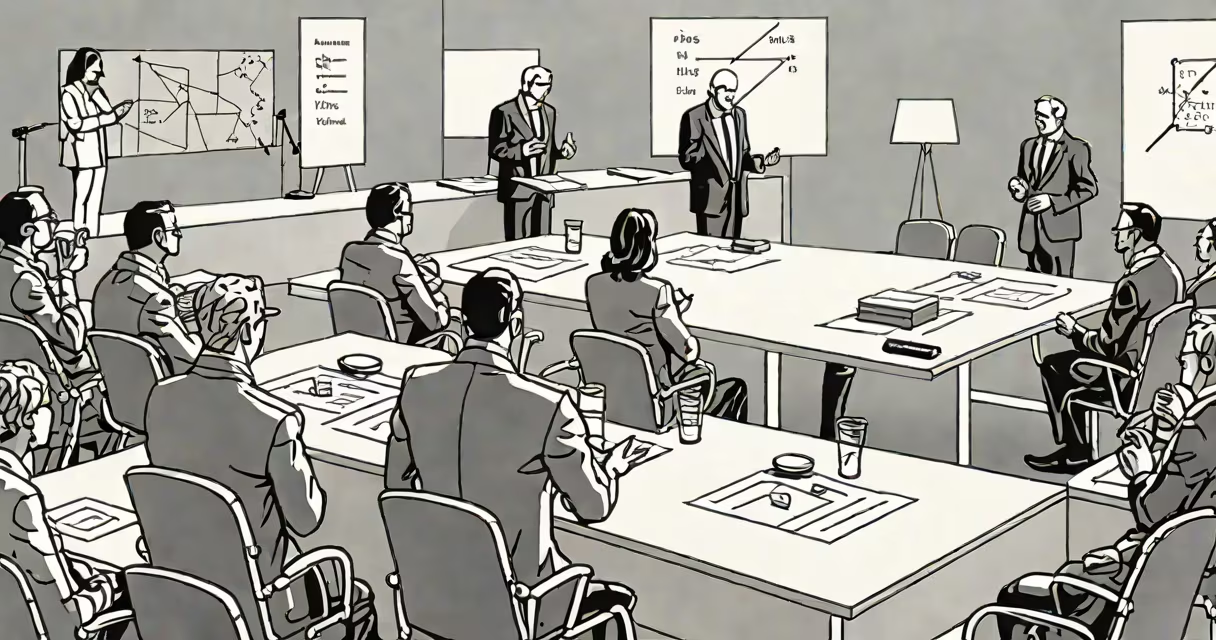
Debate is a structured conversation where participants present opposing arguments on a specific proposition, aiming to persuade an audience or judge through logic, evidence, and rhetorical skill. It is not random disagreement-it follows formal rules, roles, and time limits.
At its core, debate tests reasoning under pressure. One side supports a motion (e.g., "This house believes social media harms mental health"), the other opposes it. Each team prepares arguments, anticipates rebuttals, and delivers them within strict timeframes. Judges evaluate clarity, evidence quality, and strategic delivery.
Debates occur in schools, courts, political campaigns, and international forums. They are not just verbal sparring-they train critical thinking, improve public speaking, and expose flaws in assumptions. The goal is not to win at all costs, but to clarify issues through rigorous argumentation.
Debate operates under a set of agreed-upon rules. In competitive formats like policy debate or parliamentary debate, teams are assigned roles: Affirmative (pro) and Negative (con). Each side has a defined time to speak, usually 6-8 minutes per speaker, followed by cross-examination and rebuttal rounds.
For example, in a high school policy debate, the Affirmative team argues that "The U.S. should eliminate cash payments for federal student loans." They must define key terms (e.g., "eliminate" means ending all disbursement), provide evidence (e.g., 2023 Congressional Budget Office data showing $1.2 trillion in loan forgiveness cost), and anticipate counterarguments (e.g., inflation risks).
The Negative team then responds with refutations-disproving claims, exposing weaknesses in evidence, or offering alternative solutions. After both sides finish, judges score based on criteria such as argument strength, source credibility, and effective rebuttal. A well-structured debate often ends with a clear winner, but the real value lies in the process of refining ideas.
Different formats serve different purposes. The most common types include:
| Type | Structure | Common Use Cases | Example |
|---|---|---|---|
| Policy Debate | Two teams argue for/against a proposed government action. Uses evidence-based research and impact analysis. | High school and college competitions; legislative planning. | "This house supports banning single-use plastics nationwide." |
| Parliamentary Debate | Two teams of two speakers each. One side supports the motion, the other opposes it. Time is tight; focus is on speed and persuasion. | International tournaments; university clubs. | "This house believes artificial intelligence should be regulated by international bodies." |
| Lincoln-Douglas Debate | One-on-one format focused on ethical values. Arguments are philosophical, not policy-driven. | High school speech and debate leagues. | "Freedom of speech outweighs national security in democratic societies." |
| Public Forum Debate | Team-based, but uses accessible language. Designed for broad audience understanding. | Community forums; civic engagement events. | "Should public libraries fund free internet access?" |
Each format trains distinct skills. Policy debates emphasize research and predictive modeling. Lincoln-Douglas focuses on moral reasoning and conceptual clarity. Public forum debates build communication skills for non-specialist audiences.
One non-obvious fact: many professional debaters report that the most effective arguments aren't the most emotional-they're the ones that acknowledge the opponent's valid concerns while still advancing their own position. This is called "reframing," and it's rare in casual discussions but central to advanced debate strategy.
Debate is foundational in legal systems. In courtrooms, lawyers present arguments before judges or juries using structured formats similar to competitive debate. The U.S. Supreme Court hears oral arguments lasting 30 minutes per side, with justices interrupting to ask clarifying questions-much like cross-examination in policy debate.
In education, debate improves learning outcomes. A 2022 study by the National Association of Secondary School Principals found that students who participated in debate scored 15% higher on standardized reading comprehension tests compared to peers who did not. The act of researching, organizing, and defending a claim strengthens analytical skills.
Politically, debates shape public opinion. The 2020 U.S. presidential debates drew over 80 million viewers. While opinions differ on performance, the format forces candidates to clarify positions under scrutiny. For example, during the second 2020 debate, Joe Biden's response to a question about climate change included specific references to the Inflation Reduction Act and cited EPA data-demonstrating how debate-style answers can convey policy detail.
Even in business, debate principles apply. Startups use "pre-mortems"-imagining failure scenarios-to challenge assumptions before launching products. This mirrors the debate tactic of "refuting the opposition's worst-case scenario" to strengthen one's own proposal.
People often confuse debate with argument, shouting match, or persuasion. But debate is not about winning emotionally-it's about winning logically. A good debate doesn't rely on volume or insults. It relies on evidence, coherence, and timing.
A frequent mistake is assuming that debate requires equal time for both sides. In reality, some formats allow the affirmative team to set the agenda. In policy debate, the Affirmative defines the resolution and bears the burden of proof-that is, they must show why their plan is better than the status quo. The Negative only needs to show flaws or alternatives.
Another misconception: that debate is purely academic. In fact, it's used in conflict resolution. The United Nations uses structured dialogue formats modeled on debate to mediate disputes between nations. The 2015 Iran nuclear deal negotiations involved repeated rounds of argumentation, evidence presentation, and compromise-hallmarks of formal debate.
I once observed a middle school debate on whether video games should be classified as sports. The students had prepared for weeks. One team cited data from the International Olympic Committee's 2021 report on esports participation. The other countered with neuroscientist studies linking excessive gaming to reduced attention spans. The audience-a mix of parents and teachers-left with clearer views on both sides. That's the power of debate: it doesn't just inform-it changes minds.
When you hear "what is debate," remember: it's not just talking. It's structured argument, evidence-based reasoning, and disciplined listening. Whether in classrooms, courtrooms, or online forums, debate remains one of the most effective tools for sorting truth from noise.