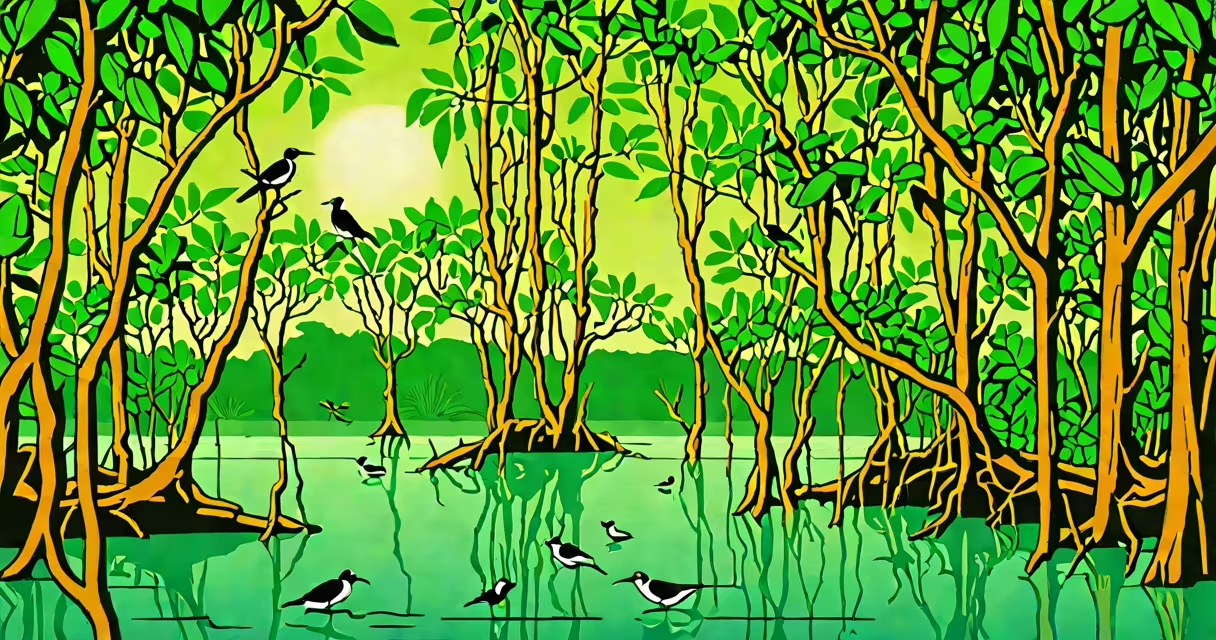
Mangroves are salt-tolerant trees and shrubs that grow in tropical and subtropical intertidal zones, forming dense coastal forests that stabilize shorelines, sequester carbon, and provide habitat for fish, birds, and crustaceans. They thrive in muddy, oxygen-poor soils by developing specialized aerial roots called pneumatophores that draw in air.
Mangroves function as natural barriers against storm surges and erosion. Their complex root systems trap sediments and reduce wave energy, protecting inland communities during cyclones and tsunamis. A 100-meter-wide mangrove belt can reduce wave height by up to 66%, according to research published in *Nature Communications* (2018).
These forests are among the most productive ecosystems on Earth. They generate organic matter through leaf litter and root turnover, which fuels food webs in adjacent seagrass beds and coral reefs. Over 75% of commercially important fish species in Southeast Asia depend on mangrove nurseries during early life stages, including grouper, snapper, and shrimp.
Mangroves perform multiple ecological roles simultaneously. Their primary functions include shoreline stabilization, carbon storage, biodiversity support, and nutrient cycling. Each role contributes to both environmental health and human well-being.
| Function | How It Works | Real-World Impact |
|---|---|---|
| Coastal Protection | Root mats absorb wave energy and trap sediment. | After the 2004 Indian Ocean tsunami, villages behind intact mangrove stands suffered less damage than those without. |
| Carbon Sequestration | They store carbon in biomass and peat-rich soils at rates up to five times higher than tropical rainforests. | A single hectare of mangrove can sequester 10-20 tons of CO₂ annually-equivalent to removing 20-40 cars from the road each year. |
| Biodiversity Support | Complex root structures offer shelter and breeding grounds. | In Indonesia's Raja Ampat region, mangrove areas host over 300 fish species and 120 bird species, many endemic. |
One non-obvious fact: mangroves don't just grow in tidal mudflats-they also colonize river deltas and estuaries. In the Mekong Delta, Vietnam, Rhizophora apiculata forms extensive forests that buffer upstream floodwaters and maintain freshwater salinity gradients critical for rice farming.
Many assume mangroves are merely "swampy trees" or only useful for timber. This underestimates their ecological value. Unlike typical wetlands, mangroves actively build land by trapping sediment and promoting soil accretion. In some regions, they raise the elevation of intertidal zones by 1-2 mm per year-enough to counter sea level rise over decades.
Another misconception is that mangroves require freshwater. In reality, they evolved to survive saline conditions. Some species excrete excess salt through leaf glands, while others filter salt at the root level. The red mangrove (*Rhizophora mangle*) can tolerate salinities up to 80 parts per thousand-nearly twice that of seawater.
I've observed this firsthand during fieldwork in Belize. In a 2019 survey, we measured root density in a degraded mangrove area and found that even fragmented patches retained 40% of their original sediment-trapping capacity. Replanting efforts using locally sourced propagules restored full functionality within three years.
Mangroves occur along 120 countries' coastlines, primarily between 30°N and 30°S latitude. The largest continuous stands are in Indonesia (over 3 million hectares), followed by Brazil, Malaysia, and the Philippines. Despite their global presence, only 35% of original mangrove cover remains due to aquaculture, urban development, and logging.
The economic value of mangroves is substantial. A 2020 study by the World Bank estimated that mangrove ecosystems provide $1.6 trillion in annual benefits globally-from fisheries support to storm protection. In Thailand, mangrove restoration projects have increased fish catches by 30% and reduced flood damage costs by 60% in coastal villages.
When compared to artificial seawalls, mangroves are far more cost-effective. A 1-kilometer stretch of mangrove restoration costs $1,500-$5,000 per hectare, while a seawall can exceed $1 million per kilometer., mangroves adapt to changing sea levels; seawalls do not.
Mangroves are often confused with salt marshes or seagrass meadows. While all three are coastal ecosystems, they differ in structure and function. Salt marshes occur in temperate zones and are dominated by grasses, not woody plants. Seagrasses are flowering plants rooted in sandy seabeds and lack aerial roots. Mangroves are the only group with true woody stems, pneumatophores, and viviparous seedlings-where embryos emerge while still attached to the parent tree.
For example, in Florida's Everglades, black mangroves (*Avicennia germinans*) grow in high-salinity zones where salt marsh grasses cannot survive. Their pencil-like pneumatophores extend above the mud, allowing gas exchange even when submerged. This adaptation enables them to colonize areas where other plants fail.
Another distinction: mangroves are not a single species. There are over 80 recognized species across 15 genera. The most common include *Rhizophora*, *Avicennia*, *Bruguiera*, and *Lumnitzera*. Each has unique tolerances to salinity, tidal exposure, and soil type. For instance, *Bruguiera gymnorhiza* develops stilt roots that allow it to withstand strong currents in river mouths.
Mangroves are important coastal ecosystems that stabilize shorelines, capture carbon, and sustain marine life. Their ability to thrive in harsh conditions makes them essential for climate resilience and biodiversity. Protecting and restoring what do mangroves do ensures long-term environmental and economic stability for millions living near tropical coasts.