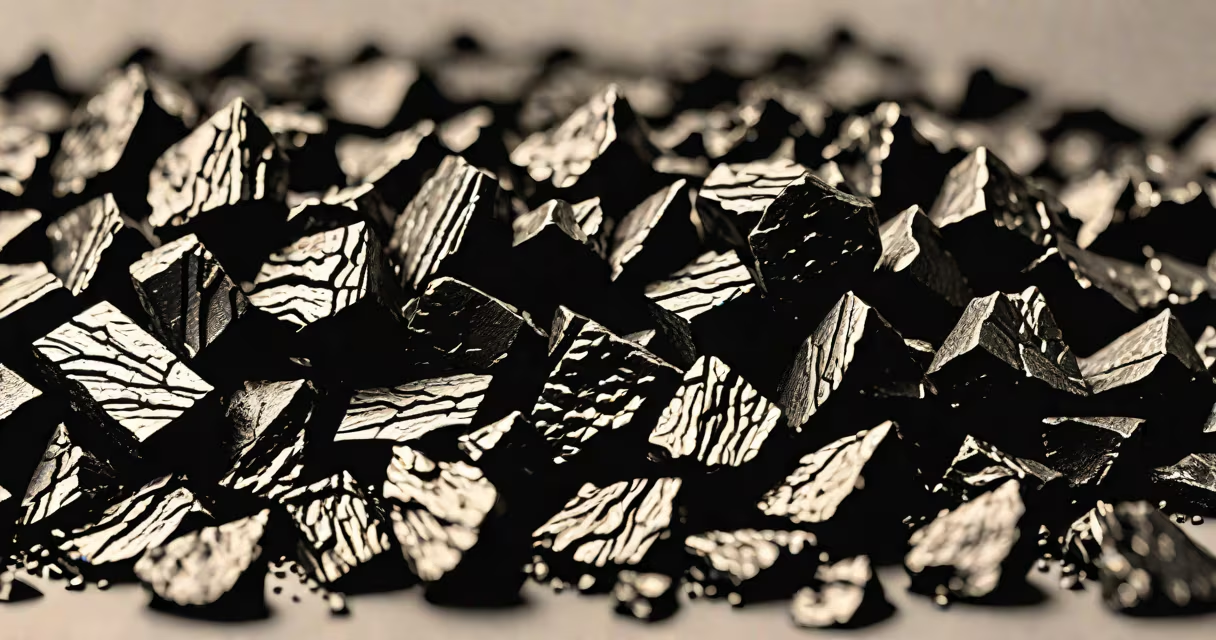
Bituminous coal is a dense, black sedimentary rock rich in carbon, formed over millions of years from compressed plant matter under heat and pressure. It accounts for about 50% of global coal production and is the primary fuel for power plants and steel manufacturing.
It forms during the coalification process, where peat transforms into lignite, then sub-bituminous, and finally bituminous coal under increasing temperature and pressure. This stage occurs between 100 million and 300 million years ago, primarily during the Carboniferous and Permian periods. The resulting rock contains 77% to 87% carbon by weight, higher than other coal types, making it ideal for energy-intensive applications.
According to the U.S. Energy Information Administration (EIA), bituminous coal has a heating value ranging from 24 to 35 megajoules per kilogram, higher than lignite (17-24 MJ/kg) and sub-bituminous (20-24 MJ/kg). Its high energy density stems from the removal of volatile compounds and moisture during metamorphism, leaving behind a carbon-rich matrix.
Bituminous coal originates from swamp forests where plant debris accumulated and was buried by sediments. Over time, microbial decomposition and physical compaction reduced the volume and increased the carbon concentration. Heat and pressure from tectonic activity further altered the organic material, driving off water, methane, and other volatiles.
The composition varies by deposit, but typical bituminous coal contains:
High sulfur content in some deposits leads to acid mine drainage and air pollution when burned. The EIA notes that sulfur levels above 2% require scrubbers in power plants to meet emissions standards under the Clean Air Act.
Bituminous coal is divided into subcategories based on rank, moisture, and heating value. The American Society for Testing and Materials (ASTM) defines four ranks:
| Type | Moisture (%) | Heating Value (MJ/kg) | Primary Use |
|---|---|---|---|
| High-volatile A | 5-10 | 24-28 | Electricity generation |
| Medium-volatile | 4-8 | 28-32 | Power plants, industrial boilers |
| Low-volatile | 3-6 | 32-35 | Steelmaking, gasification |
| Anthracite (not bituminous) | 2-3 | 35+ | Residential heating |
High-volatile A bituminous coal is common in Appalachia and the Midwest U.S., while low-volatile varieties dominate in China and India. Low-volatile coals are preferred in coke ovens because they produce stronger, more porous coke needed to reduce iron ore in blast furnaces.
Bituminous coal powers about 38% of global electricity generation, according to the International Energy Agency (IEA). In the United States, it supplied 19% of total energy consumption in 2023, with 90% of that used in thermal power stations.
Steel production relies heavily on bituminous coal. During coking, low-volatile bituminous coal is heated to 1,000°C in oxygen-free ovens, producing coke. Coke acts as both fuel and reducing agent in iron smelting. For every ton of steel produced, approximately 0.6 tons of coke are required. The global steel industry consumes around 1.2 billion tons of coal annually, with bituminous coal supplying 85% of that demand.
A real-world example: the U.S. Steel Corporation's Gary Works plant in Indiana uses 1.5 million tons of bituminous coal per year to produce 10 million tons of steel. The coal is processed into coke, which is then fed into blast furnaces alongside iron ore and limestone.
Many assume all coal is the same. That's false. Bituminous coal differs from anthracite, sub-bituminous, and lignite in energy content, combustion behavior, and environmental impact. Anthracite, though harder and higher in carbon, is rarer and used mostly for home heating.
Another myth: bituminous coal is "clean." It is not. Burning it releases CO₂, SO₂, NOₓ, mercury, and particulates. The EPA reports that coal-fired power plants emit 1,000 grams of CO₂ per kWh-about twice the rate of natural gas. Despite this, bituminous coal remains central to energy systems due to infrastructure lock-in and low extraction cost.
A lesser-known fact: bituminous coal can be processed into synthetic fuels. The Fischer-Tropsch process converts coal-derived syngas into liquid hydrocarbons. South Africa's Sasol operates such facilities, producing 70,000 barrels of synthetic fuel daily from bituminous coal. This method is energy-intensive but viable in regions with abundant coal and limited oil access.
I once visited a coal preparation plant in West Virginia where raw bituminous coal was sorted by size, density, and ash content. The facility used dense medium separation tanks filled with ferrosilicon slurry to remove impurities. After processing, the coal's calorific value rose from 26 MJ/kg to 32 MJ/kg. This step is critical-without it, power plants face efficiency losses and higher emissions.
Bituminous coal is a high-energy, carbon-dense sedimentary rock essential to modern industry. Its role in electricity and steel production persists despite climate concerns. Understanding its properties, types, and real-world applications clarifies why it remains a dominant energy source globally.