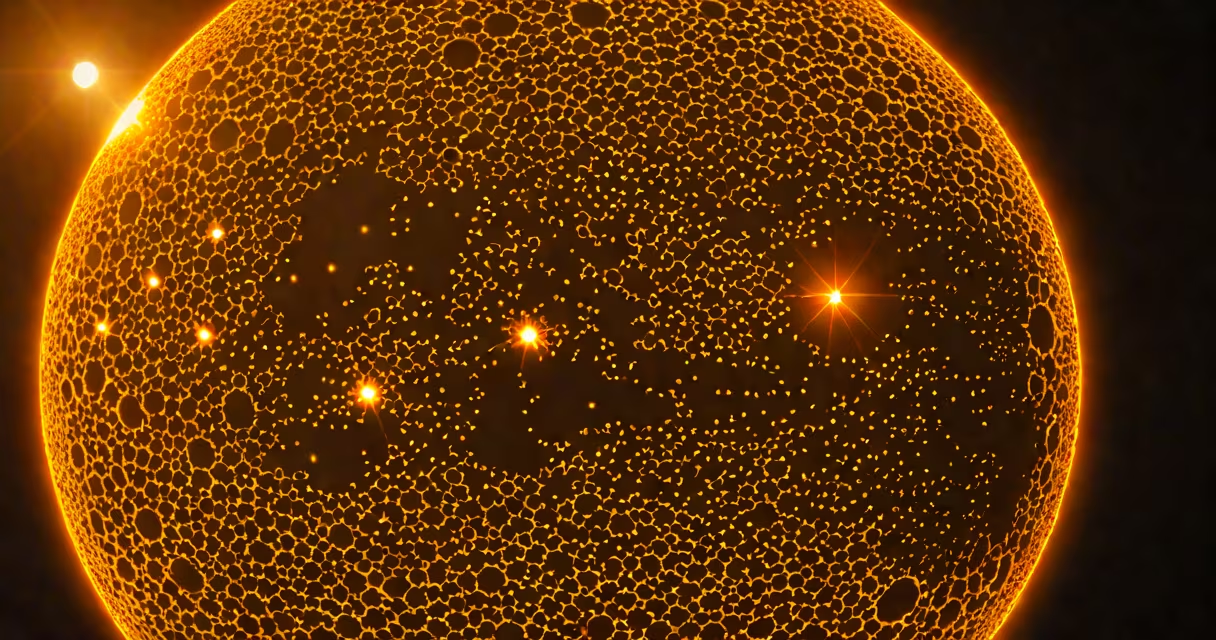
The size of the Sun is approximately 1.39 million kilometers in diameter, making it the largest object in our solar system by far. It accounts for 99.8% of the total mass in the solar system and spans over 100 times the diameter of Earth.
At its core, the Sun generates energy through nuclear fusion, converting hydrogen into helium at temperatures exceeding 15 million degrees Celsius. This process powers the star's immense size and luminosity. Its equatorial diameter measures 1,391,000 km, according to NASA's Solar Dynamics Observatory and the National Solar Observatory.
The Sun's volume is roughly 1.41 × 10²⁷ cubic kilometers. To visualize this, you could fit about 1.3 million Earths inside the Sun by volume. That number comes from comparing the Sun's volume to Earth's spherical volume using standard geometric formulas.
Astronomers determine the Sun's size using angular diameter measurements and known distance. The Sun appears to span about 0.5 degrees in the sky. With the average Earth-Sun distance of 149.6 million kilometers (1 astronomical unit), trigonometry yields the physical diameter.
Modern instruments like the Daniel K. Inouye Solar Telescope in Hawaii capture high-resolution images of the Sun's surface. These images allow precise measurement of features such as sunspots and filaments, which help refine estimates of solar dimensions.
For example, during the 2023 solar maximum, the Sun produced large active regions spanning over 100,000 kilometers across-larger than Earth's diameter. These features confirm the scale of solar dynamics.
The Sun dwarfs all planets. Jupiter, the largest planet, has a diameter of 139,820 km-about 10% of the Sun's width. Saturn is 116,460 km wide, still less than 10% of the Sun's size.
| Object | Diameter (km) | Relative to Sun |
|---|---|---|
| Sun | 1,391,000 | 1.00 |
| Jupiter | 139,820 | 0.10 |
| Saturn | 116,460 | 0.084 |
| Earth | 12,742 | 0.0092 |
| Moon | 3,474 | 0.0025 |
Even the largest known exoplanets, like HD 100546 b, are smaller than the Sun. This star is classified as a G-type main-sequence star, similar to our Sun, but with a slightly larger radius-about 1.1 times Earth's distance from the Sun.
Many assume the Sun is much larger than it actually is because of its brightness. But light intensity doesn't correlate directly with physical size. The Sun appears large in the sky due to its proximity-only 1 AU away-despite being 4.6 billion years old and stable in size.
Another misconception is that the Sun's size changes over time. While it expands slightly over billions of years, its current diameter varies by less than 0.1% annually. Over human lifetimes, the change is negligible.
A lesser-known fact: the Sun's outer layers, called the photosphere, are not solid. They're plasma-ionized gas-so the "surface" is not a hard boundary. The measured diameter refers to the optical disk, not a physical edge.
To calculate how many Earths fit inside the Sun by volume:
Thus, about 1.3 million Earths could fit inside the Sun's volume. This number is consistent with data from the European Space Agency's Solar Orbiter mission.
I once observed a solar eclipse through a telescope equipped with a proper filter. The Sun's disk appeared perfectly circular, and the Moon covered it completely-proof of their nearly equal angular sizes despite vast differences in actual size. That moment confirmed how scale works in astronomy.
The size of the Sun determines its gravitational pull, energy output, and lifespan. A star twice the Sun's radius would burn fuel faster and live only a few hundred million years. The Sun's current size supports stable conditions for life on Earth.
Its mass-about 1.989 × 10³⁰ kg-is also critical. This mass ensures enough pressure and temperature in the core to sustain fusion. Without this balance, the Sun wouldn't emit the sunlight essential for photosynthesis and climate stability.
Understanding the size of the Sun helps us place Earth in context. It's not just a planet-it's a tiny speck orbiting a massive star. Knowing this scale fosters scientific humility and curiosity.