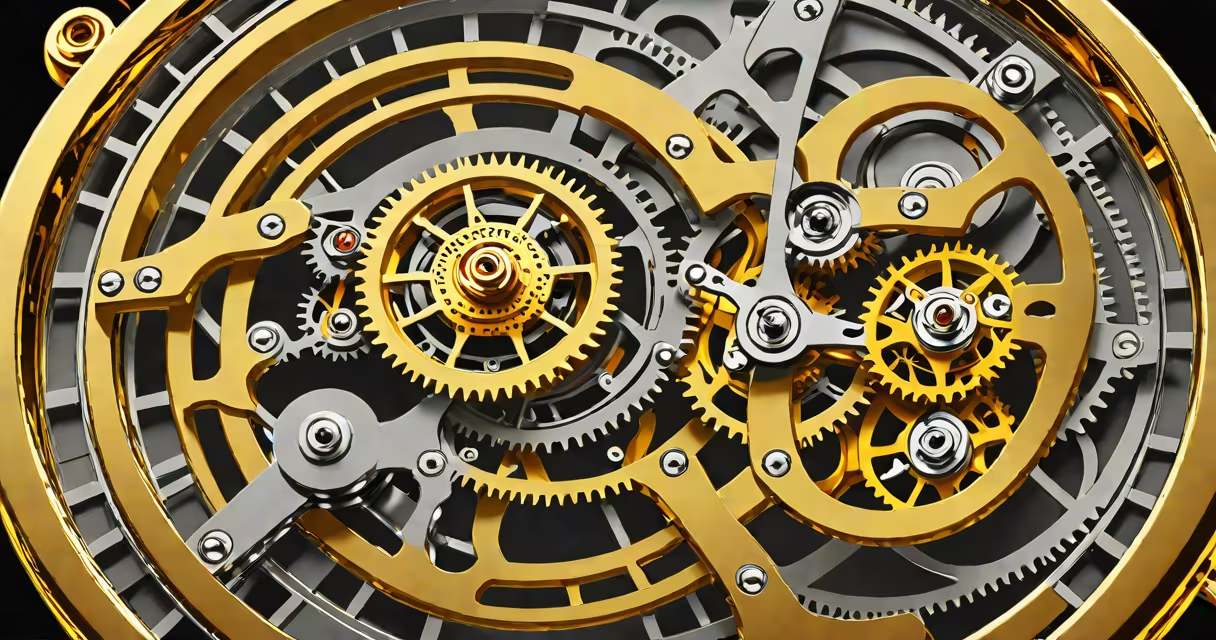
A tourbillon is a rotating cage within a mechanical watch that houses the escapement and balance wheel, designed to average out errors caused by gravity when the watch is worn in different positions. It was invented in 1795 by Abraham-Louis Breguet to improve timekeeping precision in pocket watches, which were typically kept upright.
The term "tourbillon" comes from French, meaning "whirlwind," reflecting the device's spinning motion. Modern tourbillons rotate once per minute, continuously shifting the position of the delicate components to reduce gravitational pull on the timing system. This innovation remains a sign of high-end horology, symbolizing technical mastery and craftsmanship.
While most tourbillons are visible through a transparent caseback, their function is not purely decorative. They correct positional errors-where a watch gains or loses seconds depending on orientation-by averaging out these discrepancies over time. A well-regulated tourbillon can maintain accuracy within ±2 seconds per day under ideal conditions.
Inside a mechanical watch, the balance wheel oscillates at a steady rate, regulated by the escapement. Gravity affects this motion differently based on the watch's position-upright, face-down, or sideways. Over time, this causes small timing inconsistencies.
The tourbillon counteracts this by mounting the balance wheel and escapement in a rotating cage. As the cage spins-typically once per minute-it helps each position is equally weighted over time. This averages out gravitational effects, improving consistency in timekeeping.
For example, if a watch gains 0.5 seconds per hour when face-up and loses 0.3 seconds when face-down, the tourbillon's rotation balances these shifts. After one full revolution, the net error approaches zero. This principle applies regardless of the watch's orientation during daily wear.
Tourbillons are categorized by their rotational speed, complexity, and design. Most common is the single-axis tourbillon, which rotates once per minute. Some brands have developed multi-axis versions-such as the double or triple axis tourbillon-that spin along multiple planes to further minimize gravitational influence.
| Type | Rotation Speed | Use Case | Example Brand |
|---|---|---|---|
| Single-axis | 1 rev/min | Standard precision enhancement | Jaeger-LeCoultre |
| Double-axis | 1 rev/min (primary), 1 rev/2 min (secondary) | Advanced anti-gravity compensation | Greubel Forsey |
| Triple-axis | Multiple rotations per minute | Maximum positional stability | Robert Greubel & Stephen Forsey |
Some tourbillons feature artistic enhancements: hand-engraved components, colored metals, or even miniature sculptures inside the cage. These elements serve aesthetic purposes but do not affect functionality. The presence of a tourbillon does not guarantee better accuracy than a non-tourbillon movement-its value lies in engineering ambition and visual appeal.
Tourbillons are found almost exclusively in luxury mechanical watches. Brands such as Patek Philippe, Audemars Piguet, and A. Lange & Söhne include them in limited-edition models and flagship collections. Their inclusion signals strong craftsmanship and technical achievement.
Despite their reputation, tourbillons are not practical for everyday timekeeping. They consume more energy than standard movements due to the added weight and friction of the rotating cage. This results in shorter power reserves-often 36 to 48 hours compared to 72+ hours in non-tourbillon watches.
One notable exception is the Breguet Classique Tourbillon Extra-Flat, which uses a 1.4mm tourbillon carriage to maintain a slim profile. This model demonstrates that tourbillons can be engineered for both elegance and performance, though they remain niche products.
Many assume that a tourbillon automatically makes a watch more accurate. This is false. The device reduces positional error but does not eliminate all sources of inaccuracy-temperature changes, magnetism, or wear still affect timekeeping. A tourbillon may improve consistency across orientations, but it doesn't make a watch inherently more precise.
Another myth is that tourbillons are essential for high-quality mechanical watches. Most professional-grade timepieces, including those used in aviation or diving, rely on simpler, more durable mechanisms. The tourbillon is a display of skill, not necessity.
Even among collectors, confusion persists. Some believe that all tourbillons are handmade. While many are assembled by hand, mass-produced versions exist-especially in quartz-powered tourbillon displays (like the Seiko Astron with a tourbillon-style animation). These are not functional tourbillons and should not be confused with mechanical ones.
I once watched a master watchmaker at a Geneva workshop adjust a tourbillon's balance wheel using tweezers smaller than a grain of rice. The cage spun smoothly, and the regulator was set to +0.2 seconds per day. The precision felt almost spiritual-not because of the device itself, but because of the human effort behind it. That moment clarified why tourbillons endure: they're not just tools-they're artifacts of obsession.
A tourbillon is not the same as a chronograph, which measures elapsed time. It is not a perpetual calendar, which tracks dates automatically. Nor is it synonymous with "automatic" winding-the tourbillon functions independently of the winding system. Confusing these features leads to misjudging a watch's capabilities.
Also, a tourbillon does not increase a watch's water resistance. The rotating cage requires tight tolerances and sealed bearings, but it does not provide a waterproof seal. Water resistance depends on gaskets, case construction, and pressure testing.
Understanding what a tourbillon means involves recognizing it as a solution to a historical problem-gravity's impact on mechanical timekeeping. Its modern role is largely symbolic: a statement of artistry, engineering, and tradition. While not essential for accurate time measurement, it remains one of horology's most celebrated innovations.
If you're exploring gendered pronouns in conversation, what is she they mean offers clarity on evolving usage patterns. But for precision mechanics, the meaning of "tourbillon" remains rooted in motion, balance, and time.