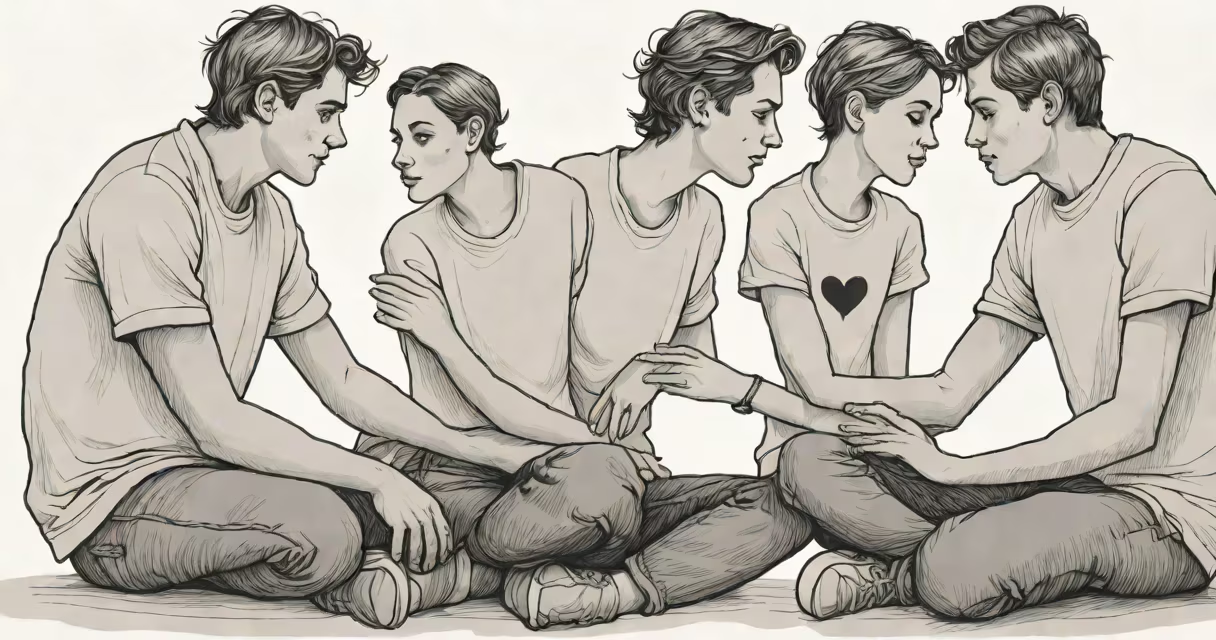
Asexual means experiencing little to no sexual attraction to others. Aromantic means experiencing little to no romantic attraction. These identities exist on spectrums and do not imply a lack of desire for intimacy or relationships.
Asexuality is not celibacy. Celibacy is a choice to abstain from sex. Asexuality is a lack of sexual interest, regardless of opportunity. Aromanticism is not loneliness. It's a pattern of emotional and relational experience distinct from romantic norms. Both identities are valid and recognized by major mental health organizations.
The American Psychological Association (APA) states that asexuality is a legitimate sexual orientation, not a disorder or medical condition. The World Health Organization (WHO) includes "lack of sexual attraction" as a normal variation in human sexuality. These positions reject pathologizing identities that don't fit heterosexual or romantic norms.
Asexual individuals may still experience physical arousal, affection, or emotional connection. They may engage in sexual activity for reasons such as pleasing a partner, curiosity, or cultural pressure-but they do not feel sexual desire. This distinction matters: desire is not the same as behavior.
Aromantic people may form deep, meaningful bonds without romantic feelings. They might describe friendships as fulfilling, or choose partnerships based on companionship, shared values, or practical support. Romantic love is not required for emotional satisfaction or long-term commitment.
Some people identify as both asexual and aromantic. Others are only one or the other. Identity labels are personal. Not everyone uses the terms "asexual" or "aromantic"-some prefer "gray-asexual," "demisexual," or "non-romantic." These terms reflect nuances in experience rather than rigid categories.
There is no single way to be asexual or aromantic. People experience varying levels of attraction across time and context. The following table outlines common identity labels and their meanings:
| Label | Meaning | Example |
|---|---|---|
| Asexual | Lacks sexual attraction | Someone who feels no desire for sex, even with someone they care deeply about. |
| Gray-asexual | Experiences sexual attraction rarely or weakly | Feels attraction only under specific conditions, like intense emotional bonding. |
| Demisexual | Only experiences sexual attraction after forming a strong emotional bond | Can't feel sexual interest until trust and closeness develop. |
| Aromantic | Lacks romantic attraction | Feels close to friends but doesn't want to date or pursue romance. |
| Gray-romantic | Experiences romantic feelings occasionally or faintly | May have crushes but finds them fleeting or unfulfilling. |
These labels aren't diagnostic tools. They're ways people describe themselves. Some use multiple labels. Others don't use any. Identity is not dependent on fitting a definition.
Many assume asexual people are "broken" or "repressed." This is false. Asexuality is not caused by trauma, fear, or hormonal imbalance. It's a natural variation in human experience. Research published in the Journal of Sex Research found that 1% of adults in the U.S. identify as asexual, with higher rates among younger populations.
Another myth is that aromantic people are cold or incapable of love. That's incorrect. Love exists in many forms-familial, platonic, spiritual, communal. Aromantic individuals often express deep loyalty, empathy, and care. They may prioritize friendship, mentorship, or community over romantic partnership.
One non-obvious fact: asexual and aromantic identities are not tied to gender. A person of any gender can be asexual or aromantic. Trans and nonbinary people report similar rates of asexuality and aromanticism as cisgender people. The presence of these identities across diverse gender groups shows they are not linked to biological sex or gender roles.
I met a friend at a community art event who described herself as aromantic. She had a close-knit group of friends, volunteered weekly, and lived with her sister. She said she'd never felt drawn to dating or romantic gestures. "I love my friends deeply," she told me, "but I don't want to hold hands or call someone 'my person.' That's not how I connect." Her relationship model was based on mutual respect and shared interests-not romance.
Another example: a 22-year-old college student I spoke with identified as gray-asexual. He said he'd had sex once during a relationship but didn't enjoy it. "I wasn't turned on," he said. "I did it because my partner wanted to. I felt obligated, not excited." After ending the relationship, he explored his identity through online forums and discovered the term "gray-asexual." He now lives with clarity and peace about his needs.
Both stories reflect lived reality-not theory. They show that asexuality and aromanticism are not absences of feeling, but different ways of relating to others.
Some confuse asexuality with asexuality-related disorders like hypoactive sexual desire disorder (HSDD). But HSDD is a clinical diagnosis involving distress or impairment. Asexuality does not require treatment. The DSM-5 does not classify asexuality as a mental illness.
Others mistake aromanticism for autism or social anxiety. While some autistic people are aromantic, the two are not equivalent. Aromanticism is about attraction patterns, not neurodivergence. A person can be highly social and emotionally expressive while being aromantic.
Another error: assuming that asexual people cannot have satisfying relationships. A couple I know-both asexual-have been together for eight years. They share a home, cook meals, travel, and support each other emotionally. Their relationship is intimate, but not sexual. They call it "platonic marriage." It works for them.
Asexual and aromantic mean lacking sexual or romantic attraction. These identities are not disorders, choices, or deficiencies. They are natural parts of human diversity. Understanding them requires moving beyond assumptions about love, sex, and connection.
People may identify differently over time. Labels are tools, not prisons. If you're exploring your own identity, consider resources from the Asexual Visibility and Education Network (AVEN) or the National Center for Transgender Equality. You're not alone.
If you're learning about these identities for the first time, remember: seeing someone who doesn't want romance or sex doesn't mean they're unhappy. It means they experience the world differently-and that's valid.