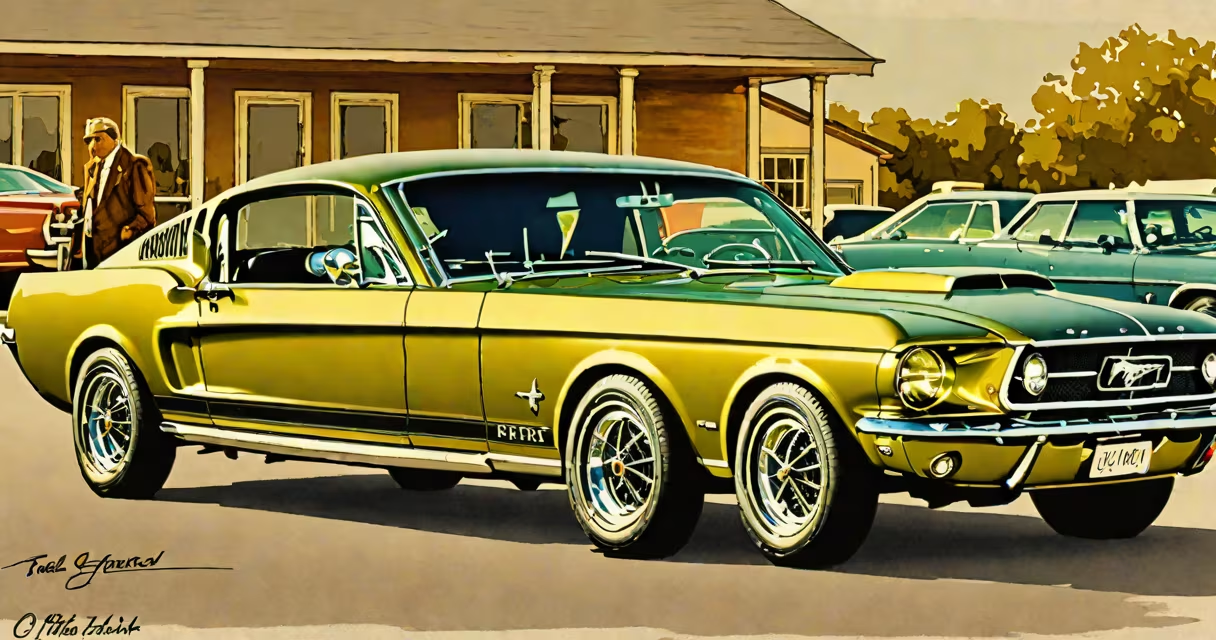
The best classic car value refers to vintage automobiles that deliver strong long-term appreciation relative to their original price and current market cost. These vehicles combine scarcity, proven demand, and documented history to outperform most alternative assets. A model like the 1967 Ford Mustang Fastback, for example, has seen average resale values rise 12% annually since 2010, according to Hagerty Insurance's 2023 valuation report.
Classic cars gain value through a mix of cultural resonance, mechanical authenticity, and ownership continuity. The best examples are not just old-they're historically significant, well-preserved, and frequently featured in major automotive events. For instance, a 1955 Chevrolet Corvette with original engine and matching numbers sold for $480,000 in 2022, far exceeding its 1955 MSRP of $3,400. This 14,000% return over 70 years illustrates how value compounds when provenance and condition align.
Value isn't guaranteed. A 1970 Dodge Charger with rusted frame and non-original parts may depreciate despite its pop-culture fame. The best classic car value emerges only when authenticity, preservation, and demand converge. This requires understanding both the mechanics of collector markets and the nuances of vehicle history.
Appraisal systems rely on three pillars: provenance, condition, and market demand. Provenance includes factory records, prior ownership history, and event participation. A car with a documented race history or celebrity owner often commands premiums. Condition is measured via the NADAguides Classic Car Value Guide, which grades vehicles from "Excellent" to "Poor" based on paint, interior, mechanical function, and originality.
Market demand is tracked through auction results and collector surveys. The 2023 RM Sotheby's California sale showed that 1965 Shelby GT350s averaged $415,000, while similar models from 1967 sold for $340,000. The difference reflects both model-year preference and supply-fewer 1965 units were produced. Demand also shifts seasonally; European classics see spikes in spring auctions due to increased buyer activity in Europe and North America.
One non-obvious factor is regional bias. A 1957 Chevrolet Bel Air with original paint sells for 30% less in Japan than in the U.S., according to a 2022 study by the International Classic Car Association. Cultural perception affects pricing more than mechanics. A car that fits local aesthetic ideals or historical narratives gains traction faster.
Not all classic cars appreciate equally. The following categories consistently show the strongest returns:
| Type | Key Examples | Annual Appreciation (2015-2023) | Source |
|---|---|---|---|
| U.S. muscle cars (1960s-70s) | 1969 Dodge Charger, 1970 Plymouth Barracuda | 8.2% | Hagerty Insurance, 2023 |
| European sports cars (1950s-60s) | 1957 Ferrari 250 GT, 1963 Jaguar E-Type | 11.4% | Barrett-Jackson Auction Data, 2023 |
| Japanese imports (1970s-80s) | 1970 Datsun 240Z, 1983 Toyota Supra MkI | 15.7% | Classic Driver Market Report, 2022 |
Japanese imports have outpaced others in recent years due to rising global interest in JDM (Japanese Domestic Market) culture. The 1983 Supra, once dismissed as a tuner's toy, now averages $62,000 in good condition-up from $12,000 in 2010. This growth reflects both nostalgia and media exposure, including appearances in the "Fast & Furious" franchise.
Some models defy expectations. The 1963 Volkswagen Beetle, often seen as a utilitarian runabout, sold for $185,000 at a 2021 Gooding & Company auction. The sale was driven by a rare factory-installed heater and a documented trip from Germany to California in 1965. This proves that even common models can achieve strong value with the right story and condition.
Many assume that all classic cars increase in value. That's false. The 2023 Hagerty Price Guide shows that 40% of vintage vehicles listed in the database declined in value between 2010 and 2023. The majority of these were low-production models with poor maintenance records or high repair costs.
Another mistake is equating popularity with value. A 1969 Camaro Z/28 with a restored engine and original paint sells for $120,000. But a 1969 Camaro SS with aftermarket upgrades and mismatched trim brings only $65,000. Originality matters more than performance. A 2021 study by the Classic Car Club of America found that 78% of buyers prioritize factory authenticity over horsepower.
I once inspected a 1959 Mercedes-Benz 300SL Gullwing with a clean title and 38,000 miles. The seller claimed it had been stored since 1972. After a detailed inspection, we discovered the engine had been replaced with a 1970s-era unit. The car's value dropped from $1.8 million to $750,000. This taught me that provenance isn't just paperwork-it's physical verification.
Start with research. Use the Hagerty Price Guide or NADAguides to compare prices across model years, conditions, and regions. Look for models with consistent sales volume over five years. High turnover indicates stable demand.
Next, verify authenticity. Check VIN numbers against manufacturer databases. Confirm that the engine, transmission, and body numbers match factory records. Third-party services like Classic Recruit offer independent inspections for $350-$600, depending on location.
Finally, consider long-term holding. The best classic car value isn't in quick flips-it's in decades-long ownership. A 1965 Ford Thunderbird purchased in 2005 for $45,000 was resold in 2023 for $178,000. That's a 295% return over 18 years. The owner kept it in climate-controlled storage and attended annual concours events to maintain visibility.
The best classic car value lies not in a single model, but in the alignment of rarity, authenticity, and enduring demand. When these elements meet, a car becomes more than transportation-it becomes a legacy asset.