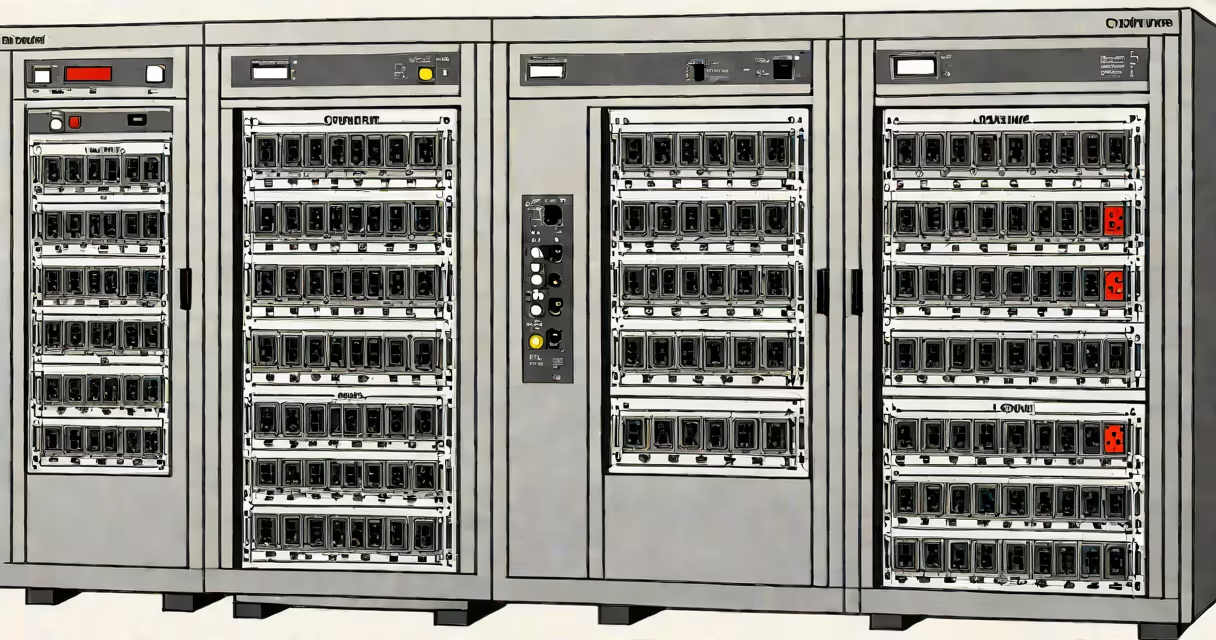
A power distribution unit (PDU) routes electrical power from a main source to multiple devices in a server rack or data center, providing controlled, monitored, and protected power delivery. It acts as a central hub for managing electricity flow to servers, switches, and storage systems, reducing the risk of overloads and outages.
PDUs are essential in environments where consistent, reliable power is critical. They prevent circuit overloads by limiting current draw and often include surge protection and circuit breakers. Some models offer remote monitoring, allowing administrators to track power usage in real time and shut off individual outlets during maintenance or emergencies.
According to the Uptime Institute's Tier Standard, PDUs are a required component in Tier III and IV data centers, where redundancy and fault tolerance are mandatory. The National Fire Protection Association (NFPA) 75 standard also requires proper power distribution methods in IT equipment rooms to reduce fire hazards from electrical faults.
A PDU receives power through a main input cable, typically from a UPS or dedicated branch circuit. Inside, it splits that power into multiple output circuits using internal wiring and circuit breakers. Each outlet or group of outlets can be independently monitored or controlled.
Basic PDUs simply distribute power with no monitoring. Smart PDUs include sensors that measure voltage, amperage, and power consumption per outlet. They send this data via SNMP, HTTP, or Modbus protocols to network management software. This allows administrators to detect spikes, identify underused outlets, and enforce power budgets.
For example, a 30-amp PDU with 20 outlets can deliver up to 3,600 watts (at 120V). If five servers each draw 300 watts, the total load is 1,500 watts-well within capacity. But if a sixth device draws 1,000 watts, the PDU may trigger an alarm or trip a breaker to prevent overheating.
PDUs come in several configurations based on function and environment:
| Type | Features | Best For |
|---|---|---|
| Basic PDU | Fixed outlets, no monitoring, manual switch | Low-risk environments, small offices |
| Smart PDU | Remote outlet control, real-time metering, alarms | Data centers, cloud infrastructure |
| Rack-Mount PDU | Designed to fit in 19-inch server racks | High-density server rooms |
| Wall-Mount PDU | Compact, installed on walls or behind equipment | Small offices, edge computing sites |
Smart PDUs with remote on/off capability are especially useful during maintenance. In one incident at a mid-sized colocation facility, a technician remotely powered down a malfunctioning server during a scheduled outage window, avoiding a physical site visit and reducing downtime by 45 minutes.
PDUs are not interchangeable with power strips. A power strip lacks overload protection, circuit monitoring, and standardized electrical ratings. Using a power strip in a server room risks tripping breakers or causing fires-especially when connecting multiple high-wattage devices.
Many assume PDUs are just "heavy-duty power strips." That's incorrect. A PDU is engineered for continuous operation under load, with thermal management, surge suppression, and compliance with industrial standards like IEC 60601-1 for medical and industrial safety.
Another misconception is that all PDUs support remote access. Only smart PDUs have network interfaces. Basic models lack IP addresses, web servers, or APIs. Attempting to monitor a basic PDU via software will return no data.
There's also confusion between PDUs and UPS units. A UPS provides backup power during outages. A PDU manages and distributes power. They're often used together-UPS feeds the PDU, which then powers the rack. In a 2022 outage at a financial services provider, a failed UPS caused a system crash. The PDU had no failover logic because it wasn't designed to handle battery backup-it only distributed power.
Consider a 48U server rack housing 12 blade servers, 4 network switches, and 2 storage arrays. Total power draw averages 4,200 watts. A single 30-amp PDU (120V) can supply up to 3,600 watts-insufficient. So two PDUs are used, each drawing from a separate circuit breaker.
Each PDU has 16 outlets. The servers are plugged into outlets with higher amperage limits. The switches go into outlets with surge protection. The storage range uses a dedicated outlet with a ground fault interrupter.
Using a smart PDU, the system logs power draw every 15 seconds. Over a week, the average load per outlet is 250W. One outlet shows a spike to 1,100W. The system alerts the admin, who discovers a misconfigured cooling fan drawing excessive current. The issue is corrected before the circuit trips.
This setup prevented a potential blackout during peak hours. Without the PDU's monitoring, the problem would have gone unnoticed until a failure occurred.
When setting up a new data center, I once oversaw the installation of 48 PDUs across four racks. We used a centralized monitoring tool to track all units. During a power audit, we discovered that 14% of outlets were unused-reducing energy waste and improving efficiency. This data informed future equipment placement and power budgeting.
Understanding what a power distribution unit does ensures reliability, safety, and efficiency in any environment where IT hardware depends on stable power. It's not just a box with plugs-it's a core element of operational continuity.