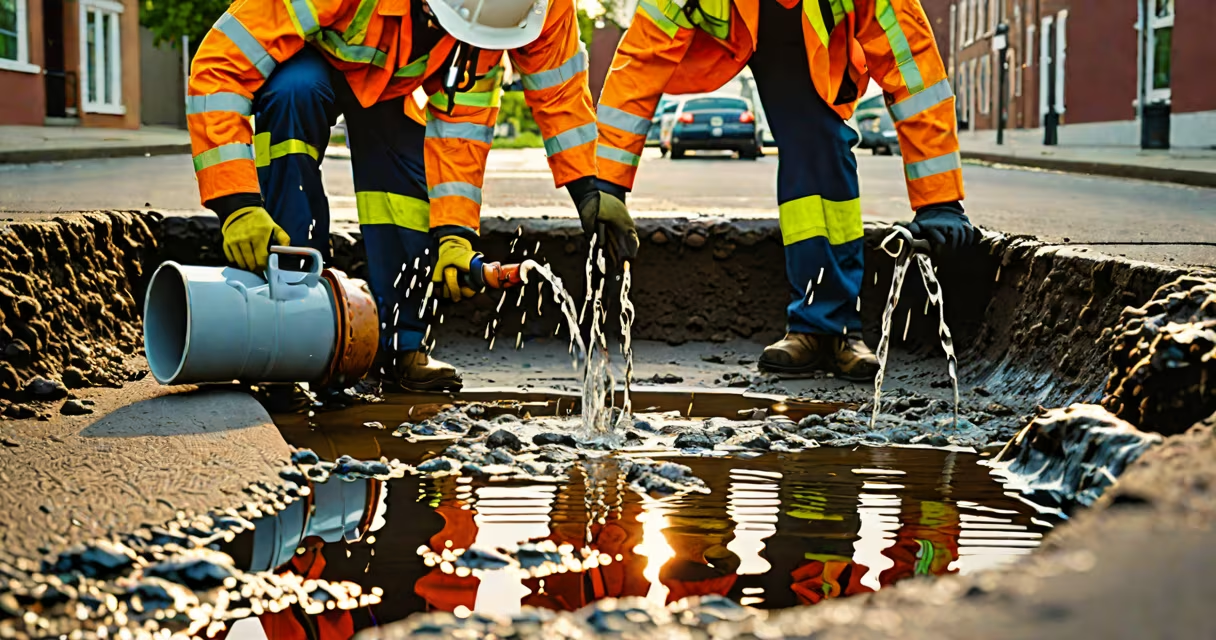
Water main breaks happen when underground pipes transporting treated water to homes and businesses rupture due to material fatigue, external stress, or environmental factors. These failures disrupt service, waste resources, and risk property damage.
Most water mains are made of cast iron, ductile iron, or asbestos cement, installed between 1940 and 1980. Over time, internal corrosion and external soil pressure weaken them. A single break can release up to 1 million gallons of water per day, according to the American Society of Civil Engineers (ASCE).
Breaks often occur during winter months when temperature drops below freezing. Water expands when frozen, increasing internal pressure beyond the pipe's tolerance. A 2021 study by the Environmental Protection Agency (EPA) found that 62% of major water main failures in the U.S. occurred between December and February.
Water mains operate under constant pressure, typically between 40 and 100 psi. When internal corrosion eats through the pipe wall, small leaks form. Over time, these grow into full ruptures. External forces like heavy traffic or ground shifting can accelerate this process.
Hydraulic transients-sudden pressure spikes caused by pump startups or valve closures-also contribute. A 2019 report from the Water Research Foundation identified transient pressure events as a leading cause of unexpected breaks, especially in older systems.
Freezing conditions are a major trigger. When soil moisture enters microcracks in pipes, freezing expands the water and fractures the pipe. This is common in regions with frequent freeze-thaw cycles, such as the Northeast U.S. and parts of Canada.
Different pipe materials degrade in distinct ways. Cast iron pipes, widely used before 1970, suffer from internal rust buildup. Ductile iron, introduced in the 1970s, resists cracking better but still corrodes over decades. Asbestos cement pipes, once popular, become brittle and prone to shattering under stress.
| Material | Typical Lifespan | Primary Failure Mode | Common Replacement Age |
|---|---|---|---|
| Cast iron | 50-70 years | Internal corrosion, scale buildup | 60 years |
| Ductile iron | 70-100 years | External corrosion, joint failure | 80 years |
| Asbestos cement | 40-60 years | Brittleness, cracking under load | 50 years |
Modern systems increasingly use HDPE (high-density polyethylene) and PVC pipes, which resist corrosion and handle pressure well. However, they're not immune to damage from excavation or rodent gnawing.
Urban areas with dense infrastructure face higher risks. New York City reported 1,200 water main breaks in 2022 alone, averaging nearly 3 per day. Most occurred in neighborhoods with pipes older than 75 years.
Soil conditions play a role. Clay-rich soils expand when wet, exerting uneven pressure on pipes. Sandy soils allow more movement, increasing stress at joints. A 2020 study in the Journal of Infrastructure Systems linked 38% of breaks in California to soil instability near fault lines.
Construction activity is a direct threat. Digging near buried mains can damage joints or puncture walls. In 2021, a construction crew in Chicago severed a 24-inch main while installing fiber-optic cables, causing a 12-hour outage and $2.3 million in repair costs.
Residents often confuse water main breaks with localized plumbing issues. A sudden drop in water pressure or discolored water may signal a problem, but not necessarily a main break. Discoloration usually results from sediment stirred up by nearby repairs, not a rupture.
Another misconception is that all breaks are sudden. Many start as slow leaks that go undetected for weeks. The EPA estimates that 40% of water loss in U.S. systems comes from undetected leaks, not catastrophic failures.
Some assume breaks only happen in cold climates. But heat and drought also cause problems. High temperatures increase pipe stress, and dry soil shrinks around pipes, creating gaps that allow air and water to mix, accelerating corrosion.
In January 2022, Boston experienced a 10-day stretch of sub-zero temperatures. The city's Department of Public Works recorded 47 water main breaks, mostly in neighborhoods with cast iron mains installed in the 1940s.
One incident occurred on Beacon Street. A 12-inch cast iron pipe failed at 3:17 a.m., releasing approximately 1.2 million gallons of water. The burst flooded a subway station entrance and damaged electrical equipment. Repair crews took 36 hours to isolate the line and replace the section.
The city later confirmed that the failure was due to a combination of freezing water in a partially drained section and long-term internal corrosion. This case illustrates how multiple factors-age, material, weather-interact to cause failure.
Cities now use acoustic monitoring systems to detect early signs of leaks. Sensors placed along pipelines listen for high-frequency sounds produced by escaping water. The system alerts operators before a break occurs.
Advanced modeling tools predict failure hotspots using data on pipe age, material, flow rates, and historical break records. Philadelphia's water department reduced break frequency by 33% between 2018 and 2023 after implementing predictive maintenance software.
Regular pipe replacement programs are critical. The ASCE estimates that replacing all U.S. water mains at current rates would take 75 years. Federal funding through the Bipartisan Infrastructure Law aims to speed this process, allocating $5 billion for water system upgrades by 2026.
During my time working with a municipal water authority in Oregon, I observed a 48-hour response drill involving 12 teams. We simulated a main break in a downtown district. The exercise revealed that communication delays between departments were the biggest bottleneck-not technical failure.
Water main breaks result from aging infrastructure, environmental stress, and operational pressures. Corrosion, freezing, and external damage are primary causes. Material type and installation date determine failure likelihood.
Prevention relies on proactive monitoring, data-driven replacement schedules, and emergency preparedness. Cities with modernized systems see fewer outages and lower repair costs.