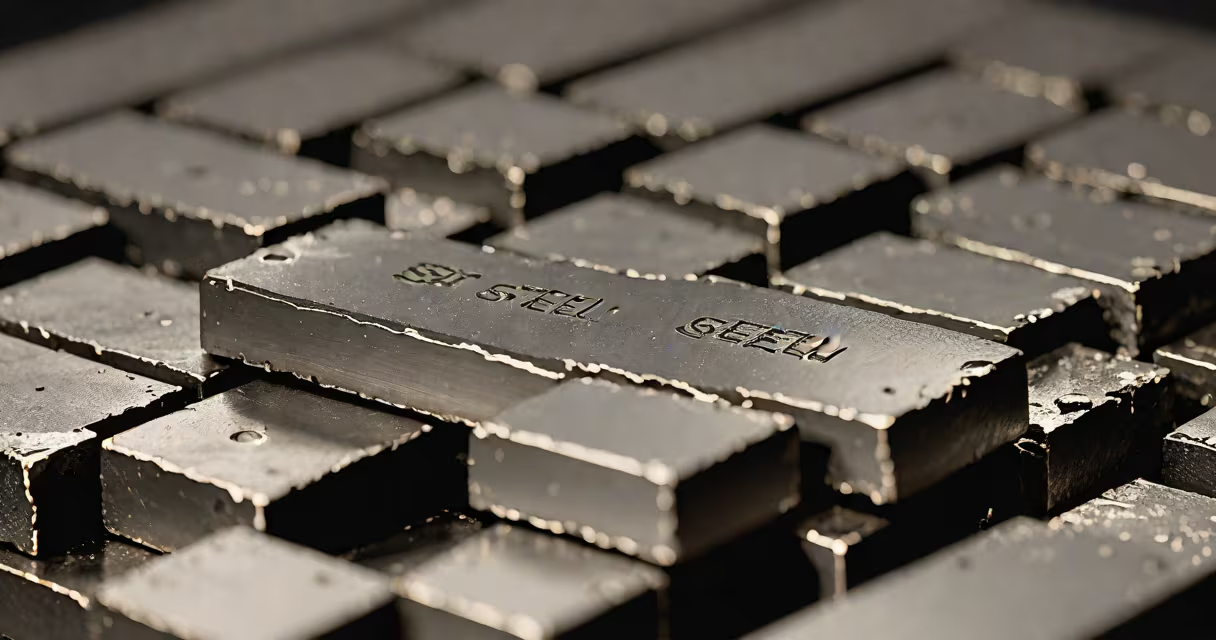
Steel billets are rectangular or square-shaped blocks of semi-finished steel, typically 150-250 mm wide and 150-250 mm high, produced by continuous casting molten steel. They serve as the primary feedstock for rolling mills that produce finished steel products like rebar, wire rod, and structural beams.
These billets are not usable in final form. Instead, they are reheated and passed through rolling mills to reduce thickness and elongate the material into specific shapes. The process begins with liquid steel poured into a mold, cooled rapidly, and pulled out as solidified billets.
According to the American Iron and Steel Institute (AISI), over 70% of U.S. steel production passes through billet stages before final shaping. This step ensures consistent quality and dimensional accuracy in downstream products.
Steel billets originate from basic oxygen furnaces (BOFs) or electric arc furnaces (EAFs), where scrap metal or iron ore is melted and refined. After refining, the molten steel is transferred to a continuous caster-a machine that pours the liquid into a water-cooled mold.
As the steel exits the mold, it is supported by rollers and continuously drawn downward while cooling. Within minutes, it solidifies into a long, uniform billet. The entire process takes less than 30 minutes from pour to exit.
A single continuous caster can produce up to 150 tons of billets per hour. For example, Nucor's facility in Crawfordsville, Indiana, produces over 1 million tons of billets annually using this method.
Billets are categorized by size, shape, and intended application. Standard sizes include:
| Size Range (mm) | Shape | Common Use |
|---|---|---|
| 150 × 150 to 250 × 250 | Square or rectangular | Rebar, structural beams, rail profiles |
| 100 × 100 to 150 × 150 | Square | Wire rod, small-diameter bars |
| 200 × 300 | Rectangular | Heavy structural components |
High-strength alloy billets, such as those containing chromium or nickel, are used in oil and gas pipelines or aerospace components. These require tighter tolerances and specialized casting techniques.
One non-obvious fact: billets are often stored at temperatures above 1,000°C before rolling. This reheating prevents cracking during deformation and ensures uniform plasticity. Rolling mills operate at speeds exceeding 10 m/s, making thermal control critical.
Steel billets are the bridge between raw steel and finished goods. Without them, rolling mills would have to start from ingots-larger, heavier, and less efficient blocks requiring longer processing times.
For example, a 20-meter-long billet weighing 1.5 metric tons can be rolled into approximately 120 meters of 20 mm diameter rebar. This conversion achieves near 95% yield efficiency, minimizing waste compared to older methods.
They are essential in infrastructure projects. The construction of the Second Avenue Subway in New York City relied on over 10,000 tons of billets processed into reinforcing bars. Each bar was derived from a billet cast at a plant in Pennsylvania.
Steel billets are often mistaken for ingots or slabs. Ingots are large, irregularly shaped blocks cast in molds and require extensive remelting. Slabs are wider and thinner than billets and are used primarily for flat-rolled products like sheets and plates.
Another misconception is that billets are interchangeable across industries. In reality, billets for automotive parts must meet stricter surface finish and inclusion standards than those used in construction. A billet with visible cracks or porosity may be rejected for high-tolerance applications.
I once visited a rolling mill in Ohio where a billet failed inspection due to internal voids detected via ultrasonic testing. The billet was rerouted to a lower-grade product line, illustrating how quality control impacts downstream value.
While steel billets are foundational, they differ from materials like electrical steel, which is specifically designed for magnetic applications in transformers and motors. Electrical steel undergoes special annealing and grain orientation processes not required for standard billets.
Understanding what are steel billets reveals their central role in modern industry. They are not just intermediate products-they are engineered components that determine the performance, cost, and sustainability of the final steel goods.