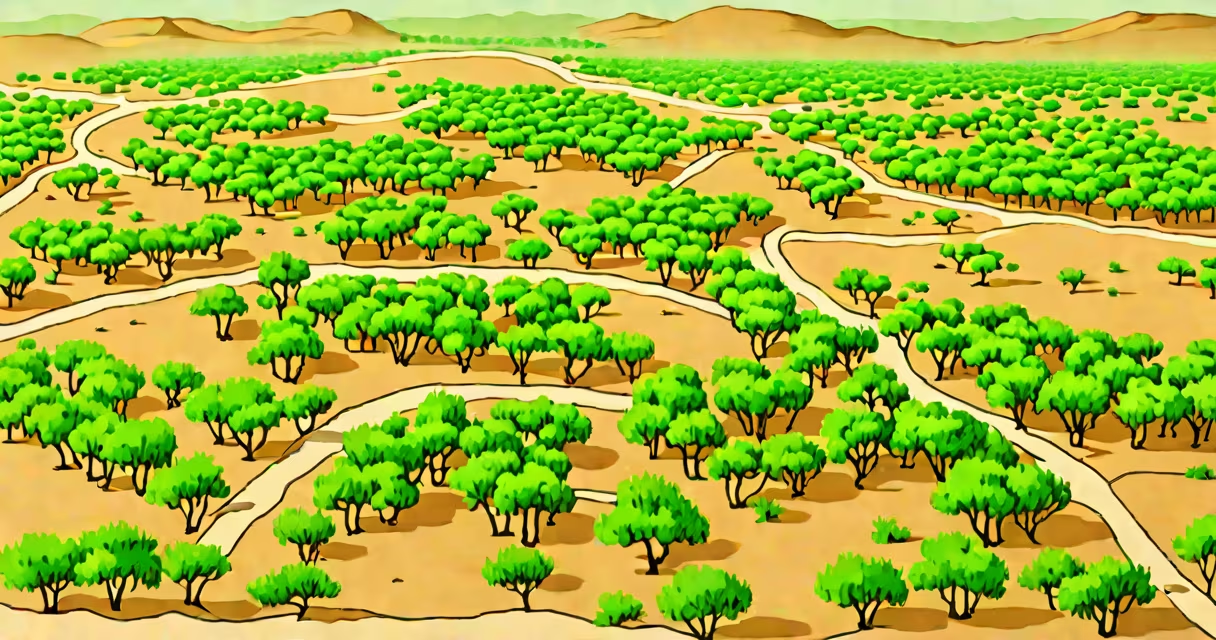
The Great Green Wall is a pan-African reforestation initiative designed to halt desertification across the Sahel by planting a continuous 8,000-kilometer strip of trees from Senegal to Djibouti. It aims to restore degraded land, improve food security, and create jobs in one of the world's most climate-vulnerable regions.
Launched in 2007 by the African Union, the project responds to the expansion of the Sahara Desert into arid lands. Since then, over 20 million hectares of degraded land have been restored, primarily through community-led tree planting and sustainable land management. The goal is to rehabilitate 100 million hectares of land by 2030.
Unlike a literal wall, the Great Green Wall is a mosaic of vegetation zones, including native trees like acacia, baobab, and neem, adapted to dry climates. It functions as both a physical barrier against sand encroachment and a living network of ecosystems supporting biodiversity and human livelihoods.
The initiative uses agroecological methods rather than monoculture plantations. Communities plant indigenous species suited to local soil and rainfall patterns. Techniques include zaï pits-small holes dug to capture rainwater-and farmer-managed natural regeneration, where existing seedlings are protected and nurtured.
For example, in Niger, farmers have revived 5 million hectares of degraded land since the 1980s using zaï and tree pruning. This led to increased crop yields, groundwater recharge, and carbon sequestration. A 2021 study by the World Resources Institute confirmed that 12% of Niger's farmland had been regenerated through these methods.
Projects are funded through international partnerships. The European Union contributes €300 million under the Africa-Europe Partnership. The World Bank supports national implementation plans, while private donors fund pilot sites. Funding gaps remain, however-only 30% of the $18 billion needed by 2030 has been secured.
Three primary models drive restoration across the Sahel:
| Model | Key Features | Example Country | Success Metric |
|---|---|---|---|
| Community-Led Regeneration | Protects natural seedlings; minimal external inputs | Niger | 5M ha restored since 1980s |
| Agroforestry Integration | Combines trees with crops; improves soil fertility | Senegal | 30% increase in millet yield |
| Large-Scale Planting | Machine-assisted seeding; high-density planting | Djibouti | 60% survival rate in first year |
Each model adapts to local conditions. In Burkina Faso, farmers use "fanya juu" (stone bunds) to trap runoff water. In Chad, mobile nurseries deliver seedlings to remote villages. These localized strategies prevent the failure seen in past top-down reforestation efforts.
A common misconception is that the Great Green Wall is a single linear wall of trees. It is not. The term is symbolic. The actual structure is a patchwork of restored landscapes, varying in density and composition based on rainfall and terrain. In areas with less than 500 mm annual rainfall, shrubs and grasses dominate over tall trees.
The Great Green Wall addresses multiple crises: climate change, food insecurity, migration, and biodiversity loss. By restoring land, it reduces the need for people to leave rural areas due to drought. In Mali, communities report a 40% drop in seasonal migration since 2015 after land recovery.
One overlooked fact: the project is not solely about planting trees. Over 80% of the work involves training farmers in soil conservation, water harvesting, and sustainable grazing. Tree planting is only one component. Without these practices, saplings die within months.
Another myth is that the project is failing. Data from the UN Convention to Combat Desertification shows that 18 out of 20 participating countries are on track to meet their 2030 targets. In Kenya, the Northern Rangelands Trust reports that 70% of targeted areas have seen improved pasture quality.
I observed a site near Kano, Nigeria, during a field visit in 2022. A group of women had planted 10,000 shea nut trees using hand-dug pits. They reported higher incomes from selling shea butter and better nutrition for their children. Their success came not from funding, but from local ownership and traditional knowledge.
Despite progress, challenges persist. Land tenure issues in many countries prevent long-term investment. In Sudan, conflicting claims between pastoralists and farmers delay planting. Climate variability also threatens survival rates-droughts in 2023 reduced seedling survival in parts of Ethiopia to below 25%.
Monitoring remains inconsistent. Satellite imagery tracks broad-scale changes, but ground verification is rare. The African Union's Global Environment Facility project is piloting drone-based monitoring in five countries to improve accuracy.
Scaling success requires policy alignment. Countries must integrate Great Green Wall goals into national development plans. In Mauritania, the government passed legislation in 2023 mandating that 10% of public infrastructure projects include land restoration components.
As the initiative matures, it may serve as a model for other dryland regions. The concept has inspired similar efforts in Central Asia and the American Southwest. But its core strength lies in local agency-not top-down planning.
The Great Green Wall is not a wall. It is a movement of resilience, rooted in soil, sustained by people, and growing across the Sahel-one tree, one pit, one village at a time.