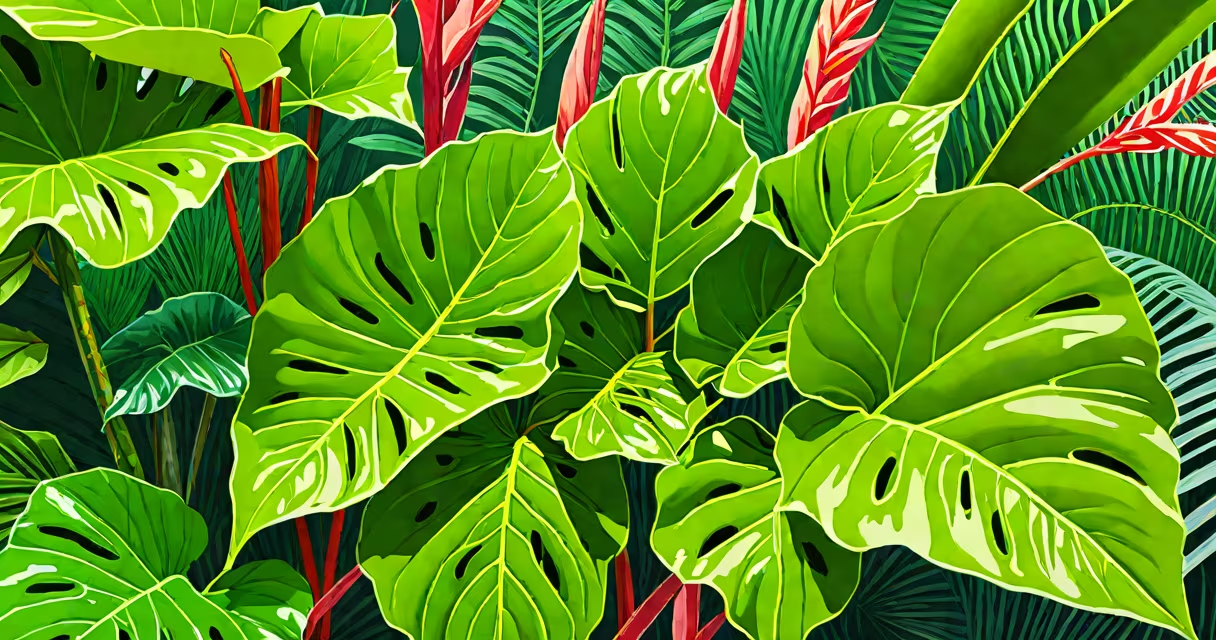
Rainforests host an estimated 50% of Earth's plant species, including towering trees, climbing vines, and delicate epiphytes adapted to high humidity and dense shade. These ecosystems thrive in equatorial regions like the Amazon, Congo Basin, and Southeast Asian islands, where annual rainfall exceeds 1,500 mm.
Plants in the rainforest occupy distinct vertical layers-canopy, understory, and forest floor-each shaped by light availability and competition. Canopy trees like the kapok (Ceiba pentandra) grow over 60 meters tall, their broad leaves capturing most sunlight. Understory shrubs such as the wild vanilla vine (Vanilla planifolia) survive in low light using large, thin leaves to maximize photosynthesis. Forest-floor plants like the giant elephant ear (Alocasia macrorrhizos) rely on rare light gaps created by fallen trees.
Many rainforest plants have evolved unique survival strategies. Epiphytes such as bromeliads grow on tree branches without harming hosts, collecting water in their central rosette. This adaptation allows them to access moisture and nutrients from airborne particles and rainwater. Another example is the strangler fig (Ficus spp.), which begins life as an epiphyte, sending roots downward until they encircle and eventually replace the host tree.
Understanding rainforest flora requires distinguishing between functional groups based on structure, growth habit, and ecological role.
| Type | Examples | Adaptation | Ecological Role |
|---|---|---|---|
| Canopy Trees | Kapok, mahogany, ceiba | Large, waxy leaves; buttress roots for stability | Provide habitat; regulate microclimate |
| Epiphytes | Bromeliads, orchids, staghorn ferns | Water-storing structures; aerial roots | Contribute to nutrient cycling; offer shelter |
| Vines & Lianas | Monkey ladder, rattan | Flexible stems; rapid upward growth | Connect canopy layers; support animal movement |
| Understory Shrubs | Wild vanilla, heliconia | Large, thin leaves; shade tolerance | Support pollinators; stabilize soil |
| Forest Floor Plants | Elephant ear, corpse flower | Fast growth; exploit light gaps | Recycle nutrients; seed dispersal |
A common misconception is that all rainforest plants are large or lush. In reality, many species are small, cryptic, or seasonally dormant. For example, the Rafflesia arnoldii-the world's largest single flower-blooms only once every few years and emits a foul odor to attract pollinating flies. Its size (up to 1 meter wide) belies its rarity and fragile lifecycle.
Another overlooked fact: over 25% of modern pharmaceuticals originate from rainforest plants. The anti-cancer drug vincristine comes from the Madagascar periwinkle (Catharanthus roseus), while quinine, used to treat malaria, was first isolated from the bark of the Cinchona tree native to the Andes and Amazon. These examples show that what are some plants in the rainforest includes species with direct human health benefits.
Rainforests exist in tropical zones near the equator due to consistent warmth and heavy precipitation. The Amazon basin alone contains over 400 billion individual trees across 16,000 species. This density supports complex food webs and symbiotic relationships.
For instance, the Brazil nut tree (Bertholletia excelsa) depends entirely on a specific species of orchid bee (Euglossa spp.) for pollination. Without these bees, the tree cannot reproduce. Similarly, the fig wasp (Pegoscapus spp.) has a mutualistic relationship with fig trees-each fig species hosts a unique wasp species that lays eggs inside the fruit, ensuring both species' survival.
These interdependencies show why removing even one plant species can disrupt entire ecosystems. A study published in *Nature* (2021) found that deforestation in the Amazon reduces regional rainfall by up to 20%, affecting plant germination and altering species distribution patterns.
People often assume that all rainforest plants are green and leafy. But many species display vivid colors-red, purple, or black-to deter herbivores or attract pollinators. The Heliconia rostrata, known as the lobster claw, produces red bracts that mimic the appearance of a lobster's claws, drawing hummingbirds for pollination.
Another misunderstanding is that rainforest soils are fertile. In fact, most tropical rainforest soils are nutrient-poor. Nutrients are rapidly recycled through the system-over 90% of nitrogen and phosphorus are stored in living biomass, not in the soil. When trees fall, decomposition releases nutrients quickly, supporting rapid regrowth.
When I visited the Daintree Rainforest in Queensland, Australia, I observed a cluster of pitcher plants (Nepenthes mirabilis) growing on a moss-covered log. Their modified leaves form urn-shaped traps filled with digestive fluid. They capture insects to supplement nitrogen in the soil. This carnivorous behavior is rare among rainforest plants but essential in nutrient-deficient environments.
Consider the use of the rubber tree (Hevea brasiliensis), native to the Amazon. Indigenous tribes in the region used latex from this tree for waterproofing and sealing. Today, commercial rubber production relies on cultivated plantations derived from wild Amazonian stocks. Over 12 million tons of natural rubber are produced annually, much of it from cloned Hevea trees grown in Southeast Asia.
Another example: the kola nut (Cola acuminata), native to West African rainforests. Its seeds contain caffeine and were traditionally chewed during ceremonies and long journeys. Today, kola nuts are used in soft drink flavoring and energy supplements. The global market for kola-based products exceeds $1.2 billion annually.
Even ornamental plants from rainforests have economic value. The bird of paradise (Strelitzia reginae), native to South Africa's coastal forests, is widely cultivated for floral arrangements. Its striking orange-and-blue blooms last up to three weeks, making it a staple in international cut-flower trade.
Understanding what are some plants in the rainforest reveals more than biodiversity-it shows how deeply human life depends on these ecosystems. From medicine to materials, each species plays a role in sustaining both nature and society.