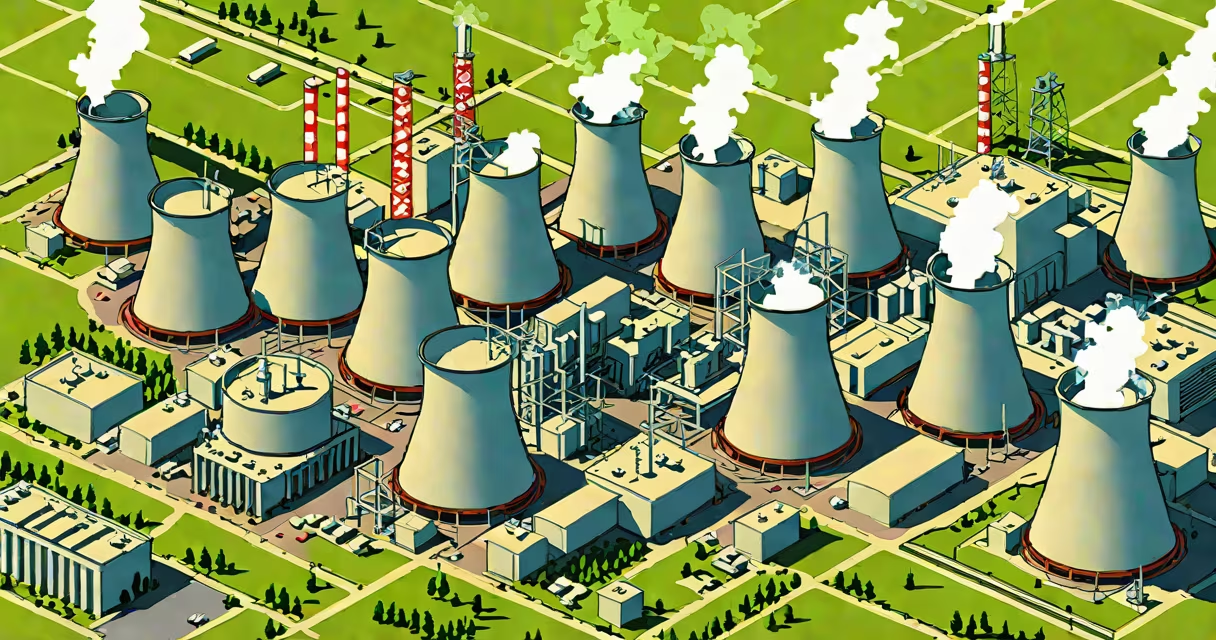
Power plants generate electricity by converting energy from fuels-such as coal, natural gas, uranium, or sunlight-into electrical current distributed through grids. They are the central nodes in national and regional energy systems, supplying power to cities, factories, hospitals, and homes.
Electricity demand varies daily, but power plants maintain continuous output by balancing supply with consumption. They operate 24/7, adjusting output based on grid signals. Without them, modern life as we know it-lighting, refrigeration, internet services, medical equipment-would cease.
Most power plants follow a thermodynamic cycle: heat creates steam, which spins turbines connected to generators. The spinning magnets inside the generator induce electric current in copper coils via electromagnetic induction.
For example, a typical coal-fired plant burns 10,000 tons of coal annually to produce 1 gigawatt-hour (GWh) of electricity. This process heats water in boilers to 540°C, producing high-pressure steam that drives turbine blades at 3,600 RPM. The mechanical rotation converts to alternating current (AC) at 50 or 60 Hz, matching grid frequency standards.
Nuclear plants use fission instead of combustion. A single uranium fuel rod, about 1 meter long, contains enough energy to power a city of 100,000 people for a year. The heat from splitting uranium atoms boils water to drive turbines-no carbon emissions during operation.
Power plants are categorized by primary fuel or energy source. Each type has distinct efficiency, cost, and environmental profiles.
| Type | Fuel Source | Typical Output Capacity | Emissions Profile |
|---|---|---|---|
| Coal-fired | Bituminous coal | 500 MW - 1,000 MW | High CO₂, SO₂, NOx, particulates |
| Natural Gas | Combustible hydrocarbons | 200 MW - 600 MW | Lower CO₂ than coal; some methane leakage |
| Nuclear | Uranium-235 | 800 MW - 1,200 MW | Zero operational CO₂; radioactive waste |
| Solar Photovoltaic | Direct sunlight | 10 MW - 500 MW (utility scale) | Zero emissions; intermittent |
| Wind Farms | Wind kinetic energy | 50 MW - 300 MW per site | Zero emissions; variable output |
Hydroelectric dams use falling water to spin turbines. The Grand Coulee Dam in Washington State generates 6,800 megawatts-enough for 2 million homes annually. However, such projects alter river ecosystems and displace communities.
Geothermal plants tap underground heat. The Geysers facility in California produces 725 MW using steam from fractured rock formations at 300°C. These plants have low land use and consistent output but require specific geological conditions.
People often assume all power plants run continuously. In reality, many adjust output based on demand. During peak hours, gas plants ramp up quickly; solar farms stop at night. Grid operators balance supply and demand in real time.
Another misconception: all power plants emit carbon dioxide. Nuclear and renewables do not release CO₂ during electricity generation. But construction, maintenance, and fuel transport still contribute to lifecycle emissions. According to the U.S. Energy Information Administration (EIA), nuclear plants emit 12 grams of CO₂ per kWh-lower than wind (11 g/kWh) and solar (48 g/kWh).
A lesser-known fact: most U.S. power plants are not owned by utilities. Independent power producers (IPPs) build and operate 40% of the nation's generating capacity. These entities sell electricity under long-term contracts to utilities, reducing capital risk.
Consider a typical weekday in Texas. At 6 a.m., solar panels begin producing 3 GW of power. By 7 a.m., demand rises. Wind farms contribute 5 GW. As the sun sets, solar output drops to zero. Natural gas plants increase output to 12 GW to meet evening demand.
At 10 p.m., demand peaks. Coal plants, previously idled, restart. The grid operator dispatches 8 GW from existing coal units and 4 GW from gas peakers. Total generation reaches 25 GW-matching load. All adjustments happen within seconds via automated control systems.
This coordination prevents blackouts. In 2021, Texas experienced a winter storm that caused 40% of power plants to fail. Over 4 million customers lost power. The event underscored that reliability depends not just on plant count, but on resilience and redundancy.
Do power plants cause pollution? Yes-but not all types equally. Fossil-fuel plants emit sulfur dioxide (SO₂), nitrogen oxides (NOx), and particulate matter. These pollutants trigger respiratory illness and acid rain. The World Health Organization estimates 7 million premature deaths annually due to air pollution, with power plants contributing.
Renewables avoid these emissions. However, manufacturing solar panels requires mining silicon and rare earth metals. Lithium-ion batteries for storage involve cobalt extraction-linked to child labor in the Democratic Republic of Congo. Lifecycle analysis shows solar and wind have lower environmental harm than fossil fuels, but not zero impact.
For context, the average U.S. coal plant emits 1,000 pounds of CO₂ per megawatt-hour. A natural gas plant emits 500 pounds. A utility-scale solar farm emits 48 pounds. Wind emits 11 pounds. These figures reflect full lifecycle emissions, including materials, transport, and decommissioning.
When evaluating energy choices, consider both immediate output and long-term footprint. A 100 MW solar farm in Nevada reduces annual CO₂ emissions by 120,000 metric tons compared to a coal plant. That's equivalent to removing 26,000 cars from roads each year.
Understanding the role of power plants reveals their centrality in modern society. They are not just machines-they are infrastructure that enables communication, transportation, healthcare, and economic activity. As climate goals tighten, the shift toward cleaner sources accelerates. Yet, even green plants require careful siting, maintenance, and policy support.