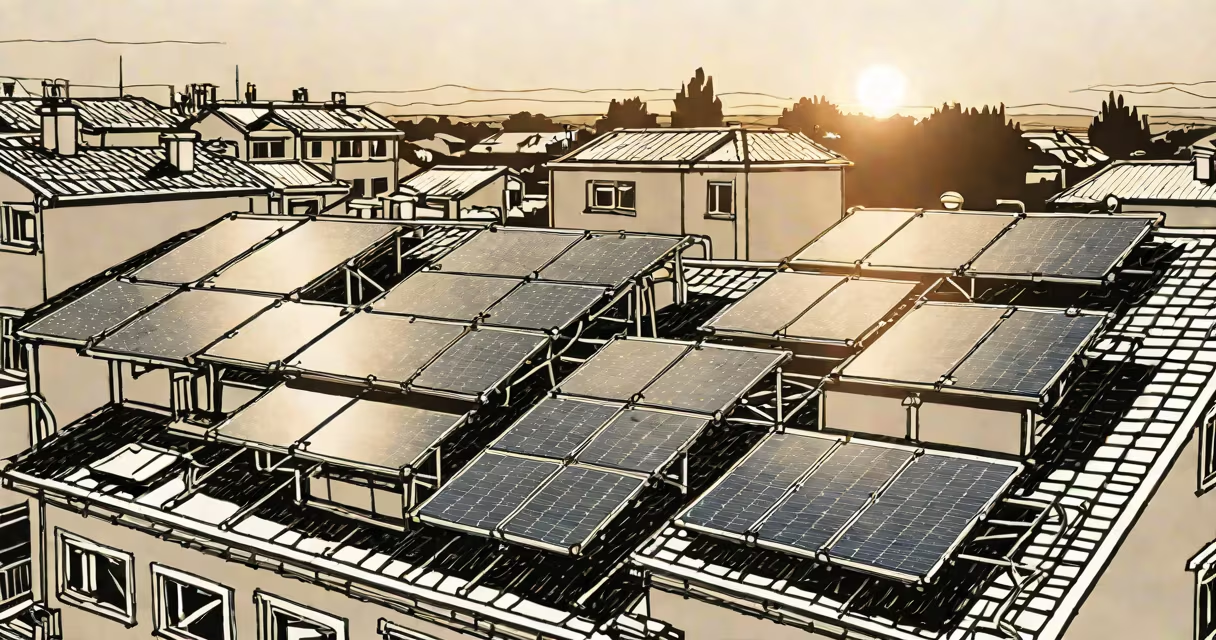
Solar energy is the process of converting sunlight into usable electricity or heat using technologies like photovoltaic cells or solar thermal collectors. This form of renewable energy relies on photons from the sun striking semiconductor materials, generating electric current through the photovoltaic effect.
Photons from sunlight strike the surface of a solar panel, typically made of silicon-based semiconductors. When these photons transfer enough energy to electrons in the material, they break free and flow as an electric current. This direct conversion of light to electricity powers homes, businesses, and utility-scale installations worldwide.
The global installed capacity of solar photovoltaic systems reached 1.2 terawatts by the end of 2023, according to the International Renewable Energy Agency (IRENA). That's enough to supply electricity to over 300 million households annually. Solar energy contributes less than 5% of total global electricity generation but grows faster than any other energy source.
At the core of solar energy systems is the photovoltaic (PV) cell. These cells are layered structures made of doped silicon-typically n-type (electron-rich) and p-type (hole-rich)-forming a p-n junction. When sunlight hits the junction, electron-hole pairs form. The built-in electric field separates these charges, driving electrons through an external circuit, producing direct current (DC).
For home or grid use, DC electricity passes through an inverter, which converts it to alternating current (AC). This AC power integrates with household wiring or feeds into the electrical grid. Modern inverters monitor voltage and frequency to maintain stable grid synchronization, meeting IEEE 1547 standards for grid interconnection.
A 6-kilowatt residential system in California generates approximately 9,000 kilowatt-hours per year. That's enough to offset the average U.S. household's annual electricity consumption, which is around 10,600 kWh per year, according to the U.S. Energy Information Administration (EIA).
Solar energy applications fall into two broad categories: photovoltaic and concentrated solar power (CSP).
| Type | Technology | Use Case | Efficiency Range |
|---|---|---|---|
| Photovoltaic (PV) | Silicon wafers, thin-film layers | Residential rooftops, commercial buildings, utility farms | 15%-22% (crystalline), 10%-13% (thin-film) |
| Concentrated Solar Power (CSP) | Parabolic troughs, heliostats, molten salt storage | Large-scale power plants, grid stability support | 20%-35% (with thermal storage) |
While PV dominates new installations due to lower costs and modular design, CSP excels in regions with high direct normal irradiance, such as the Mojave Desert. The Ivanpah Solar Electric Generating System in California uses 173,000 heliostats to focus sunlight on boilers atop towers, producing 392 megawatts of power.
Some systems combine both approaches. For example, hybrid solar farms in Spain integrate PV panels with CSP towers to provide continuous output during peak demand hours, even after sunset.
Solar energy is often mistaken for being only viable in sunny climates. In reality, Germany-known for cloudy weather-generated over 12% of its electricity from solar in 2023, according to the Fraunhofer Institute for Solar Energy Systems. Modern panels operate efficiently under diffuse light, and snow-covered panels still produce 80% of their rated output when illuminated.
Another misconception is that solar panels require constant maintenance. Most rooftop systems need cleaning only once or twice a year. A study by the National Renewable Energy Laboratory (NREL) found that performance degradation averages 0.5% per year, meaning a panel lasts 25 years with less than 12% output loss.
People also confuse solar energy with solar thermal heating. While both use sunlight, solar thermal systems heat water or air for space heating or industrial processes. They do not generate electricity. A solar water heater in Arizona can reduce a household's gas heating bill by 50% annually.
In 2021, I installed a 5.2 kW solar range on my home in Austin, Texas. After accounting for local incentives and net metering, the system paid for itself in 7.3 years. Over five years, it produced 43,000 kWh-enough to eliminate 32 tons of CO₂ emissions, equivalent to planting 750 trees.
During a winter storm in February 2023, when the grid failed across parts of Texas, my solar-plus-battery system kept the refrigerator and lights running for 36 hours. The system didn't rely on sunlight during the storm but drew stored energy from lithium-ion batteries charged during daylight hours.
This experience clarified a key point: solar energy is most effective when paired with storage. Without batteries, solar systems cannot deliver power at night or during outages. The combination of solar generation and battery storage is now standard in new residential builds across California and New York.
Solar energy differs from other forms of renewable energy because it is directly sourced from a consistent, abundant resource-the sun. Unlike wind or hydro, which depend on regional geography, solar potential exists globally. Even polar regions receive sufficient sunlight during summer months to justify solar deployment.
It's also distinct from fossil fuels. Solar energy produces no greenhouse gas emissions during operation. Lifecycle emissions for manufacturing and installation are estimated at 40 grams of CO₂ per kilowatt-hour, compared to 820 g/kWh for coal-fired power, according to the IPCC Sixth Assessment Report.
As solar technology advances, efficiency gains continue. Perovskite-silicon tandem cells recently achieved 33.9% efficiency in lab tests, surpassing traditional silicon cells. These innovations promise higher output per square meter, reducing land use and installation costs.
A short definition of solar energy captures its essence: sunlight converted into electricity or heat through physical processes involving light absorption and charge separation. Its scalability, low operating cost, and environmental benefits make it central to decarbonizing the global energy mix.