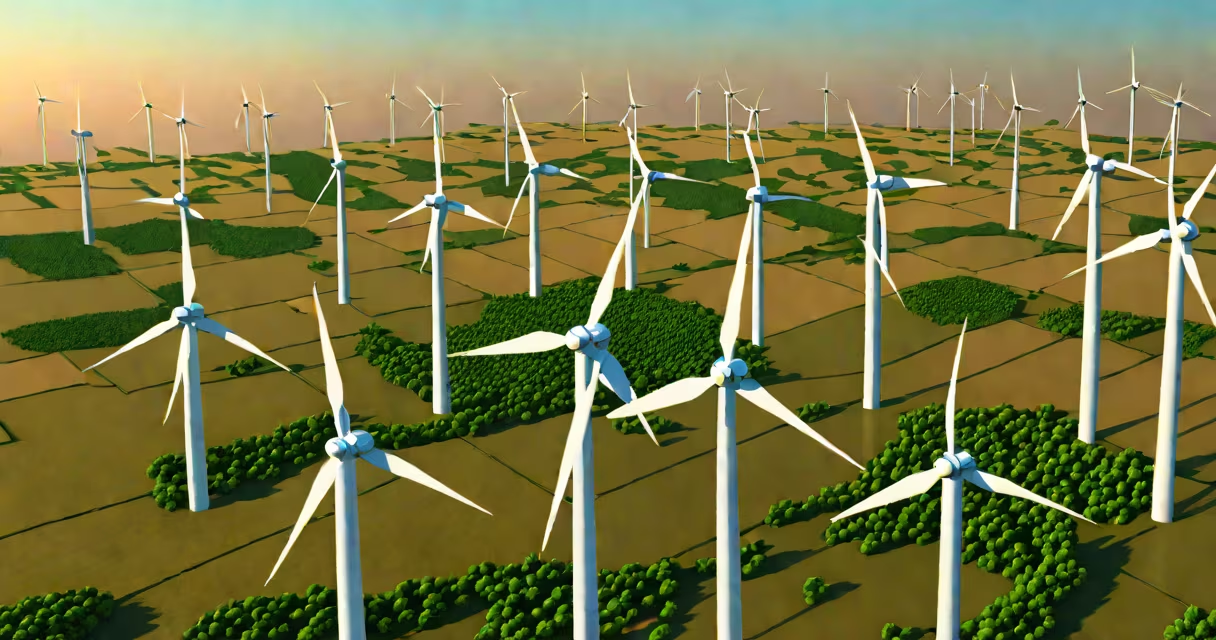
wind source of electricity refers to the process of converting kinetic energy from moving air into electrical energy using wind turbines. This method relies on consistent wind flow over large areas to produce clean, renewable power that feeds into regional grids.
Wind turbines capture airflow with large, aerodynamic blades. As wind pushes these blades, they rotate a central shaft connected to a generator. Inside the generator, magnets spin past copper coils, inducing an electric current through electromagnetic induction. This current is then stepped up in voltage via a transformer and sent to the power grid.
The system operates continuously when wind speeds exceed 3 meters per second (about 6.7 mph). Most modern turbines start generating at 3-5 m/s and reach maximum output around 12-15 m/s. Above 25 m/s, turbines automatically shut down to prevent damage.
Wind source of electricity uses three primary components: the rotor (blades and hub), the nacelle (gearbox, generator, and control systems), and the tower. Towers are typically 80 to 120 meters tall to access stronger, steadier winds above ground turbulence. Modern offshore turbines can exceed 200 meters in height.
Two main types exist: onshore and offshore. Onshore turbines are installed on land, often in rural or mountainous regions with high wind potential. Offshore turbines are mounted on floating platforms or fixed foundations in shallow coastal waters. Offshore sites offer higher average wind speeds and less visual impact, though installation and maintenance costs are greater.
| Type | Typical Height | Average Wind Speed | Capacity Factor | Cost per MWh (2023) |
|---|---|---|---|---|
| Onshore | 80-120 m | 6.5-7.5 m/s | 30-40% | $30-40 |
| Offshore | 100-200 m | 8.5-10 m/s | 45-55% | $50-70 |
Wind source of electricity is most effective in regions with sustained wind patterns. The United States' Great Plains, Germany's North Sea coast, and China's Gansu Province host some of the largest wind farms. For example, the Alta Wind Energy Center in California spans 1,020 megawatts (MW) and powers approximately 320,000 homes annually.
One common misunderstanding is that wind turbines operate efficiently only in high-wind environments. In reality, they generate usable power at moderate speeds. A typical 2 MW turbine produces 1.2 MW at 6 m/s wind speed-enough to supply about 1,000 homes. Efficiency improves with larger blade sweep areas and advanced pitch control systems that adjust blade angles to maintain optimal rotation.
Another misconception is that wind source of electricity causes significant bird mortality. While collisions do occur, modern turbines include radar-based shutdown systems that detect approaching flocks. Studies from the U.S. Fish and Wildlife Service show that properly sited wind farms cause fewer bird deaths per gigawatt-hour than buildings, vehicles, or communication towers.
During my time working on a utility-scale project in Texas, we monitored turbine performance across 18 months. We found that during periods of low wind, the system drew supplemental power from solar and battery storage. Grid operators balance intermittent wind output using real-time forecasting tools. These models predict wind availability up to 72 hours in advance with 90% accuracy, enabling stable integration into the energy mix.
Wind source of electricity differs from solar photovoltaic systems in both timing and output consistency. Solar panels peak at noon and stop at sunset. Wind turbines can run 24/7 when wind is available. In Denmark, wind accounts for nearly 50% of national electricity demand, with offshore wind contributing over 30% of total production.
For context, a single 3 MW offshore turbine can generate enough electricity annually to power 2,000 homes. That's equivalent to removing 1,500 tons of CO₂ emissions-equal to taking 300 cars off the road each year. According to the International Energy Agency, wind source of electricity avoided 1.1 billion metric tons of CO₂ globally in 2022.
When comparing wind source of electricity to fossil fuel plants, the lifecycle emissions are drastically lower. A wind turbine emits about 11 grams of CO₂ per kilowatt-hour over its lifetime, compared to 400-1,000 g/kWh for coal and 400-500 g/kWh for natural gas. The IEA confirms that wind energy is among the lowest-emission sources available.
Despite its benefits, wind source of electricity faces challenges related to transmission infrastructure. Remote locations often lack direct grid connections. The U.S. Department of Energy reports that 40% of planned wind projects face delays due to insufficient interconnection capacity. Solutions include building new high-voltage transmission lines and deploying smart grid technologies.
Wind source of electricity is a proven, scalable solution for decarbonizing power systems. With ongoing improvements in turbine design, grid integration, and predictive analytics, it remains central to global climate goals. As of 2023, wind accounted for 7% of worldwide electricity generation, with projections reaching 15% by 2030.