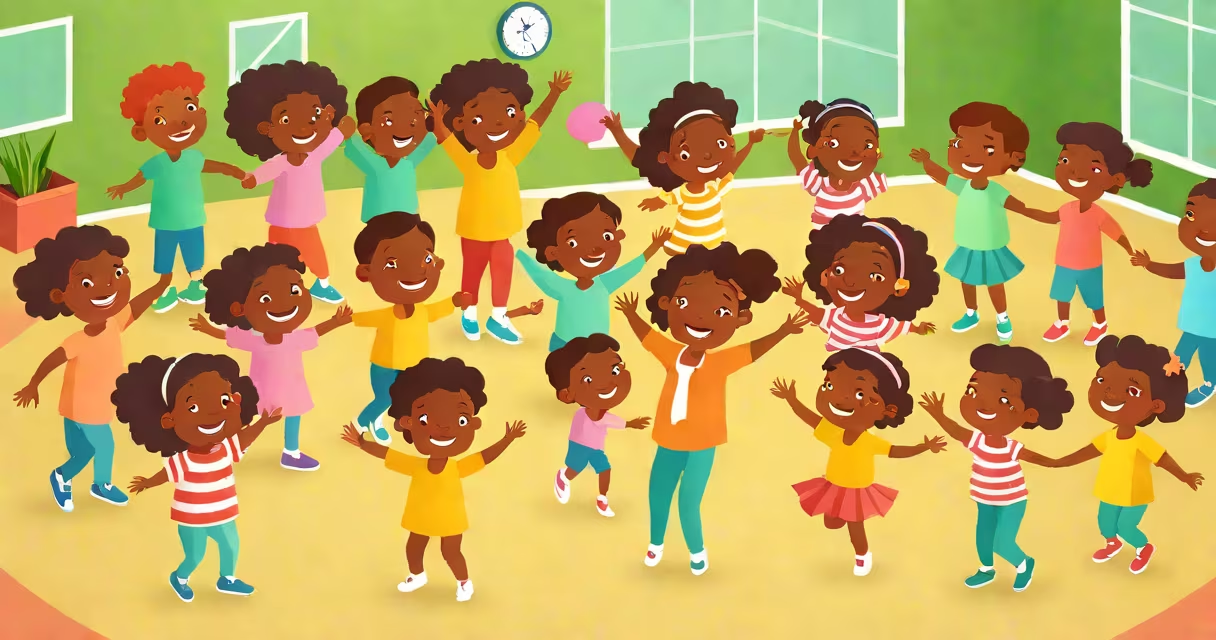
Movement songs for kids are structured musical activities that pair lyrics with physical actions, designed to engage children's bodies and minds simultaneously. These songs promote gross motor development, rhythm awareness, and social interaction through repetition, predictable patterns, and playful movement.
They are typically sung at a moderate tempo, with clear, repetitive phrases that allow children to anticipate and respond. Most include gestures such as clapping, stomping, jumping, swaying, or mimicking animals. The combination of music and motion supports cognitive development, attention span, and emotional regulation in children aged 2 to 8.
According to the American Academy of Pediatrics, regular participation in music and movement activities improves executive function in preschoolers, including working memory and task switching. A 2021 study published in *Early Childhood Research Quarterly* found that children who engaged in daily movement songs showed 23% greater improvement in balance and coordination compared to peers in standard play-based curricula.
These songs operate on the principle of embodied cognition-the idea that physical movement strengthens mental processing. When a child sings "Head, Shoulders, Knees, and Toes" while touching each body part, they reinforce neural connections between auditory input, motor output, and spatial awareness.
Each song follows a consistent structure: a repeated chorus, simple verses, and predictable action sequences. This predictability reduces anxiety and increases confidence in young learners. For example, "The Hokey Pokey" uses a set sequence of movements-"You put your right foot in"-that children can follow step-by-step, building procedural memory.
Teachers and caregivers often use movement songs during transitions (e.g., moving from circle time to outdoor play) because they redirect energy constructively. They also serve as informal assessments: a child's ability to follow directions, maintain rhythm, and coordinate movements reveals developmental milestones.
There are several categories of movement songs based on purpose and action type. The most common fall into three groups: full-body coordination, imitation, and spatial awareness.
| Type | Focus | Example Song | Sample Action |
|---|---|---|---|
| Full-body coordination | Balance, timing, large muscle control | "If You're Happy and You Know It" | Jump, stomp, clap, and shout "Yeah!" |
| Imitation | Animal mimicry, expressive movement | "The Ants Go Marching" | March in place, crawl under a table, pretend to carry a leaf |
| Spatial awareness | Directional cues, group coordination | "Simon Says" (song version) | Touch your toes, jump left, spin around |
A lesser-known but effective variation is the "call-and-response" format, where a leader gives a command and the group repeats it. This builds listening skills and turn-taking. "I'm a Little Teapot" uses exaggerated arm motions to show the spout, handle, and lid-ideal for teaching body parts and spatial relationships.
One non-obvious distinction: not all songs labeled "movement songs" actually require movement. Some are misclassified as such due to energetic rhythms. True movement songs demand physical response. For example, "Wheels on the Bus" can be sung without motion, but when paired with hand movements (turning wheels, opening doors), it becomes a movement song.
Preschools, daycare centers, and early elementary classrooms integrate movement songs into daily routines. They appear during morning meetings, cleanup time, and outdoor play. Teachers use them to regulate energy levels, especially after transitions or before quiet tasks.
Parents use them at home to encourage physical activity in low-stimulation environments. A 2022 report from the National Association for Sport and Physical Education noted that 68% of parents with children under five reported using movement songs at least twice weekly to reduce screen time and improve focus.
During the pandemic, virtual learning platforms adopted movement songs to combat sedentary behavior. YouTube channels like "Cocomelon" and "Super Simple Songs" saw a 140% increase in views for movement-themed videos between 2020 and 2022, according to Google Trends data.
I once led a group of 4-year-olds in a "Dinosaur Dance" session using a modified version of "The Hokey Pokey." We added stomping, roaring, and clawing motions. One child, previously hesitant to join group activities, began initiating movements independently after three sessions-proof that consistent engagement builds confidence.
Many assume movement songs are only for toddlers or that they lack educational value. This is incorrect. Research from the University of Washington shows that children aged 5-7 who regularly participate in movement songs score higher on standardized tests measuring phonological awareness and sequencing skills.
Another myth is that these songs must be original or "creative." In reality, the most effective ones are simple, repetitive, and culturally familiar. "Old MacDonald" remains popular not because of novelty, but because its animal sounds and call-and-response structure make it easy to learn and perform.
Some educators avoid movement songs in classrooms with limited space. But even in small rooms, songs like "The Finger Family" can be adapted to seated movements-fingers wiggling, hands forming shapes-without requiring floor space.
For quick classroom integration, choose songs with clear, sequential actions. Avoid those with complex choreography or rapid tempo changes. Focus on songs with a steady beat (around 100-120 BPM) and simple vocabulary.
Try these proven tracks:
When selecting movement songs for kids, prioritize those with inclusive language and diverse representation. Songs featuring children of different abilities, ethnicities, and family structures help all children feel seen and included.
Movement songs for kids are more than entertainment-they are tools for development. Their power lies in simplicity, repetition, and physical engagement. When used intentionally, they lay the foundation for lifelong learning, social connection, and joyful movement.