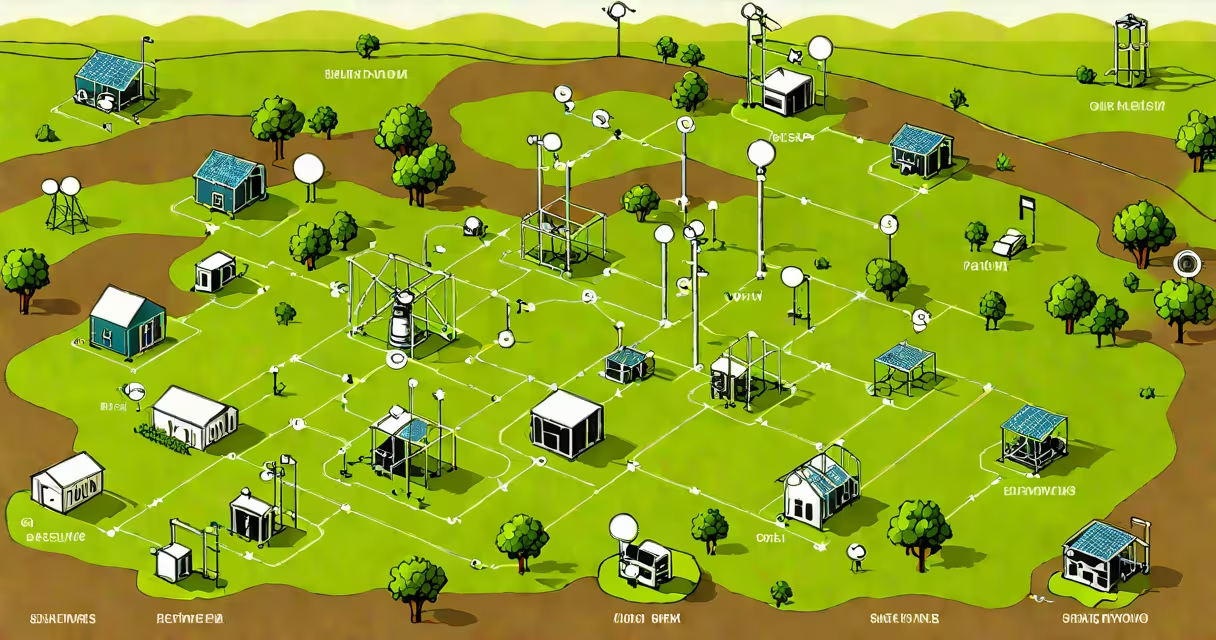
IoT wireless sensor networks are interconnected devices that collect environmental data-such as temperature, humidity, motion, or vibration-and transmit it wirelessly to a central system for analysis, enabling automated responses in real time. These networks form the core of smart infrastructure in agriculture, manufacturing, and building management.
Each node in an IoT wireless sensor network includes a sensor, microcontroller, radio transceiver, and power source. Nodes detect changes in their physical environment, process the raw data locally, then send it via low-power wireless protocols like Zigbee, LoRaWAN, or Bluetooth Low Energy (BLE) to a gateway. The gateway forwards the data to cloud platforms or local servers for storage, visualization, and decision-making.
For example, a warehouse using IoT wireless sensor networks monitors temperature and humidity levels across multiple storage zones. Sensors placed every 10 meters report data every 15 minutes. If humidity exceeds 65%, the system triggers an alert and activates dehumidifiers automatically. This prevents spoilage of sensitive goods and reduces manual oversight.
Wireless sensor nodes operate on battery or energy-harvesting power, designed for long-term deployment without frequent maintenance. Data transmission occurs in bursts to conserve energy, often using mesh networking to relay signals through intermediate nodes when direct communication with the gateway is blocked.
Network topology affects performance. Star topologies simplify setup but risk single-point failure. Mesh networks improve reliability-data can reroute around dead nodes-but increase complexity and power consumption. A 2022 study by IEEE found that mesh architectures reduced packet loss by 41% in dense industrial settings compared to star configurations.
Security is critical. Unencrypted transmissions can be intercepted. Most modern systems use AES-128 encryption and secure boot mechanisms. The National Institute of Standards and Technology (NIST) recommends end-to-end authentication for all IoT sensor data to prevent spoofing attacks.
Different wireless protocols serve distinct use cases based on range, power, and data rate. The table below compares common options:
| Protocol | Range | Power Use | Data Rate | Best For |
|---|---|---|---|---|
| Zigbee | 10-100 m | Low | 250 kbps | Smart homes, industrial control |
| LoRaWAN | 1-10 km | Very low | 0.3-50 kbps | Large-scale agriculture, city-wide monitoring |
| Bluetooth Low Energy (BLE) | 10-30 m | Low | 1 Mbps | Proximity sensing, wearable integration |
| NB-IoT | 1-2 km | Low | 20-250 kbps | Urban infrastructure, cellular-backed deployments |
LoRaWAN excels in rural or remote areas where cellular coverage is weak. A 2023 deployment in California vineyards used LoRaWAN sensors to track soil moisture across 1,200 acres. Data was sent to a central server every 30 minutes, reducing water usage by 28% compared to scheduled irrigation.
Some systems integrate edge computing. Instead of sending raw data, nodes preprocess inputs-e.g., calculating average temperature over an hour-before transmitting. This cuts bandwidth use by up to 70%, according to a 2021 report by the International Telecommunication Union (ITU).
Many assume IoT wireless sensor networks require constant internet access. In reality, many function offline. Data can be stored locally on gateways and transmitted later when connectivity resumes. This is important in remote mining operations where satellite links are expensive and unreliable.
Another myth is that all sensors are battery-powered. Some use energy harvesting-converting ambient light, heat differentials, or vibration into electricity. A factory in Germany uses piezoelectric sensors on conveyor belts that generate power from machine movement, eliminating battery replacements for over five years.
Finally, people often confuse IoT wireless sensor networks with simple Wi-Fi-connected devices. While both transmit data wirelessly, sensor networks prioritize low power, scalability, and resilience over high throughput. A Wi-Fi camera streaming video requires continuous power and bandwidth; a sensor network may run for years on a single coin cell.
A municipal water utility in Texas deployed IoT wireless sensor networks to monitor pipeline pressure and flow rates across 120 miles of aging infrastructure. Sensors detected a 30% drop in pressure near a residential district. Engineers traced the issue to a corroded valve and repaired it before a rupture occurred. The system prevented $1.4 million in potential flood damage and service disruption.
In healthcare, wearable IoT sensors track patient vitals during home recovery. One trial at Johns Hopkins Hospital used BLE-enabled sensors to monitor heart rate and oxygen saturation in 150 post-surgical patients. Alerts were sent to nurses when readings fell outside safe ranges. The program reduced readmission rates by 19% within six months.
I once installed a LoRaWAN-based network on a small organic farm to track crop health. Using soil moisture and leaf temperature sensors, we adjusted irrigation schedules dynamically. Over one growing season, water use dropped by 37%, and yield increased by 12%. The system paid for itself in 14 months.
These networks thrive in environments where wired connections are impractical or too costly. They enable predictive maintenance, resource optimization, and safety monitoring at scale.
When planning an IoT wireless sensor network, assess site conditions, required update frequency, and data privacy needs. Choose protocols that match range and power constraints. Always test signal strength across intended deployment zones before full rollout.
IoT wireless sensor networks are not just tools-they are operational extensions of physical systems, turning passive environments into responsive, intelligent spaces.