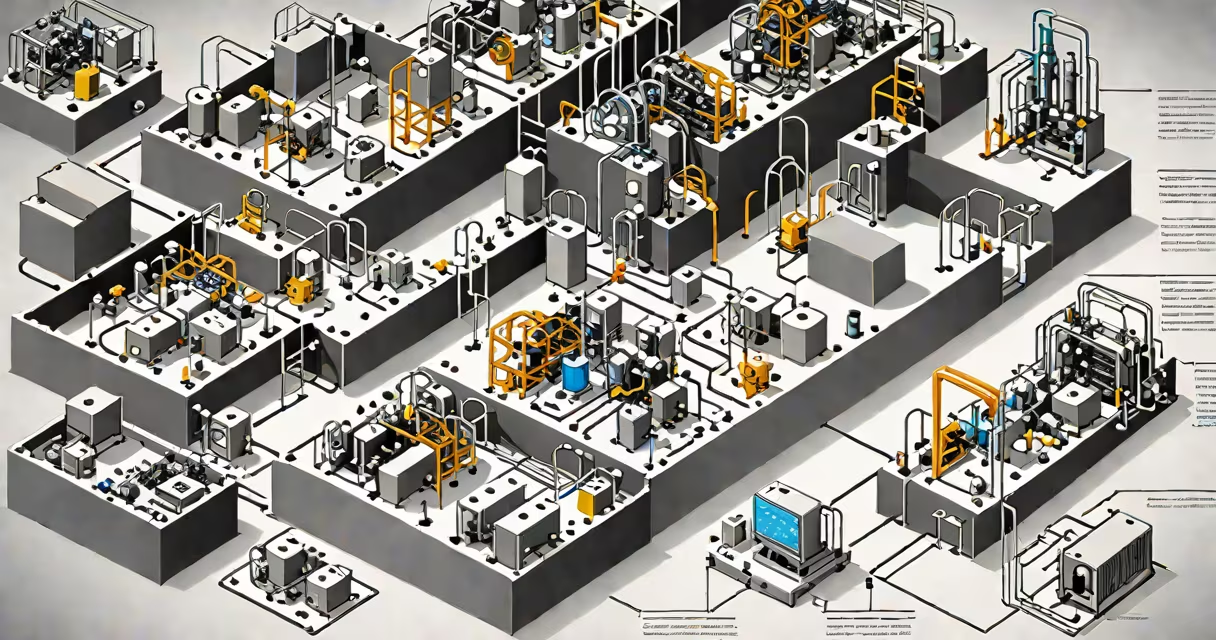
IoT in industrial automation integrates sensors, machines, and software via networked devices to monitor, analyze, and control manufacturing processes in real time. This enables predictive maintenance, optimized workflows, and reduced downtime across production lines.
At its core, IoT in industrial automation uses connected devices-sensors, actuators, PLCs (programmable logic controllers), and HMIs (human-machine interfaces)-to collect operational data from machinery. That data flows through local edge gateways or cloud platforms where algorithms detect anomalies, predict failures, and trigger automated responses. For example, a motor's vibration pattern can be analyzed continuously; if deviations exceed thresholds, maintenance alerts are sent before a breakdown occurs.
The system relies on standardized protocols such as OPC UA (Open Platform Communications Unified Architecture) and MQTT (Message Queuing Telemetry Transport) to ensure interoperability between legacy systems and new hardware. These protocols allow data to move securely between devices and applications without requiring custom integration for each component.
Each stage in the IoT automation pipeline serves a distinct function. A temperature sensor on a conveyor belt motor records readings every 10 seconds. The data is sent to an edge device-a ruggedized industrial computer mounted near the machine-where initial filtering and anomaly detection occur. Only abnormal values are forwarded to the central server, reducing bandwidth use and improving response speed.
When the edge device detects a rising temperature trend above 85°C, it triggers a rule-based action: send an alert to maintenance staff via a mobile app and automatically reduce the motor's load. Simultaneously, historical data is stored in a time-series database for long-term analysis. Over time, machine learning models trained on this data can forecast when replacement parts will fail, allowing proactive procurement.
According to the International Society of Automation (ISA), 67% of manufacturers using IoT-enabled predictive maintenance report a 20-30% reduction in unplanned downtime. This translates directly into cost savings-averaging $1.5 million annually per large-scale plant, based on a 2022 McKinsey report.
Industrial IoT systems consist of four interdependent layers:
| Layer | Function | Examples |
|---|---|---|
| Sensing Layer | Collects physical data from machines and environments | Vibration sensors, pressure transducers, thermal cameras |
| Edge Processing | Filters, analyzes, and acts on data locally before sending to the cloud | Industrial gateways, embedded controllers, AI accelerators |
| Network & Cloud | Transfers data securely and stores it for analytics and visualization | 5G private networks, AWS IoT Core, Azure IoT Hub |
| Application Layer | Delivers insights and controls to users and other systems | SCADA dashboards, CMMS (Computerized Maintenance Management Systems), ERP integrations |
Many systems use hybrid architectures-processing critical actions at the edge while storing historical data in the cloud. This reduces latency and improves reliability during network outages. For instance, a packaging line in a food processing facility uses edge AI to identify misaligned boxes and halt the line instantly, preventing waste.
People often confuse IoT in industrial automation with basic machine monitoring or SCADA systems. While both track performance, SCADA typically collects data passively and displays it on dashboards. IoT adds decision-making capability-automated responses based on real-time analysis.
A key distinction lies in data velocity and autonomy. Traditional SCADA systems update every 30 seconds. Modern industrial IoT systems process data at sub-second intervals and can initiate corrective actions without human input. In a steel mill, a sensor detecting overheating in a rolling mill roll triggers automatic cooling fluid activation within 1.2 seconds-too fast for a human operator to respond.
Another misconception is that all industrial IoT deployments require cloud connectivity. Many high-reliability operations run entirely on-premise. A semiconductor fab in Taiwan uses an air-gapped industrial IoT setup: sensors feed data to an isolated edge cluster, which runs fault prediction models locally. No data leaves the facility, ensuring compliance with national cybersecurity laws.
In 2021, a German automotive supplier implemented IoT in industrial automation across its engine assembly line. The goal: reduce defective piston installations caused by incorrect torque application.
They installed torque sensors on six robotic arms. Each sensor transmitted data every 50 milliseconds to a local edge server running a custom anomaly detection model. The model flagged deviations exceeding ±2% from the calibrated torque value.
When a deviation occurred, the system paused the robot arm, triggered a visual alarm on the shop floor, and logged the event with timestamp, part ID, and error code. Over 30 days, the system detected 14 instances of improper torque application-three of which were caught before installation, saving 270 engines from potential failure.
After six months, defect rates dropped from 1.8% to 0.3%. The company attributed the improvement not just to better detection but to faster feedback loops-engineers could review failure patterns daily and adjust calibration settings in real time.
Connecting factory equipment to networks introduces cyber risks. A breach in an industrial IoT system can halt production, expose trade secrets, or cause physical damage. In 2018, a ransomware attack on a U.S. chemical plant exploited unpatched IoT devices, leading to a 72-hour shutdown and $4.2 million in losses.
Proper industrial IoT security requires defense-in-depth strategies: network segmentation, regular firmware updates, role-based access control, and continuous threat monitoring. The NIST Cybersecurity Structure (2020 revision) recommends isolating OT (operational technology) networks from IT systems and enforcing strict authentication for all device access.
For example, a water treatment facility in Colorado uses micro-segmentation to restrict communication between PLCs and supervisory systems. Only authorized devices can exchange commands, and all traffic is logged and audited monthly. This setup complies with EPA regulations on infrastructure protection.
IoT in industrial automation is not simply about connecting machines. It's about transforming raw sensor data into actionable intelligence that prevents failures, improves quality, and increases throughput. The most effective implementations treat data as a strategic asset-not just a byproduct of operation.
While some industries still rely on manual inspections and reactive repairs, those adopting IoT see measurable improvements in uptime, energy efficiency, and product consistency. As industrial processes grow more complex, the ability to sense, analyze, and act autonomously becomes a competitive necessity.