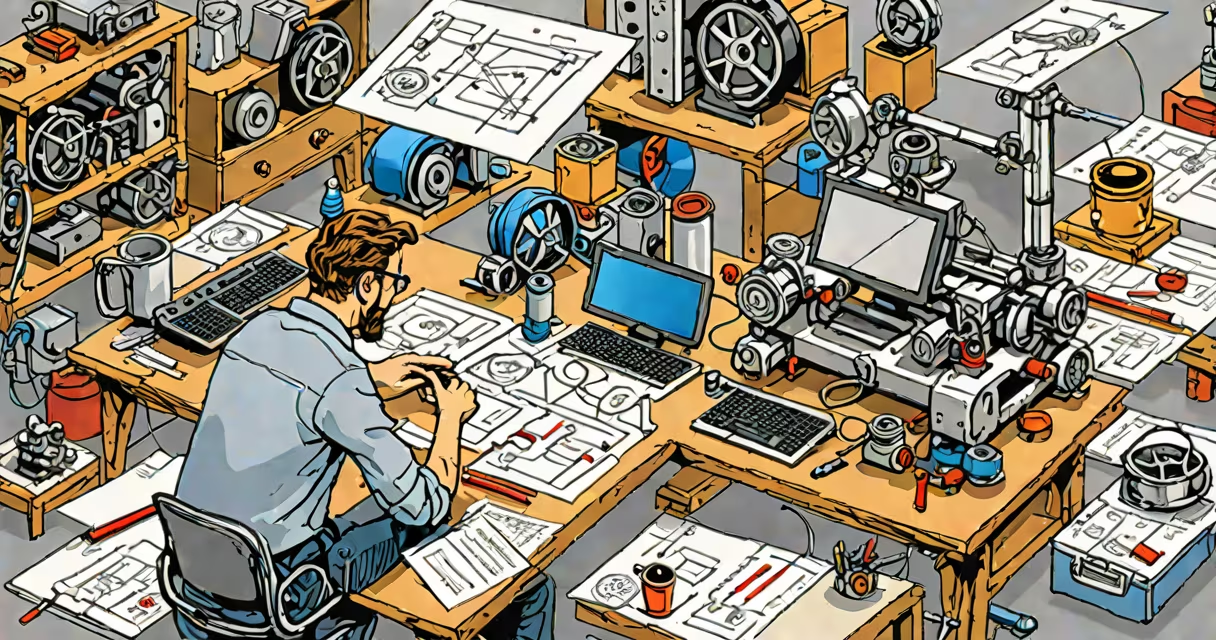
Mechanical design engineers develop physical products by applying physics, materials science, and manufacturing constraints to turn concepts into functional, buildable designs. They use computer-aided design (CAD) software to model components, simulate performance under load, and prepare documentation for production. Their work spans consumer goods, medical devices, automotive systems, and industrial machinery.
These engineers begin with a problem statement-such as "design a lightweight bicycle frame that withstands 500 lbs of impact"-and apply mechanical principles to generate solutions. They analyze forces, stresses, thermal behavior, and motion to ensure reliability. Once a design is finalized, they produce technical drawings, bill of materials, and assembly instructions for manufacturing teams.
The role blends creativity with rigorous analysis. A single component may require hundreds of iterations to balance weight, strength, cost, and ease of assembly. According to the U.S. Bureau of Labor Statistics, mechanical engineers held over 280,000 jobs in 2022, with demand growing in automation, robotics, and sustainable energy systems.
Design begins with defining requirements: dimensions, operating environment, material limits, safety standards, and lifecycle expectations. Engineers then sketch initial ideas-either freehand or digitally-to explore form and function. These early stages prioritize feasibility over detail.
Once a concept shows promise, engineers build a 3D model in CAD software. This model becomes a virtual testbed. Using simulation tools integrated into platforms like SolidWorks, they run stress tests, thermal analyses, and changing motion studies. For example, a gear train might be simulated under 10,000 RPM to detect fatigue points before prototyping.
After validation, engineers generate 2D engineering drawings with tolerances, surface finishes, and material specifications. These documents guide CNC machining, injection molding, or sheet metal fabrication. Any deviation from design intent during manufacturing triggers a redesign loop-often involving supplier feedback or field testing results.
Modern mechanical design relies heavily on digital tools. SolidWorks is the most widely adopted CAD platform in industry, used by over 60% of mechanical engineering firms according to a 2023 survey by Engineering.com. It enables parametric modeling, where changing one dimension automatically updates related features-a critical feature for iterative design.
Beyond CAD, engineers use finite element analysis (FEA) software such as ANSYS or Abaqus to predict structural failure. Thermal simulation tools like FloTHERM model heat dissipation in electronics enclosures. Version control systems like Git track changes across design revisions, especially in collaborative environments.
| Tool Type | Common Examples | Purpose |
|---|---|---|
| CAD Software | SolidWorks, AutoCAD, Fusion 360 | Create and modify 3D models |
| Simulation Tools | ANSYS, Abaqus, COMSOL | Analyze stress, heat, fluid flow |
| Documentation | PDF exporters, GD&T tools | Generate manufacturing-ready drawings |
| Automation | Python, MATLAB, scripting APIs | Automate reporting, validation, file conversion |
Every manufactured product involves mechanical design engineers. In automotive development, they design engine mounts, suspension systems, and cooling ducts. In healthcare, they create surgical instruments with precise tolerances-some requiring ±0.005 mm accuracy-and ensure biocompatibility through material selection.
Even in consumer electronics, mechanical engineers are essential. Apple's iPhone casing, for instance, requires careful balancing of thinness, durability, and antenna performance. Engineers optimized the aluminum alloy thickness and cutouts to maintain signal integrity while resisting drops from 1 meter.
Many assume mechanical design engineers only draw parts. In reality, they solve complex trade-offs. A lighter material may reduce weight but increase cost or degrade longevity. A simpler shape may be easier to machine but fail under vibration. Engineers weigh these factors systematically.
Another misconception is that CAD replaces thinking. The opposite is true: CAD amplifies analytical capacity. A model can show stress concentrations at a fillet-but only an experienced engineer recognizes whether those values exceed yield strength or indicate a design flaw due to poor boundary conditions.
There's also confusion between mechanical design and mechanical drafting. Drafting focuses on drawing precision; design centers on function, manufacturability, and lifecycle. A draftsperson creates views; a designer ensures the part fits, moves correctly, and can be produced affordably at scale.
I once observed a student project where a team built a robotic arm using off-the-shelf servos and 3D-printed joints. The initial design failed repeatedly under load. Only after we ran FEA simulations and adjusted wall thicknesses did it perform reliably. That moment taught me: no amount of visual appeal matters if the part doesn't survive real-world use.
What do mechanical design engineers do? They bridge imagination and reality. They take an idea, validate it through math and simulation, and deliver a product that works safely, efficiently, and at scale. Their work defines how machines move, how devices last, and how innovations reach people.
Understanding this role clarifies why mechanical design remains central to engineering progress. Whether designing a wind turbine blade or a smartphone hinge, the engineer's decisions shape performance, cost, and reliability. Explore more about the daily tasks and career paths in this field.