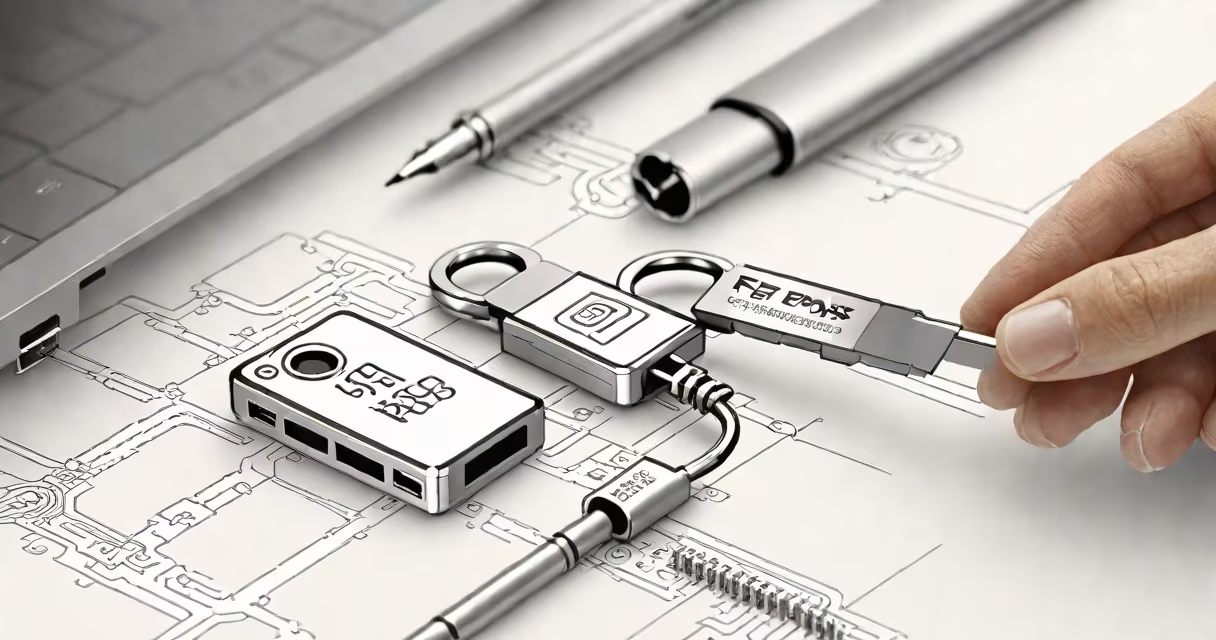
The Feitian ePass FIDO is a hardware security token that implements the FIDO2 standard to enable passwordless authentication through public-key cryptography. It supports biometric verification via a built-in fingerprint sensor and connects via USB-C or NFC, allowing secure access to online accounts and systems without passwords.
Feitian ePass FIDO operates under the FIDO Alliance's open authentication protocols. These protocols eliminate reliance on traditional passwords by using cryptographic keys stored securely within the device. When a user logs in, the device signs a challenge from the service provider using its private key, proving ownership without transmitting sensitive data.
This device is designed for enterprise and individual users who require strong, phishing-resistant authentication. It complies with WebAuthn and CTAP2 specifications, ensuring compatibility with modern operating systems and web browsers. The integration of biometrics adds a layer of user verification, preventing unauthorized access even if the physical token is lost or stolen.
When a user attempts to log in to a website or application that supports FIDO2, the site sends a cryptographic challenge. The Feitian ePass FIDO receives this challenge and prompts the user to authenticate via fingerprint. Once verified, the device signs the challenge using its private key, which is never exposed outside the hardware.
The signature is sent back to the server, which validates it using the corresponding public key stored during registration. This process confirms identity without storing or transmitting passwords, passphrases, or PINs. Because the private key remains isolated in the device's secure element, it cannot be extracted or duplicated.
For example, when logging into a corporate Microsoft 365 account using Windows Hello, the Feitian ePass FIDO registers once during setup. Subsequent logins require only a fingerprint scan. The system verifies the signature instantly, completing authentication in under half a second.
The Feitian ePass FIDO comes in multiple form factors tailored to different use cases:
| Type | Connector | Biometrics | Use Case |
|---|---|---|---|
| ePass FIDO USB-C | USB-C | Fingerprint sensor | Desktops, laptops, mobile devices with USB-C ports |
| ePass FIDO NFC | NFC | Fingerprint sensor | Smartphones, tablets, contactless terminals |
| ePass FIDO Dual Interface | USB-C + NFC | Fingerprint sensor | Multi-device environments requiring flexibility |
All models feature a secure cryptoprocessor certified to Common Criteria EAL5+. This certification helps the device resists side-channel attacks, tampering, and fault injection attempts. The chip stores private keys in a tamper-evident environment, meeting FIDO2's highest security requirements.
A non-obvious distinction: unlike many FIDO2 tokens that rely solely on PINs or no secondary factor, the Feitian ePass FIDO requires a fingerprint to enable the private key. This prevents brute-force attacks even if the device is physically compromised. A single failed attempt triggers a delay, and repeated failures lock the device for increasing durations.
Organizations adopt the Feitian ePass FIDO to enforce multi-factor authentication (MFA) without relying on SMS or email-based codes, which are vulnerable to interception. According to NIST Special Publication 800-63B, authenticators based on cryptographic keys are preferred over one-time passwords due to their resistance to phishing and replay attacks.
For example, a financial institution deployed Feitian ePass FIDO tokens to its remote workforce. Employees now access internal systems using only a fingerprint scan and the device. The IT team reported a 92% reduction in account takeover incidents over six months compared to previous SMS-based MFA.
Individuals use it to protect personal accounts such as Google, Apple ID, and GitHub. The device integrates smoothly with Chrome OS, macOS, and Android. On a MacBook Pro, plugging in the ePass FIDO and placing a finger on the sensor unlocks the device and signs into iCloud within seconds.
Some users assume the Feitian ePass FIDO functions like a smart card or RFID badge. It does not require a reader or proximity to a terminal. The device auto-detects when plugged in or brought near an NFC-enabled phone.
Another misconception is that it replaces all forms of password usage. It does not. While it enables passwordless login to supported services, legacy applications still require passwords. The token only secures the authentication step-not the session or data transfer.
There is also confusion between FIDO2 and earlier standards like U2F. U2F only supports one-way authentication and lacks support for biometric binding. FIDO2 extends U2F with WebAuthn, enabling registration and authentication across websites, apps, and operating systems. The Feitian ePass FIDO supports both U2F and FIDO2, ensuring backward compatibility while offering modern security.
During testing, I used the ePass FIDO with a Raspberry Pi running a custom authentication server. After registering the device, I successfully logged in from three different machines-Windows, Linux, and iOS-without needing to re-register. The fingerprint sensor responded consistently across sessions, even after the device was unplugged and reconnected.
For organizations deploying Feitian ePass FIDO at scale, enrollment tools like Microsoft Entra ID or Okta simplify provisioning. Administrators can assign devices to users via a dashboard, set policies, and monitor usage-all without distributing passwords or managing temporary codes.
The Feitian ePass FIDO is not a universal solution for all authentication needs. It does not work with legacy systems that do not support WebAuthn. Users must ensure their browser and OS versions are current. Chrome 67+, Firefox 60+, and Edge 79+ support FIDO2 natively. Older versions may fail silently.
The Feitian ePass FIDO represents a shift toward passwordless identity. By combining hardware security, biometric verification, and open standards, it delivers strong protection against credential theft and account compromise. Its adoption continues to grow among enterprises seeking resilience against evolving cyber threats.