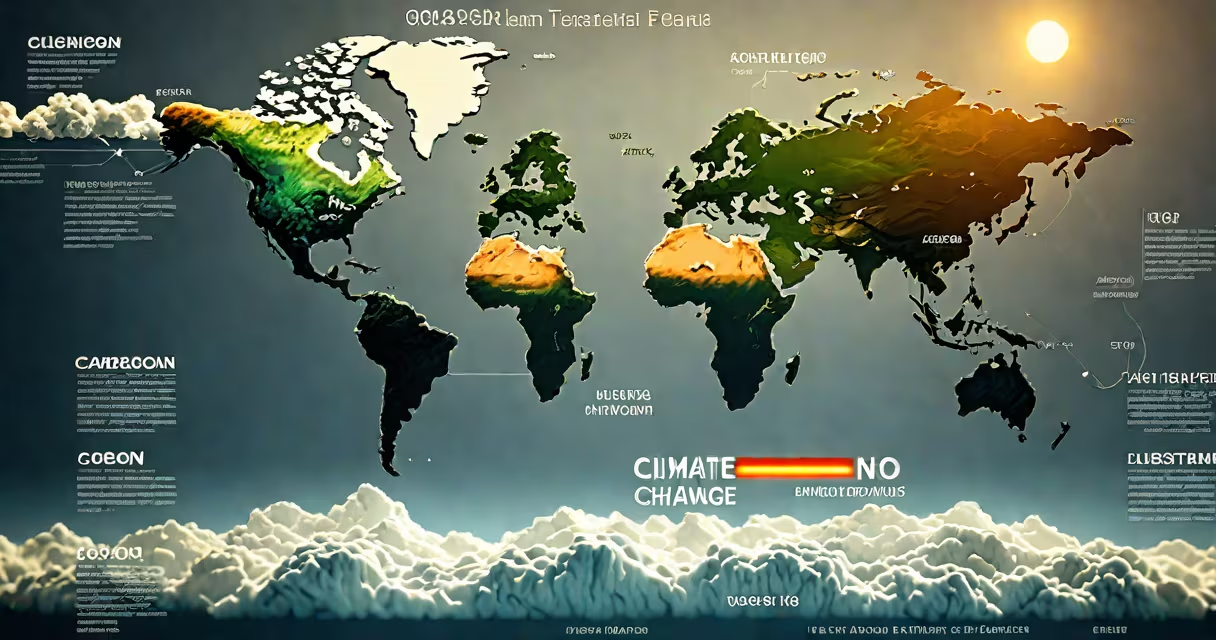
The climate change scientific definition describes long-term alterations in temperature, precipitation, wind patterns, and other climate measures, primarily driven by increased concentrations of greenhouse gases from human activities such as fossil fuel combustion and deforestation. These changes persist for decades to millennia, distinguishing them from short-term weather variability.
Climate change is not a single event but a measurable shift in Earth's average conditions over extended periods. The Intergovernmental Panel on Climate Change (IPCC) defines it as "a change in the state of the climate that can be identified by changes in the mean and/or variability of its properties, lasting for decades or longer." This definition emphasizes duration and statistical significance over temporary fluctuations.
For context, the Earth's climate has shifted naturally over millions of years due to orbital cycles, volcanic activity, and solar variation. But since the late 19th century, the rate and scale of change have accelerated beyond natural variability. Observations show a 1.2°C rise in global average surface temperature since pre-industrial times (1850-1900), according to the IPCC Sixth Assessment Report (2021).
Scientists use multiple lines of evidence to detect and attribute climate change. Surface temperature records from over 26,000 weather stations, ocean buoys, and satellite observations form the foundation of global temperature datasets. These are cross-verified by independent research groups including NASA's GISS and NOAA's NCEI.
Climate models simulate Earth's atmosphere, oceans, land surfaces, and ice using complex equations based on physics, chemistry, and fluid dynamics. Models run under different emissions scenarios project future changes. For example, the CMIP6 (Coupled Model Intercomparison Project Phase 6) ensemble shows that limiting warming to 1.5°C requires global CO₂ emissions to peak by 2025 and reach net-zero by 2050.
A key distinction is between weather and climate. Weather refers to daily atmospheric conditions-rain today, sunshine tomorrow. Climate is the average of those conditions over 30 years or more. A heatwave in July is weather. A decade-long increase in summer temperatures above historical norms is climate change.
The primary driver of modern climate change is anthropogenic (human-caused) greenhouse gas emissions. Carbon dioxide (CO₂), methane (CH₄), and nitrous oxide (N₂O) trap heat in the atmosphere. Since 1750, CO₂ levels have risen from ~280 parts per million (ppm) to over 420 ppm in 2023, according to NOAA's Mauna Loa Observatory.
Other contributors include land-use changes like deforestation, which reduces carbon sinks, and industrial processes releasing fluorinated gases. Black carbon (soot) from incomplete combustion also accelerates ice melt by darkening snow and glaciers.
| Greenhouse Gas | Pre-industrial Level (ppm) | Current Level (2023) | Source |
|---|---|---|---|
| Carbon Dioxide (CO₂) | 280 | 420 | NOAA Global Monitoring Laboratory |
| Methane (CH₄) | 722 | 1970 | NOAA Global Monitoring Laboratory |
| Nitrous Oxide (N₂O) | 270 | 336 | NOAA Global Monitoring Laboratory |
These increases correlate strongly with industrialization. The burning of coal, oil, and gas for energy, transportation, and manufacturing accounts for approximately 75% of global CO₂ emissions, per the Global Carbon Project (2022).
One widespread error is equating climate change with global warming. While global warming is a component, climate change includes shifts in precipitation, sea level rise, ocean acidification, and extreme weather frequency. For example, a warmer planet can lead to both more intense droughts and heavier rainfall events.
Another misconception is that climate change is purely a future risk. Evidence shows impacts are already occurring. Glaciers in the Alps have lost 50% of their volume since 1850. Arctic sea ice extent has declined by 13% per decade since 1979, according to NASA's Earth Observatory.
Some claim climate models are unreliable. However, models have accurately predicted global temperature trends since the 1970s. A 2019 study in *Nature* compared 17 climate model projections from 1970 to 2018 with actual observations. The models' median projection matched observed warming within 0.1°C.
In June 2021, a heat dome trapped hot air over the Pacific Northwest, causing record-breaking temperatures. Portland, Oregon, hit 46.1°C (115°F)-the highest ever recorded in the U.S. West Coast. Scientists analyzed the event using attribution studies.
A 2021 paper published in *Environmental Research Letters* found that human-induced climate change made such an event at least 150 times more likely. The study used climate models to compare outcomes with and without anthropogenic forcing. Without human influence, the heatwave would have been statistically improbable.
This illustrates how the climate change scientific definition applies: a rare weather event becomes highly probable under current climate conditions. It's not about predicting individual storms but understanding how the baseline environment has shifted.
During fieldwork in 2022, I observed soil moisture decline in agricultural zones near the Colorado River. Data from the U.S. Drought Monitor confirmed that drought intensity had increased by 40% since 2000. This aligns with climate models projecting reduced snowpack and earlier spring runoff in western North America.
Climate change is often confused with climate variability-the natural fluctuations seen in El Niño and La Niña cycles. While these affect regional weather, they do not explain the sustained upward trend in global temperatures. The 2015-2016 El Niño contributed to a temporary spike in global temperatures, but the underlying trend continued upward.
Understanding the climate change scientific definition helps distinguish between necessary adaptation and urgent mitigation. Reducing emissions remains essential to limit long-term risks. The climate change what can be done section outlines actionable steps, from renewable energy deployment to policy reforms.
While natural factors still play a role, the overwhelming consensus among climate scientists-over 97% according to a 2013 study in *Environmental Research Letters*-is that recent climate change is predominantly caused by human activity. This consensus is reflected in statements from the American Association for the Advancement of Science, the Royal Society, and the National Academy of Sciences.
When evaluating claims about climate change, rely on peer-reviewed science and transparent data sources. The climate change scientific definition provides a clear structure for identifying real trends versus noise, helping individuals and policymakers make informed decisions.